
A wattage label alone does not tell you whether a tube amp will be quiet enough for your room. If your goal is power-stage breakup without disturbing neighbors, even a low-power valve amp may be too loud. Start by deciding whether you need clean sound, preamp distortion, power-stage distortion, or headphone practice; then test the actual amp at the volume you can use.
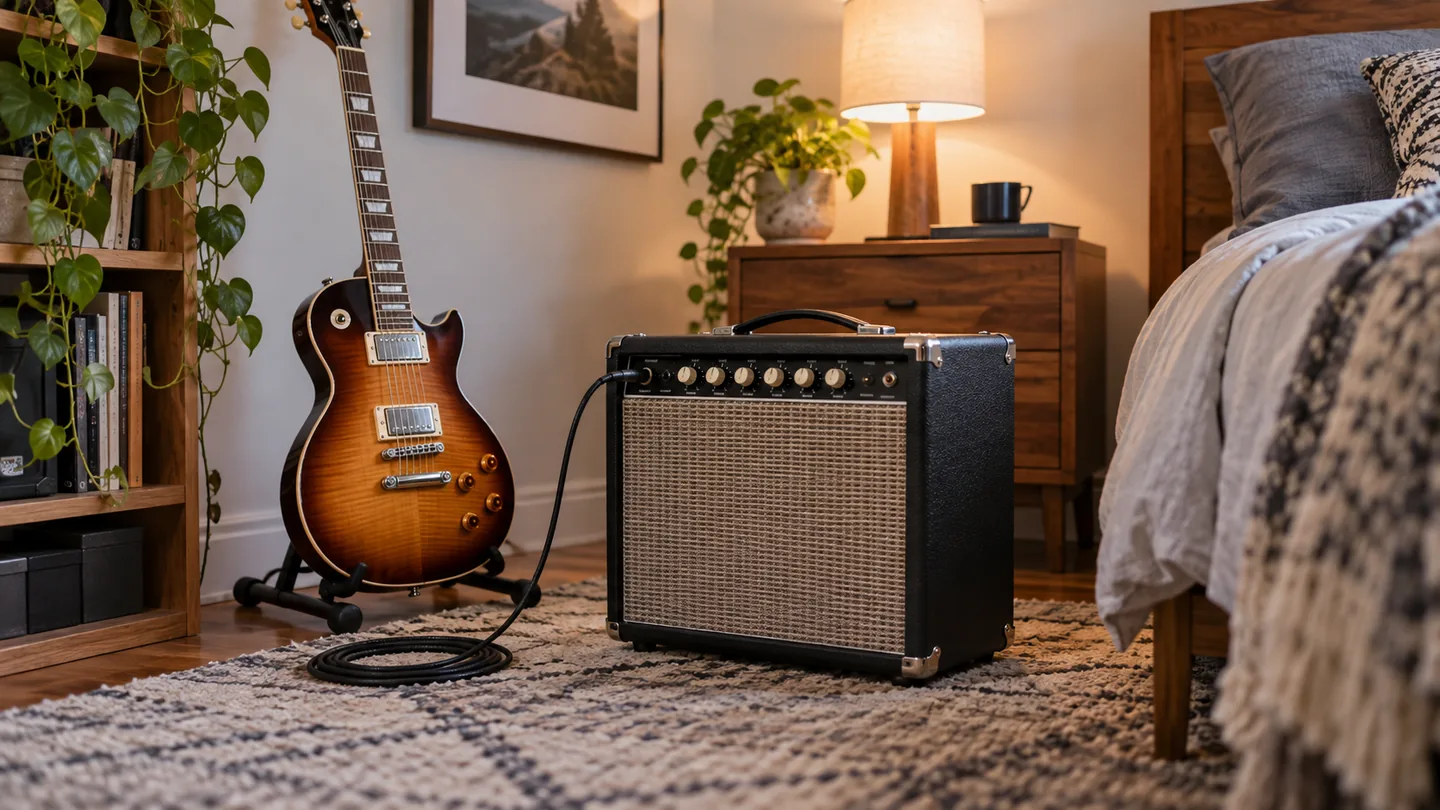
Illustrative image; not a photograph of a specific product.
Watts are an incomplete buying shortcut
In a Reddit bedroom-amp discussion, the buyer said a 5 W amp might still be loud, set a budget of about €1,000, and could not justify spending another €500 to €1,000 on an attenuator. Replies included both larger amps with good master volumes and tiny amps. That disagreement is useful: output rating, gain structure, speaker sensitivity, and the volume at which the player likes the sound all matter.
For example, Marshall’s Origin20C specification lists POWERSTEM power scaling and a MASTER control, with high 20 W, mid approximately 3 W, and low approximately 0.5 W settings. Those are model-specific controls and ratings, not a promise of silent power-tube distortion.
Match the solution to the sound you want
| Your main need | First feature to try | What to check in person |
|---|---|---|
| Clean practice | Good low-level master control | Is the first part of the knob’s travel usable? |
| Preamp drive | Separate gain and master controls | Does the desired gain remain clear at your volume? |
| Power-stage drive | Approved power reduction or matched attenuator | Is the sound worth the extra heat, cost, and setup? |
| No audible speaker | Headphone-capable model or a suitable load-and-cab-simulation system | Does the maker explicitly permit speaker-free use in this configuration? |
The speaker matters too. Celestion’s A-Type specification lists 8 Ω or 16 Ω rated impedance, 98 dB sensitivity, and a 50 W power rating. A different speaker or cabinet can change perceived loudness and tone, so do not buy from wattage alone when you cannot audition the cabinet you will actually use. Those are values for one guitar speaker, not a room-level loudness prediction.
When a tube amp is the wrong first purchase
If you must practice through headphones every night, a tube head that requires a speaker load adds equipment and complexity. Never disconnect a speaker or substitute a load box on the assumption that all tube amps allow it. Marshall’s Origin20C support page explicitly permits speaker-free operation when using that model’s emulated line out; this is an exception documented for that model, not permission for another amp. If you want many sounds at very low volume, a modeler may solve the problem more directly. These are use-case decisions, not verdicts about the quality of tube amplifiers.
Ask the seller for a demonstration with your guitar and pedals at your real room level. Note the model, speaker, settings, and whether anyone outside the room can hear it. That short test is more useful than treating 1 W, 5 W, or 20 W as a universal bedroom threshold.