
Consider an EL34-to-6L6 swap only when the specific amplifier supports it and you can follow the maker’s procedure. Both are common power-tube families, but a shared socket shape does not establish compatible bias, heater capacity, operating conditions, or output-stage design. Identify the amp model and manual before comparing tone.
In a Mesa/Boogie Badlander discussion, a player described trying 6L6 tubes in an amp supplied with EL34s. A later commenter asked what to buy and how many tubes were needed. That advice concerns the discussed model; it does not authorize the same swap in another guitar amplifier.
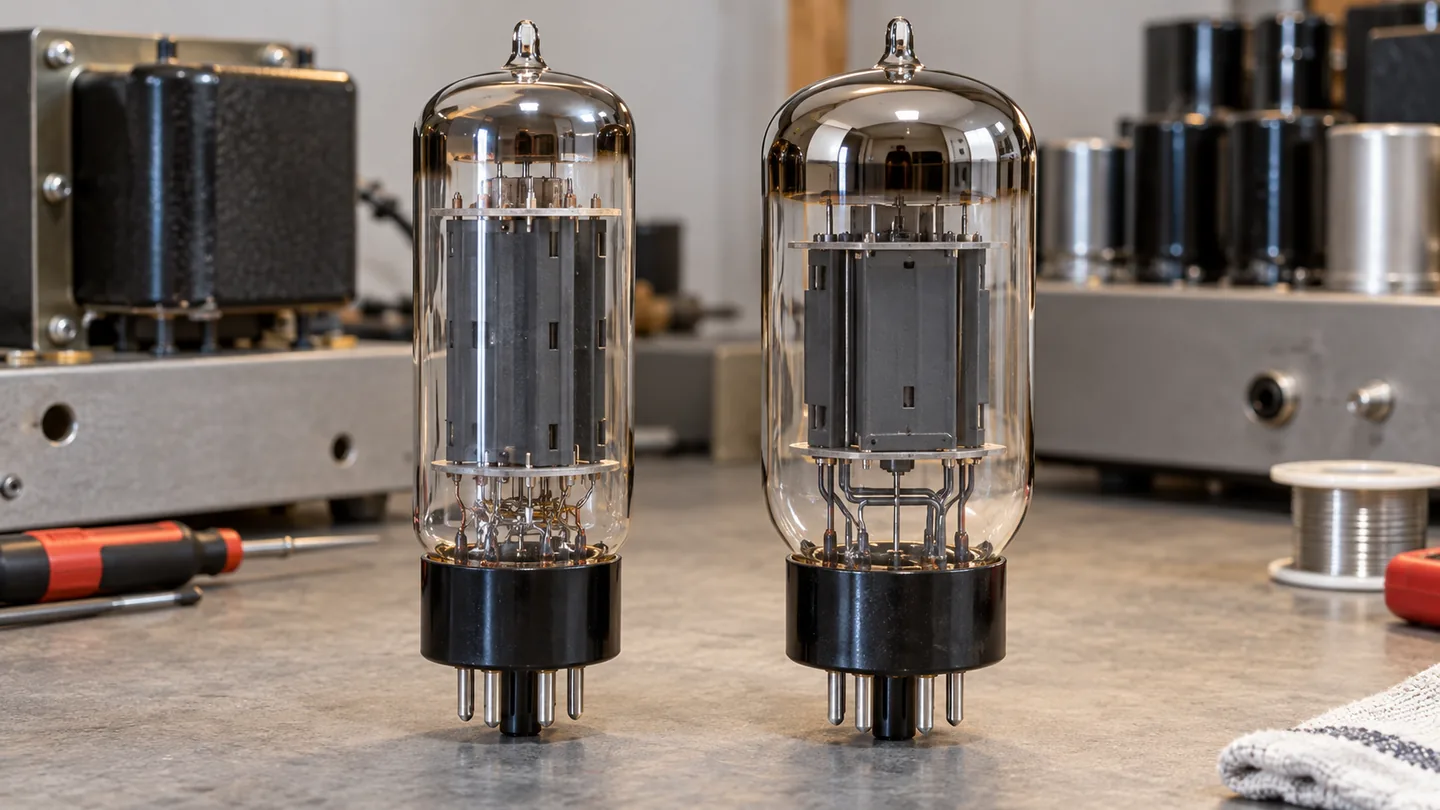
Illustrative image; not a photograph of a specific product.
Why model-specific support is decisive
The Badlander 100 owner’s manual explicitly permits its stock EL34 complement or 6L6 tubes and says the bias switch setting must match the tube type. This is documented support for that model, not proof that any amp with octal sockets can do the same. Other models may have different settings, tube requirements, or no approved swap at all. Follow the manual for the exact model and revision.
JJ Electronic lists the EL34 as an octal output tube with a maximum plate dissipation of 25 W. Its 6L6GC datasheet describes a particular 6L6 variant with its own heater, pinout, and operating limits. Neither sheet determines whether an amplifier can run a swap safely or what its bias should be; the amplifier design decides the operating point. The 6L6 family contains variants, so the suffix and maker’s specified type matter when ordering.
If the amp has a labeled EL34/6L6 switch, check its instructions for the required tube set, switch position, and any manufacturer-specific selection requirements. If the manual does not explicitly support both families, do not infer permission from a forum success story. A qualified amplifier technician can assess the circuit, including bias system and power supply, before recommending a modification. Owners should not change internal bias settings or wiring based on a generic online recipe.
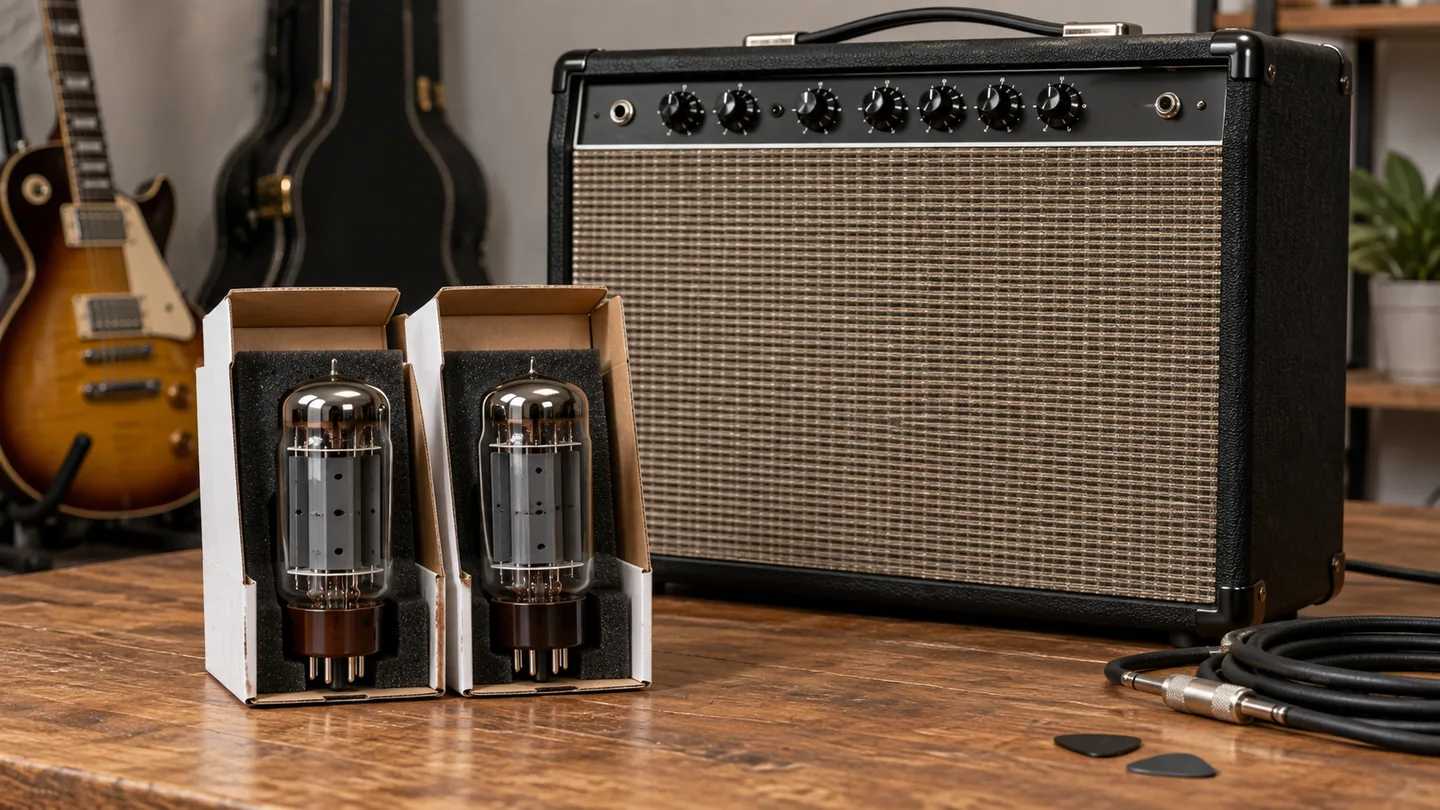
How much tone change should you expect?
The answer depends on the amp, speaker, cabinet, settings, playing level, and the particular tubes. A direct-comparison Badlander thread reports that the listener heard only a modest difference under their conditions. That observation is a useful reminder to set expectations, but it is a subjective report, not a controlled result that predicts your amp. Equal knob positions do not guarantee equal output level, and a louder sample can sound preferable for reasons unrelated to tube family.
If the complaint is harsh treble or insufficient mids, record the speaker and cabinet, amp mode, EQ settings, and listening volume before buying tubes. Existing controls or the speaker may address it more directly. If the amp is failing, red-plating, blowing fuses, or running unusually hot, stop using it and have the fault diagnosed; a tube-family swap is not a repair plan.
The purchase checklist
Before ordering, confirm the exact amplifier model, manual-approved types, number of power tubes, whether a matched set is specified, and the maker’s instructions for any external switch. Compare current stock and seller descriptions against the specified suffix, not just the broad “6L6” or “EL34” name. Where the manual is unavailable or ambiguous, leave the swap pending until the maker or a qualified technician confirms it.
Tube amplifiers can retain dangerous voltage while unplugged. Keep any internal inspection, bias measurement, and modification with a qualified technician. A documented, user-accessible tube switch is different from opening the chassis to change the circuit.
Sources
- Reddit: Badlander 100 W with 6L6 tubes — demand evidence about purchasing and model-specific swapping.
- Reddit: Badlander 6L6 versus EL34 comparison — subjective user comparison, not technical proof.
- Mesa/Boogie Badlander 100 owner’s manual — model-specific bias-switch requirement.
- JJ Electronic EL34 and 6L6GC datasheet — component-specific limits, not amplifier swap approval.