
For a first all-tube hi-fi system in a small room, choose the speaker and amplifier as a pair. A small room does not automatically make a low-power amp suitable: speaker sensitivity, impedance, listening distance, and desired peaks decide whether the combination has enough headroom. Start with a returnable or demonstrable pairing, then price the tubes and service it will eventually need.
That advice addresses the details raised in a Reddit request for a first all-tube setup in a 10-by-10-foot room. The poster later clarified that the budget was for speakers and the amplifier, while streaming equipment was already covered. Those follow-ups materially change the purchase plan; a generic list of popular tube amps would miss them.
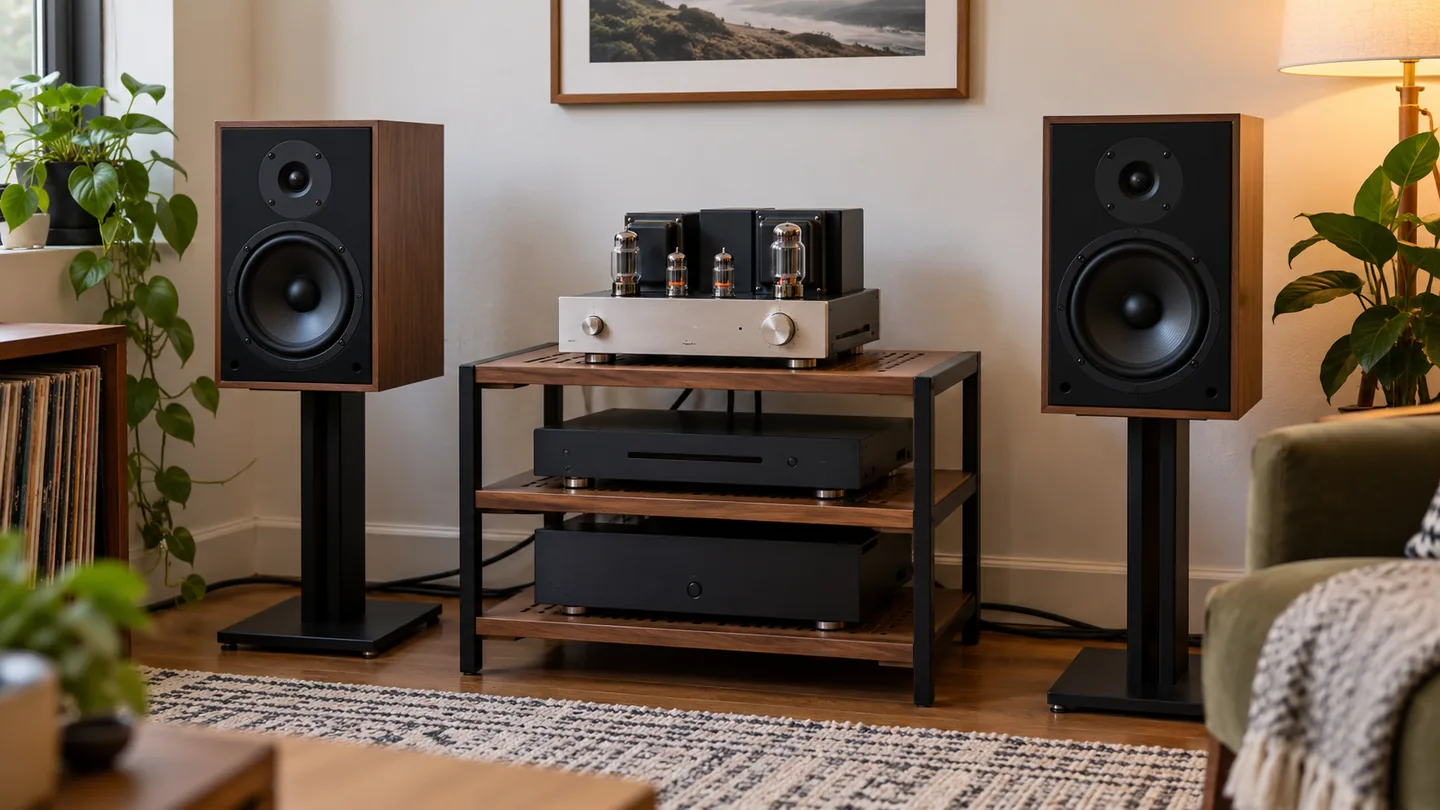
Illustrative image; not a photograph of a specific product.
Define the system boundary before choosing models
Write down your room, seating distance, typical and occasional listening levels, music sources, speaker placement limits, and the total amount available for speakers plus amplification. If the source is a streamer, check whether it supplies an appropriate analog output or whether a separate DAC is needed. If a turntable is involved, check whether the amplifier has a suitable phono input or needs a separate phono preamp. Reserve some budget for safe speaker placement and cables that fit the actual connections, rather than allocating everything to the amplifier.
Decide whether you need an integrated amplifier with volume control and source inputs or a power amp that needs a preamp. “All tube” can describe different signal paths; verify which stages actually use valves in the maker’s documentation. Also confirm the unit’s mains voltage and ventilation clearances before ordering across regions.
Match speakers using more than a wattage headline
Klipsch’s speaker-sensitivity guide defines sensitivity as acoustic output for a specified power input. It helps compare how much output different speakers produce from the same electrical input, but measurement conventions may differ between brands. Check the stated test method before comparing numbers.
Nominal impedance is another screening tool, not a complete description of the load. Klipsch explains that speaker impedance changes across the frequencies of music and that a low rating can challenge an amplifier. Read the tube amplifier’s manual for supported speaker loads and output taps, then look for the speaker’s minimum impedance or impedance curve when available. If either document is silent, ask the makers for a pairing assessment instead of guessing from an “8 ohm” label. Do not use sensitivity alone as proof that a speaker is an easy electrical load.
An audition should include quiet listening and demanding passages at the levels you will actually use. Listen for strain, noise at idle, balance at low volume, and enough headroom for short peaks. A small room may let you sit closer, but it does not erase difficult electrical loads or the need to control bass through placement.
Allow for heat, maintenance, and a safe setup
Tube amps need open ventilation and placement where children, pets, and loose objects cannot contact hot valves. Follow the exact clearance and start-up instructions for the chosen model. Ask whether replacement tubes are commonly available, whether the amp needs owner bias adjustment, and who will service it locally. The Rogue Audio M-120 manual warns that dangerous voltage can remain after unplugging; keep chassis inspection and repair with a qualified technician.
For a first purchase, favor a combination you can hear or return, with readable documentation and a realistic service path. Room size alone is no reason to buy a low-power amp; a larger power rating alone is no reason to spend more. Keep only combinations whose speakers fit your space, whose amplifier supports their load, and whose full ownership cost fits your budget.