
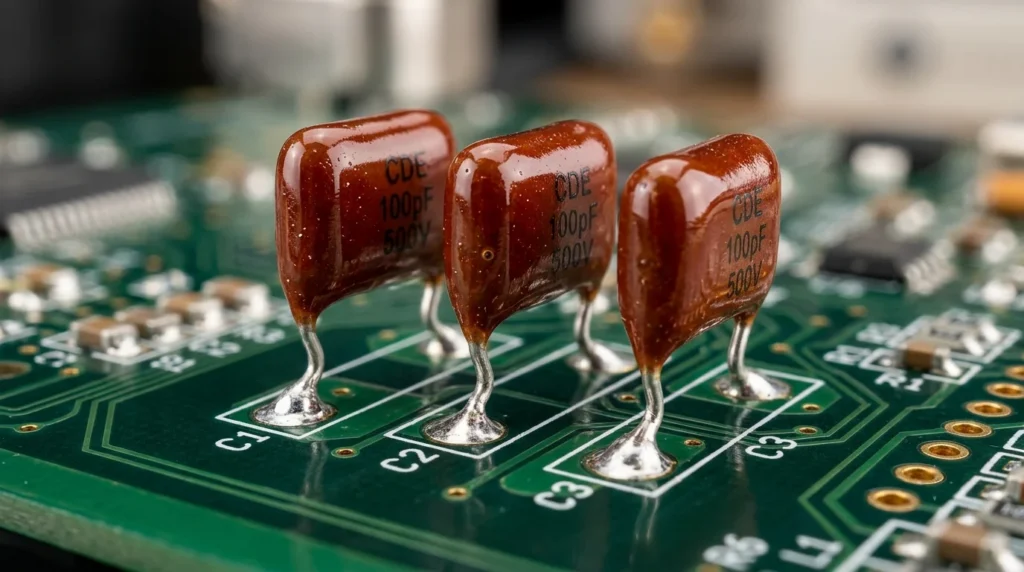
To optimize high-frequency circuits, you must understand what a mica capacitor is and why it remains indispensable. Unlike common ceramic capacitors, these parts use a highly stable, natural mica dielectric sheet. Consequently, this unique physical structure yields incredibly low electrical losses and an exceptionally high Q factor.
For decades, industry leaders like Cornell Dubilier have manufactured these premium components for demanding military and RF applications, While they cost more than standard multilayer ceramic alternatives, their high voltage capacity and temperature coefficient are unmatched. They do not age, degrade, or drift under heavy electrical stress.
As a hands-on engineer, I have seen these parts survive where cheaper options fail completely. This reliability makes them ideal for high-precision tuning and transmitters. Let us break down the physical properties, cost trade-offs, and critical applications that make these components a modern necessity.
What is a Mica Capacitor? (Definition and Core Concept)
To understand this necessity, we must look at how a mica capacitor operates at its physical core. At its most basic level, this component consists of thin mica dielectric sheets interleaved with metal electrodes. In modern designs, manufacturers deposit silver directly onto the mica surface to ensure intimate electrical contact. This specific design differs drastically from cheap ceramic capacitors that rely on pressed metal oxides, Because of this stable physical construction, the device achieves a remarkably high Q factor and a level of temperature stability that synthetic materials simply cannot match.
In the field, we rely on these parts because they behave predictably under extreme electrical pressure. For instance, when you expose a standard capacitor to high frequencies, dielectric heating usually causes the capacitance to drift. A silver mica capacitor, however, maintains its nominal value even when subjected to high breakdown voltage thresholds, Because of this thermal endurance, manufacturers like Cornell Dubilier have kept these parts in production for decades, serving critical RF applications where circuit drift means system failure.
From a practical engineering standpoint, you can identify a genuine mica capacitor by a few defining physical traits:
-
Natural Muscovite Mica: The dielectric uses natural mineral sheets cleaved into incredibly thin, uniform layers.
-
Low Self-Inductance: The physical geometry of the stacked sheets keeps parasitic inductance to an absolute minimum.
-
High Voltage Rating: The design resists dielectric puncture, allowing reliable operation at several hundred to thousands of volts.
How Silver Mica Capacitors Are Constructed
To safely handle these high operating voltages, the physical assembly of a silver mica capacitor must be incredibly precise. In the field, we rely on this specific design because its physical layout eliminates the microscopic voids that often plague standard ceramic capacitors.
The manufacturing process begins with natural muscovite mica. Technicians cleave this mineral into ultra-thin sheets that serve as the mica dielectric, Because this natural mineral splits easily along flat crystalline planes, the resulting sheets have a uniform thickness and flat surfaces.
Next, manufacturers deposit a silver paste directly onto both sides of the cleaved sheets to form the electrodes. This screen-printing method creates an intimate, void-free contact between the metal and the mineral. As a direct result of this tight mechanical bond, the capacitor exhibits exceptional temperature stability and a remarkably high Q factor. Under heavy RF loads, this interface prevents the localized heating that causes cheaper parts to drift.
Once the silver electrodes are printed, the sheets are stacked to achieve the desired capacitance value. Metal foil leads are then clamped directly to the stack under high pressure. This mechanical clamping ensures low contact resistance and keeps parasitic inductance to an absolute minimum.
Finally, the entire stack undergoes epoxy encapsulation. The component is dipped in a specialized, heavy-duty epoxy resin that cures into a rigid protective shell. This encapsulation prevents moisture from penetrating the layers and degrading the insulation resistance over time. For this reason, industry leaders like Cornell Dubilier have used this exact multi-step construction process for decades to supply rugged parts for critical RF applications.
The Unique Properties of the Mica Dielectric
This ruggedness depends entirely on the raw physical properties of the mica dielectric itself. Specifically, manufacturers use muscovite mica because its monoclinic crystal structure allows it to split cleanly into ultra-thin, flat sheets, Because these sheets are split along flat crystalline planes, engineers can achieve highly uniform thicknesses down to a fraction of a mil. Consequently, this physical uniformity translates directly into tight capacitance tolerances and highly predictable voltage ratings.
Also, this mineral possesses exceptional dimensional and chemical stability. Unlike the formulations used in class-2 ceramic capacitors, mica does not suffer from mechanical aging or voltage-coefficient drift. As a result, the distance between the printed electrodes remains completely stable over time. This structural rigidity is the primary driver behind the component’s legendary temperature stability and low drift.
In practice, muscovite also boasts an exceptionally high breakdown voltage, often exceeding 1,000 volts per mil of thickness, Because the material resists electrical puncture so effectively, thin sheets can safely withstand high-voltage RF waveforms without failing. Additionally, its highly ordered atomic structure minimizes molecular friction under alternating current fields. This low-loss behavior yields an exceptionally high Q factor, ensuring that the capacitor loses virtually no energy to heat during high-frequency operation.
The Silver Electrode Deposition Process
To realize this low-loss potential in demanding RF applications, manufacturers screen-print the silver electrodes directly onto the cleaved mica dielectric. This deposition step is highly critical because it establishes the precise physical interface between the metal and the mineral.
Specifically, a highly conductive silver paste is applied to both sides of each thin mica sheet using high-precision screens. After printing, these sheets are fired in a furnace at temperatures high enough to burn off organic binders and sinter the silver particles. As a result, this process creates an extremely thin, highly uniform metallic layer bonded directly to the mica surface.
this direct printing method completely eliminates microscopic air pockets. In contrast to older mechanical clamping methods, a void-free interface prevents localized corona discharges under high voltage, Because air has a much lower breakdown voltage than mica, removing these air gaps prevents catastrophic internal arcing.
Also, this intimate bonding directly reduces equivalent series resistance (ESR). It ensures that the current distributes evenly across the entire surface of the electrode during high-frequency operation. For this reason, industry leaders like Cornell Dubilier utilize this exact process to guarantee a high Q factor and reliable temperature stability, preventing the capacitance drift common in standard ceramic capacitors. Ultimately, this screen-printing technique yields a rugged, highly predictable electrode structure that remains stable under severe RF power loads.
Epoxy Encapsulation and Environmental Protection
To preserve this highly stable electrode structure against external environmental degradation, the completed mica-silver stack must be thoroughly sealed. Consequently, manufacturers dip-coat or transfer-mold the assembly in a heavy-duty, flame-retardant epoxy resin. This encapsulation layer serves as a robust barrier against moisture ingress, Because water molecules have high polarizability, any humidity penetrating the mica dielectric would rapidly degrade the component’s high Q factor. By excluding moisture, the epoxy shell ensures that the capacitor maintains its high breakdown voltage in humid environments.
Also, this outer protective casing provides essential mechanical rigidity. The cured epoxy absorbs physical shocks and vibrational stresses that might otherwise shift the internal plates, Because the thermal expansion coefficient of the epoxy matches the internal assembly, the component experiences minimal internal stress. As a result, this structural integrity directly preserves the capacitor’s excellent temperature stability during demanding RF applications. Ultimately, this rigorous sealing process ensures that silver mica designs, like those from Cornell Dubilier, maintain a stable, drift-free lifespan. This long-term reliability far exceeds that of standard ceramic capacitors under harsh environmental conditions.
Key Performance Characteristics of Mica Capacitors
To understand this superior reliability, one must analyze the key performance characteristics that define the mica dielectric under electrical stress. Unlike standard ceramic capacitors, which often exhibit capacitance drift under temperature fluctuations, mica maintains a highly predictable, linear response. Consequently, this predictable behavior translates into several distinct performance advantages.
Specifically, the component exhibits a very high Q factor, which means it loses minimal energy during high-frequency oscillations, Because of this low-loss profile, engineers select these parts for demanding RF applications where signal integrity is critical. Furthermore, the physical structure of the cleaved sheets ensures an exceptionally high breakdown voltage. As a result, the device can withstand massive voltage stresses without experiencing dielectric puncture.
This structural resilience directly contributes to outstanding temperature stability across a wide operating range. Ultimately, brands like Cornell Dubilier leverage these physical properties to produce highly reliable parts for critical systems. Indeed, these characteristics arise from the highly ordered atomic lattice of the mineral. Therefore, understanding these core performance metrics helps engineers specify the correct component for high-precision circuitry.
Exceptional Temperature Stability and Low Drift
Achieving high-precision circuitry requires components that resist thermal variation, making temperature stability the defining parameter of the mica dielectric, While alternative options like ceramic capacitors exhibit significant capacitance drift as temperatures climb, mica remains remarkably constant. Specifically, these components offer a nominal temperature coefficient of 0 to +70 ppm/°C. Consequently, this predictable thermal behavior ensures that the circuit operates within its target parameters across wide thermal swings, Because of the highly ordered crystal lattice of the mineral, the material experiences negligible physical expansion when heated. As a result, the distance between the electrodes does not change. Ultimately, this structural integrity prevents the unpredictable drift that causes tuning errors in RF applications. Furthermore, brands like Cornell Dubilier utilize advanced encapsulation techniques to protect this internal alignment. By sealing the plates in a stress-matched epoxy, the assembly resists thermal cycling without fracturing. Therefore, the electrical properties remain constant from sub-zero environments up to extreme operating limits.
High Voltage Limits and Maximum Breakdown Voltage
Operating reliably at these physical extremes also requires a component that can withstand significant electrical stress without dielectric failure, Because of the exceptional dielectric strength of the natural mica dielectric, which ranges between 118 and 250 kilovolts per millimeter, these capacitors safely manage immense electric fields. Consequently, even extremely thin layers of the mineral prevent electrical arcing between the electrodes.
This physical toughness allows manufacturers to design compact parts with high breakdown voltage ratings, While alternative choices like standard ceramic capacitors degrade or crack under high-voltage surges, the highly stable crystalline structure of mica remains intact. As a result, silver mica capacitors easily handle operating voltages from 100 volts up to 20,000 volts DC, Because of this high threshold, the capacitor maintains an incredibly low dissipation factor and a high Q factor under continuous electrical stress. Ultimately, this structural resilience prevents the localized heating that typically causes premature component failure. For this reason, industry leaders like Cornell Dubilier produce specialized high-voltage mica units specifically for demanding RF applications. These robust parts ensure that the circuit maintains its overall temperature stability and operational integrity during high-power broadcasts without suffering from voltage-induced capacitance drift.
Low Losses and High Q Factor
This freedom from drift directly correlates with the minimal energy dissipation within the component during high-frequency operation. Specifically, the natural mica dielectric exhibits an exceptionally low loss tangent. This characteristic minimizes the conversion of electrical energy into waste heat. Consequently, these components achieve an incredibly high Q factor, often exceeding 1,000 at 1 megahertz.
This performance metric represents the ratio of stored energy to dissipated energy per cycle. In high-frequency RF applications, maintaining a high Q is vital for filter selectivity and oscillator frequency stability. By comparison, standard ceramic capacitors suffer from much higher internal dielectric losses. These losses lead to signal attenuation and unwanted heat generation under RF stress.
Also, the physical construction of silver mica units minimizes parasitic equivalent series resistance (ESR) and self-inductance. Manufacturers like Cornell Dubilier optimize the electrode geometry to ensure uniform current distribution across the silver layers. As a direct result of this design, the capacitor maintains its low-loss characteristics even as temperatures fluctuate. Ultimately, this thermal and electrical efficiency ensures that resonant circuits remain highly selective. This prevents detuning and maximizes signal transmission efficiency in critical transmitter and receiver stages.
Critical Applications: Where Are Mica Capacitors Used?
These demanding transmitter and receiver stages represent only a fraction of the specialized environments that rely on these high-performance components. Consequently, engineers specify the mica dielectric for systems where electrical drift or component failure is entirely unacceptable, Because alternative technologies like standard ceramic capacitors exhibit noticeable capacitance shifts under electrical and thermal stress, they cannot match this physical reliability.
As a result, silver mica capacitors find their primary utility in high-stress systems requiring extreme temperature stability. For instance, high-power RF applications utilize these parts to manage substantial reactive currents without thermal runaway. Ultimately, this performance ensures that the high Q factor and high breakdown voltage of the system remain stable over decades of continuous operation. Therefore, analyzing where these components are deployed reveals why they remain an indispensable tool in precision electrical engineering.
RF Applications and High-Frequency Tuning Circuits
In high-frequency RF applications, these components are critical in transmitter tank circuits, impedance matching networks, and filter stages. Designers frequently specify the silver mica dielectric because high-frequency systems require exceptional temperature stability to prevent frequency drift. Under high power, standard ceramic capacitors often exhibit dielectric heating, which directly causes the resonant frequency of a circuit to shift. Consequently, substituting a ceramic component with a silver mica alternative ensures that tuning remains locked under sustained load.
Also, transmitters generate large reactive currents that demand capacitors with extremely high Q factors. Industry-standard parts, such as those manufactured by Cornell Dubilier, minimize internal resistive losses through optimized electrode designs. As a direct result, these capacitors exhibit negligible equivalent series resistance (ESR) even at tens of megahertz. Ultimately, this low ESR prevents thermal runaway and maintains a high breakdown voltage under peak RF voltage swings.
In addition, the physical geometry of silver mica capacitors minimizes parasitic self-inductance, Because of this layout, the self-resonant frequency of the component remains well above the operating frequency of the circuit. Consequently, the capacitor behaves as a pure capacitive element rather than a parasitic inductive element. By maintaining this predictable performance, engineers can design high-power RF amplifiers and matching networks with complete confidence in their long-term reliability.
High-End Audio Amplifiers and Musical Instruments
This same demand for absolute electrical consistency makes silver mica capacitors highly valued in high-end audio amplifiers and musical instruments. In these systems, components must process low-level audio signals without introducing unwanted noise or harmonic distortion, While standard ceramic capacitors are prone to microphonics, the rigid physical structure of the mica dielectric does not exhibit piezoelectric activity. Consequently, physical vibrations from speakers or power transformers cannot modulate the audio signal passing through the capacitor. This mechanical stability directly prevents the generation of ghost tones and physical noise in high-gain tube preamplifiers.
Also, the exceptional temperature stability of silver mica prevents circuit detuning during extended operations. Vacuum tubes generate significant heat inside an amplifier chassis, Because of this thermal buildup, lesser components suffer from capacitance drift and alter the frequency response of the tone stack. Utilizing silver mica ensures that the equalization curves of the amplifier remain locked to their exact designed specifications.
Ultimately, these physical characteristics provide a level of signal purity that alternative dielectrics cannot replicate. Designers of premium audio hardware rely on these parts to maintain low distortion and predictable phase response across the entire acoustic spectrum.
Defense and Aerospace Electronics
Beyond the demands of high-fidelity audio, these same structural advantages make silver mica capacitors essential in defense and aerospace electronics, Because military systems must operate under extreme environmental conditions, component reliability is a primary engineering constraint. The raw physical stability of the mica dielectric ensures that spacecraft and missile guidance systems do not experience critical drift. Consequently, these components maintain precise capacitance despite rapid pressure changes and severe mechanical shock. Furthermore, unlike standard ceramic capacitors, silver mica capacitors exhibit high radiation resistance. As a result of this atomic stability, they operate reliably in high-altitude flight paths and outer space orbits without physical degradation.
In aerospace RF applications, engineers rely on parts manufactured by industry leaders like Cornell Dubilier to meet strict military specifications. These specialized components leverage the high Q factor and high breakdown voltage of the natural mineral to survive high-power transmitter environments, Because of this high dielectric strength, the capacitors resist electrical arcing even at high altitudes where air density is low. Therefore, they are frequently integrated into radar installations, radio communications gear, and telemetry systems, Because they possess exceptional temperature stability, the tuning frequencies of these high-frequency circuits remain constant throughout extreme thermal cycling, preventing communication dropouts during rapid atmospheric flight.
Mica Capacitors vs. Ceramic Capacitors: Key Differences
To survive these demanding operating environments without signal degradation, circuit designers must understand the physical differences between silver mica dielectric units and standard ceramic capacitors, Because ceramic capacitors rely on polycrystalline ferroelectric materials, they exhibit a strong piezoelectric effect. Consequently, mechanical vibrations in the system translate directly into electrical noise, modulating the RF or audio signal. In contrast, the natural crystalline structure of the mica dielectric possesses no piezoelectric properties, Because of this absolute structural rigidity, silver mica capacitors remain completely immune to microphonic noise under severe mechanical stress.
Class II and Class III ceramic capacitors experience a significant drop in capacitance when a DC voltage is applied. Conversely, silver mica capacitors maintain a flat capacitance curve regardless of the applied voltage. As a direct result of this stability, the circuit maintains its design frequency even near the maximum breakdown voltage limit.
In high-frequency RF applications, the electrical dissipation factor determines overall efficiency, Because ceramic materials exhibit higher dielectric losses, they generate internal heat during high-power operations. This localized heating causes Class II ceramics to drift rapidly due to their poor temperature stability. Silver mica capacitors, however, feature an exceptionally high Q factor. Consequently, they dissipate minimal energy, preventing thermal runaway and preserving critical circuit tuning across broad temperature ranges.
FAQ About what is mica capacitors
Why are mica capacitors so expensive compared to ceramic alternatives?
Mica capacitors are pricier primarily because of the raw material and how they are made. Mica is a naturally occurring mineral that must be mined, carefully sorted, and manually split into ultra-thin sheets. This labor-intensive manufacturing process drives up the cost, whereas ceramic capacitors use cheap, synthetic materials that are easily mass-produced. Additionally, mica delivers exceptional electrical stability and reliability under high temperatures and voltages.
A good practical tip is to reserve silver mica capacitors-for-amplifier-case-study/”>capacitors for critical spots where frequency stability is absolutely essential, such as in radio transmitters or high-end audio amplifiers. For general everyday tasks like power supply filtering, stick with standard ceramic alternatives to keep your project budget-friendly.
Do silver mica capacitors degrade or wear out over time?
Silver mica capacitors are famous for their exceptional stability and can easily last for decades. they are not completely immune to wearing out. Over time, especially when exposed to moisture and continuous voltage, the silver coating can migrate across the mica layers. This creates tiny conductive paths that lead to electrical leakage or even a complete short circuit.
A classic example of this is found in vintage tube radios. If you hear a loud, erratic crackling sound resembling distant thunder, a failing silver mica capacitor is likely the culprit. As a practical tip, always store your vintage or high-precision electronics in a dry, temperature-controlled environment, as minimizing humidity is the best way to prevent this degradation.
Can I replace a silver mica capacitor with a ceramic or film capacitor?
Yes, you can replace a silver mica capacitor. you need to choose the right alternative to keep your circuit running smoothly. Silver mica capacitors are prized for their incredible stability and precision. If you are repairing a radio or high-frequency circuit, your best substitute is a C0G (also called NP0) ceramic capacitor, as it matches the temperature stability of silver mica. For audio gear, a high-quality film capacitor is often the preferred choice.
As a practical tip, always double-check the voltage rating before swapping them out. Vintage silver mica capacitors often handle 500 volts or more. your new ceramic or film replacement must meet or exceed that original rating to keep your device safe.