
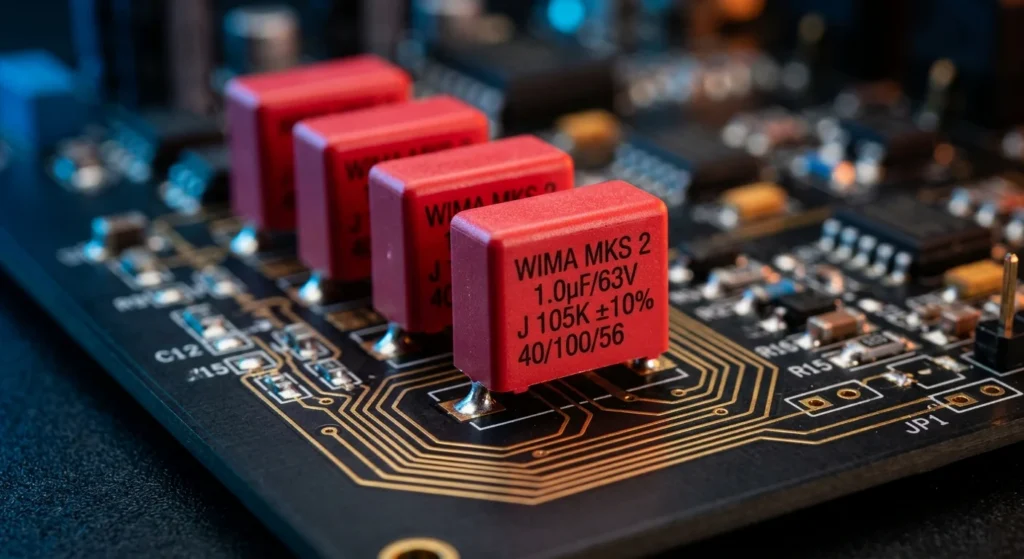
Selecting the right polyester film capacitors requires balancing cost, size, and electrical performance. As an engineer, you know that choosing the correct dielectric material directly impacts circuit stability, While polypropylene offers lower dissipation factors, polyester provides a higher dielectric constant. This allows for much smaller component footprints at any given capacitance. For space-constrained designs, metallized film variants also offer invaluable self-healing properties.
To achieve peak reliability, you must compare manufacturer datasheets and supplier catalogs carefully. For example, premium WIMA series excel in high-pulse environments. Meanwhile, jb Capacitors offers cost-effective stability for general coupling applications. Evaluating these specifications side-by-side helps you balance unit costs against strict electrical tolerances. Let’s analyze how these components perform under load so you can source the exact part your system demands.
Understanding Polyester Film Capacitors: Construction and Dielectric Properties
To optimize your choice of polyester film capacitors under real-world loads, you must first evaluate how the physical dielectric layer behaves under thermal and electrical stress. When you design for tight spaces, polyester delivers a significantly higher dielectric constant than polypropylene. Consequently, this characteristic lets you specify a much higher capacitance in a compact component footprint. However, you must trade off this space-saving benefit against a higher dissipation factor. In practice, this means polyester works best in general-purpose coupling, DC blocking, and bypass paths rather than high-frequency resonant circuits.
To balance performance, reliability, and unit cost during your sourcing process, focus your evaluation on these key criteria:
-
Self-Healing Characteristics: Opt for metallized film constructions when your design requires fault tolerance. If a localized voltage breakdown occurs, the thin metallization layer vaporizes and instantly clears the short. As a result, your circuit continues to operate safely without catastrophic failure.
-
Dielectric Trade-offs: Keep in mind that polyester displays a positive temperature coefficient. If your circuit demands high stability over temperature or low dielectric absorption, you might need to transition to polypropylene, despite its larger physical size.
-
Environmental and Agency Standards: Ensure your chosen series complies with international environmental directives. Specifically, major manufacturers like WIMA design their leaded and box-type series to meet strict RoHS requirements, which ensures smooth passage through regulatory compliance testing.
Mylar vs. Metallized Film (PET) Capacitors
Building on these regulatory baselines, optimizing your circuit requires comparing traditional Mylar foil with modern metallized film. When you source components, remember that traditional film-foil Mylar capacitors utilize thick, discrete metal foil sheets. Consequently, they handle massive peak currents but demand a much larger footprint on your printed circuit board.
If physical space is tight, metallized film alternatives should be your default choice, Because the metal layer is vapor-deposited directly onto the PET dielectric, you get a much higher capacitance density. As a direct benefit, this thin layer enables self-healing properties that protect your board from catastrophic shorts. For instance, leading series like the WIMA MKS2 pack this reliability into a compact radial package.
To maximize board-level efficiency, keep these technical comparisons in mind during your next component evaluation:
-
Voltage and Pulse Handling: Film-foil construction excels in high-pulse environments because the solid metal electrodes absorb thermal stress. By contrast, metallized film handles lower pulse currents but fits easily into dense, modern layouts.
-
Footprint and Sourcing: Metallized PET capacitors reduce board space by up to fifty percent compared to film-foil variants of the same capacitance. Consequently, they remain the industry standard for general-purpose DC blocking.
-
Long-Term Reliability: If a localized dielectric breakdown occurs, metallized film vaporizes the electrode around the fault. As a result, the component heals itself instead of causing a short circuit. Additionally, these metallized parts maintain full compliance with RoHS standards across major supplier catalogs.
If your application involves high-frequency AC power, transitioning to a polypropylene dielectric is usually necessary. Otherwise, polyester metallized film remains the most cost-effective solution for your general-purpose DC designs.
Structural Differences: Foil-Type vs. Box-Type Capacitors
Transitioning to a compact radial package requires a clear-headed evaluation of raw foil-type windings versus encapsulated box-type structures. Traditional foil-type capacitors feature a simple wrap-and-fill outer tape. Consequently, they often exhibit inconsistent physical dimensions that complicate automated pick-and-place assembly.
By contrast, box-type capacitors house the wound or stacked metallized film dielectric inside a pre-molded, flame-retardant plastic shell. As a direct benefit of this rigid casing, box-type components provide highly predictable lead spacing and outer dimensions. Leading manufacturers like WIMA design these active sub-assemblies to fit standardized grid pitches down to 2.5 mm. Consequently, designers can maximize PCB layout density without risking component collision during automated assembly.
Also, the epoxy resin filling in box-type designs protects the internal metallized film from humidity and mechanical vibration. This encapsulation shields the self-healing electrode layers from moisture ingress, which otherwise accelerates capacitance loss over time. When sourcing from supplier catalogs, engineers should prioritize RoHS compliant box-type series to ensure seamless integration into lead-free wave soldering lines. If the target application demands extreme pulse handling, a raw film-foil winding is occasionally preferred. Otherwise, for cost-effective, high-yield DC blocking and filtering, the box-type polyester option remains the superior physical form factor.
Key Technical Specifications and Performance Metrics
To leverage this physical form factor effectively, engineers must evaluate key electrical parameters during the component sourcing phase. Consequently, selecting the correct capacitance and voltage rating prevents premature dielectric breakdown on the board. Standard polyester metallized film capacitors typically offer capacitance values ranging from 1 nF to 10 µF. Their DC voltage ratings generally span from 50V to 1000V.
By contrast, when operating under AC conditions, the dissipation factor of a polyester dielectric rises significantly as frequency increases. As a result, high-frequency applications will experience increased internal heating. To prevent thermal runaway, engineers must derate the operating voltage at elevated frequencies. For circuits exceeding 10 kHz, switching to a polypropylene dielectric is often necessary to minimize dielectric losses.
The self-healing capability remains a key reliability metric for these components. During a localized overvoltage event, the thin metallized film layer vaporizes around the fault site. As a direct benefit of this action, the capacitor isolates the short circuit and continues operating normally. However, this clearing process slightly reduces the overall capacitance.
Also, pulse strength, measured as dV/dt, represents another critical limiting parameter, Because metallized polyester capacitors have a lower dV/dt capability than thick film-foil types, rapid voltage transitions can degrade the internal contact layers. Consequently, designers must check the manufacturer’s datasheet for pulse limits in snubber or high-current switching layouts.
When sourcing from supplier catalogs, engineers must verify tolerance ratings and environmental standards. Standard tolerances typically range from ±5% to ±20%. Leading brands like WIMA offer tight-tolerance options suitable for analog filtering circuits. Furthermore, ensuring the chosen series is fully RoHS compliant simplifies regulatory approval for global markets. Ultimately, matching these technical metrics to the specific operating environment ensures reliable, cost-effective circuit performance.
Capacitance Range and Voltage Ratings
Achieving this optimal matching requires understanding how capacitance and voltage ratings scale across commercial offerings. For standard applications, designers select metallized polyester film capacitors within the 1 nF to 10 µF range, Because the dielectric constant of polyester is relatively high, these components pack high capacitance into a small footprint. Consequently, they save valuable board space compared to larger alternative dielectrics. However, as capacitance increases, the physical volume of the component expands. To prevent layout interference, designers must cross-reference lead spacing options in catalogs from brands like WIMA or jb Capacitors, Because of the self-healing properties of the metallized film, minor dielectric punctures do not cause catastrophic short-circuits. This reliable clearing behavior allows engineers to design closer to the rated DC voltage with higher safety margins. Voltage selection demands equal rigor, as standard DC ratings span from 50V up to 1000V. Nevertheless, operating temperatures above 85°C degrade the internal dielectric breakdown strength. As a direct result of this thermal sensitivity, engineers must derate the working voltage by 1.25% per °C above 85°C. For high-frequency applications, transitioning to a polypropylene dielectric is often required. This selection change prevents thermal runaway and maintains stable circuit parameters. Furthermore, sourcing RoHS-compliant series ensures global regulatory compliance while guaranteeing long-term environmental safety.
Dissipation Factor, Self-Healing, and Temperature Coefficient
To maintain safety without sacrificing performance, designers must evaluate the dissipation factor of the chosen metallized film. For polyester dielectrics, this factor typically measures around 0.5% to 1.0% at 1 kHz. However, this value rises sharply as operating frequencies exceed 10 kHz. Consequently, operating these components at high frequencies generates excessive internal heat. This thermal rise directly shifts the nominal capacitance because of the positive temperature coefficient of polyester. Specifically, polyester exhibits a positive temperature coefficient of approximately +400 ppm/°C.
To mitigate these thermal risks, engineers specify self-healing components from reputable catalogs, such as the WIMA MKS series. During localized dielectric breakdowns, the thin metallized layer vaporizes around the fault site. As a direct result, the component safely isolates the short circuit and remains operational. Nevertheless, each self-healing event causes a minute, permanent loss of overall capacitance.
If the circuit requires tight tolerances under high thermal stress, engineers must switch to a polypropylene dielectric. Polypropylene maintains a much lower dissipation factor and a negative temperature coefficient. Consequently, choosing the correct material prevents detuning in high-Q filters. Sourcing RoHS-compliant parts from established suppliers ensures that these critical physical parameters remain within specified tolerances.
Tolerance and RoHS Compliance Standards
Maintaining these tight tolerances requires a deep understanding of how manufacturing variables and RoHS compliance standards impact metallized film integrity. Standard polyester capacitors typically exhibit a nominal capacitance tolerance of ±10% or ±5%. However, the lead-free reflow soldering processes required by RoHS compliance expose components to temperatures exceeding 250°C. Consequently, this intense thermal stress can shrink or deform the delicate polyester dielectric. This deformation directly causes an irreversible shift in the post-assembly capacitance value.
To mitigate these thermal assembly shifts, engineers must evaluate the manufacturer’s soldering specifications. High-quality manufacturers, such as WIMA, utilize robust thermosetting plastic cases that shield the internal metallized film from transient soldering heat. If your design demands a tolerance tighter than ±5% over its operating life, you should transition to a polypropylene dielectric. Polypropylene withstands these high-temperature cycles with minimal physical distortion.
Also, the self-healing mechanism of metallized film components directly alters long-term tolerance stability. During a localized clearing event, the vaporized electrode material permanently reduces the active dielectric area. As a direct result, the overall capacitance decreases slightly with every self-healing cycle. To ensure long-term parameter stability in critical timing or filtering circuits, designers must select parts with higher rated voltages. Sourcing certified RoHS-compliant components from authorized catalogs guarantees that these material tolerances remain predictable throughout the lifecycle of the system.
Commercial Sourcing: Leading Manufacturers and Capacitor Series
To translate these lifecycle guarantees into reliable hardware, engineers must systematically evaluate commercial datasheets against actual circuit stresses. When operating close to the physical limits of a metallized film dielectric, high-stress conditions will accelerate thermal degradation. As a direct result, sourcing decisions must prioritize manufacturers that specify strict parameter drift limits under continuous load, Because of the inherent thermal sensitivity of polyester, you must verify the component’s maximum rated temperature and apply the required voltage derating above 85°C. To mitigate the risk of premature self-healing wear-out, designers should analyze the maximum AC current ratings, not just the nominal DC voltage. Selecting a brand like WIMA ensures access to comprehensive data curves that document how dissipation factor changes with frequency. Consequently, this prevents localized hot spots that could compromise the integrity of the metallized film layer over time.
Also, if your application demands exceptional high-frequency performance or tighter capacitance stability, you must compare polyester directly with alternative dielectrics during the sourcing phase. For instance, while a polypropylene component offers a lower dissipation factor, polyester remains the superior choice for space-constrained layouts due to its higher dielectric constant. To balance these trade-offs effectively, engineers must verify that the selected parts carry verified RoHS compliance documentation to avoid procurement bottlenecks. By matching these material realities with specific manufacturer tolerances, you guarantee that the final physical design remains highly resilient under dynamic operating conditions.
WIMA MKS2 and Radial Lead Series
To achieve this level of physical resilience, you must specify robust components like the WIMA MKS2 radial lead series during layout optimization. This specific series utilizes a metallized film dielectric and is highly valued for its subminiature 5mm lead spacing. Consequently, it is ideal for dense printed circuit board layouts where space is limited.
However, you must not overlook the specific pulse loading (dV/dt) limits outlined in the manufacturer’s documentation, While the self-healing properties of the PET film minimize the risk of catastrophic short circuits, excessive voltage transients will still degrade the metallized electrode layer over time. Therefore, you must verify the maximum pulse rise time for your target operating voltage to prevent progressive loss of capacitance.
In addition to pulse limits, engineers must evaluate the capacitance drift and dissipation factor of these radial components. As a rule, the WIMA MKS2 series exhibits a higher dissipation factor than its polypropylene counterparts, Because of this trade-off, you must restrict these polyester capacitors to applications where high-frequency losses do not cause internal thermal runaway. If your design operates near the upper boundary of your thermal envelope, you should implement the mandatory voltage derating factor. Specifically, reduce the operating voltage by 1.25% per degree Celsius for any temperature rise above 85°C.
Finally, always confirm that your selected WIMA part numbers explicitly match your environmental compliance policies. To prevent procurement delays, you must verify that the components adhere to active RoHS standards. When sourcing, demand certified datasheets directly from authorized distributors. This ensures that the nominal capacitance tolerances, which typically range from ±5% to ±20%, remain stable under your specific soldering and environmental profiles.
Alternatives from jb Capacitors, Faratronic, and Nissei
To maintain stability across alternative vendors, you must systematically evaluate their thermal and physical profiles against the established WIMA benchmark. When sourcing from jb Capacitors, you must specify their JFE metallized film series. This option offers highly reliable self-healing properties under standard voltage conditions. Unlike polypropylene alternatives, this polyester dielectric provides higher capacitance density in a smaller footprint. Consequently, it fits well in space-constrained layouts. However, you must carefully analyze its dissipation factor at high operating frequencies to avoid localized thermal runaway.
In addition, Faratronic and Nissei offer strong alternatives for high-density layouts. For example, Faratronic’s CL21 series features robust construction that minimizes dielectric degradation. For highly humid environments, you should prioritize Nissei’s MMB series. This series offers superior moisture resistance. To ensure a seamless substitution, you must execute the following validation steps:
-
First, confirm that the alternative’s lead spacing matches your PCB footprint exactly.
-
Second, verify that the dV/dt pulse ratings meet or exceed the original WIMA specifications.
-
Finally, demand certified RoHS compliance documentation directly from the manufacturer.
Checking these parameters ensures that alternative sourcing does not compromise system-level reliability.
Typical Applications of Polyester Capacitors in Modern Circuits
To maintain this system-level reliability, you must enforce a rigorous optimization protocol. Apply this when integrating any polyester metallized film capacitor into modern signal paths. You cannot simply drop these parts into high-frequency decoupling slots without evaluating thermal stress on the dielectric. In DC blocking and analog filtering applications, you must prioritize parts like the WIMA MKS series. This selection ensures stable capacitance values under typical operating environments. Conversely, if your application exceeds 20 kHz, you must execute a strict transition analysis. Specifically, check if a polypropylene alternative is required to prevent excessive dissipation factor losses.
When deploying these components in coupling or timing circuits, you must verify their physical and electrical limits against these non-negotiable criteria:
-
Enforce Thermal De-rating: You must de-rate the operational voltage by at least 1.25% per degree Celsius for any ambient temperature exceeding 85°C.
-
Audit Self-Healing Events: You must verify that transient pulse currents do not trigger frequent self-healing cycles. Consequently, excessive self-healing will cause cumulative capacitance loss and eventual parametric failure.
-
Mandate Environmental Certification: You must reject any alternative component that lacks certified, verifiable RoHS compliance documentation from the manufacturer.
Ultimately, sourcing engineers must cross-reference all electrical parameters against official manufacturer catalogs rather than relying on third-party distributor summaries. You must run independent laboratory validation on sample batches to confirm dV/dt ratings before approving volume production.
High-Frequency Coupling and Decoupling
To execute a strict transition analysis, you must check if a polypropylene alternative is required to prevent excessive dissipation factor losses, While a polyester metallized film capacitor offers excellent volumetric efficiency, its losses rise sharply as operating frequencies increase. Consequently, you must systematically audit the dissipation factor of any baseline WIMA MKS2 or jb JFE series component. If the signal frequency exceeds 10 kHz, you must reject standard polyester. Mandate low-loss polypropylene to prevent localized thermal runaway.
To mitigate thermal risks, you must de-rate the operational voltage by at least 1.25% per degree Celsius for any ambient operating environment above 85°C. For instance, a 100V rated part must not exceed 75V at 105°C. Additionally, you must verify that peak transient currents do not induce repeated self-healing cycles within the dielectric, Because each clearing event vaporizes the metal electrode, excessive self-healing degrades nominal capacitance and shifts critical tuning frequencies.
Therefore, sourcing engineers must demand certified datasheets directly from official manufacturer catalogs. Do not rely on third-party distributor summaries. You must also confirm certified RoHS compliance on all incoming bill-of-materials lines. To finalize validation, you must run independent dV/dt stress testing on sample batches before approving volume production. If any batch fails to meet the specified pulse rise-time limits, you must reject the entire shipment immediately.
Audio Circuit Design and Signal Filtering
executing these strict screening procedures is vital when you optimize polyester film capacitors for audio circuit design and signal filtering. For low-frequency coupling stages, you may utilize a metallized film dielectric because of its compact volume. However, you must recognize that polyester exhibits relatively high dielectric absorption. This physical limitation introduces unwanted phase shifts and harmonic distortion in high-fidelity signal paths.
For this reason, you must restrict standard WIMA MKS or equivalent PET series to non-critical DC blocking positions. If your analog circuit demands precise equalization or active filtering, you must specify low-loss polypropylene alternatives instead. This substitution ensures a flat frequency response and minimizes signal degradation across the audible spectrum.
Also, you must evaluate the risk of self-healing events caused by transient voltage spikes during power-on cycles. These clearing events permanently reduce nominal capacitance and shift your filter’s cut-off frequency. To prevent this drift, you must verify that the peak transient voltages remain well below the rated DC limits of the component.
As a final step, sourcing engineers must verify certified RoHS compliance and demand original manufacturer datasheets for every batch. You must reject any incoming components that exhibit inconsistent dissipation factors during high-frequency pre-production bench testing. Never compromise on these validation steps if you expect to maintain professional audio standards.
Polyester vs. Polypropylene Film Capacitors: A Technical Selection Guide
To achieve this reliability, you must optimize your selection of polyester film capacitors by analyzing their physical and electrical limits, While polyester offers excellent volumetric efficiency, you must recognize when its dielectric properties fail to meet your circuit demands.
you must audit the operating frequency of every signal path in your design. If your application exceeds 10 kHz, you must reject PET options like the WIMA MKS2 series. Instead, you must immediately transition to low-loss polypropylene capacitors. This strict substitution prevents excessive dissipation factor losses and eliminates the risk of thermal runaway.
Beyond frequency constraints, you must enforce a strict thermal de-rating protocol. For ambient operating temperatures above 85°C, you must de-rate the operational voltage by a minimum of 1.25% per °C. This means you must limit a 100V-rated metallized film capacitor to a maximum of 75V at 105°C. Any failure to de-rate will result in dielectric breakdown and catastrophic component failure.
Also, you must mitigate the degradation caused by repeated self-healing events. Excessive transient voltage spikes vaporize the metallized electrode. Over time, this localized clearing permanently reduces nominal capacitance and shifts critical tuning frequencies. Therefore, you must demand peak transient voltage verification during your bench testing.
As a final step, sourcing teams must verify certified RoHS compliance on all incoming parts. You must reject any components that lack original manufacturer documentation. Never accept unverified parts if you expect to maintain professional engineering standards.
FAQ About polyester film capacitors
What are the main limitations of polyester film capacitors?
While polyester film capacitors are excellent for general-purpose electronics, they do have a few key limitations. Their biggest drawback is their sensitivity to temperature. As the surrounding environment warms up or cools down, their capacitance value can shift significantly. They also tend to lose energy as heat when used in high-frequency applications, which can cause them to degrade over time, Because of these traits, a great practical tip is to avoid using polyester capacitors in precision timing circuits or high-frequency power supplies where stability is critical. Instead, they are much better suited for general filtering or basic audio circuits where minor fluctuations won’t affect your overall performance.
Can polyester film capacitors be used in AC power applications?
Generally, polyester film capacitors are not suitable for high-voltage AC power applications, such as direct connection to household mains, While they work wonderfully for DC circuits and small AC signals in audio equipment, they tend to overheat and degrade quickly when subjected to the continuous stress of AC power lines.
If you are working on a project that connects to a wall outlet, a great practical tip is to use polypropylene capacitors with “Class X” or “Class Y” safety ratings instead. These are specially designed to handle AC power safely and are engineered to fail safely without causing a fire hazard.
How does temperature affect the stability of PET film capacitors?
Polyester (PET) film capacitors are highly reliable, but their performance does shift with temperature. As the temperature rises, the capacitance—or the amount of electrical charge the capacitor can store—typically increases. Conversely, colder temperatures will cause this value to drop, While they handle moderate everyday temperature swings quite well, extreme heat can permanently degrade the delicate plastic film inside, leading to a loss of efficiency or even premature failure.
To keep your devices running smoothly, a great practical tip is to physically position PET capacitors away from high-heat components on your circuit board, such as hot power resistors or voltage regulators. Keeping them in a cooler zone ensures they maintain their stable target values and enjoy a much longer, healthier lifespan.