Compare Best Vacuum Tube Sockets (Technical Review)

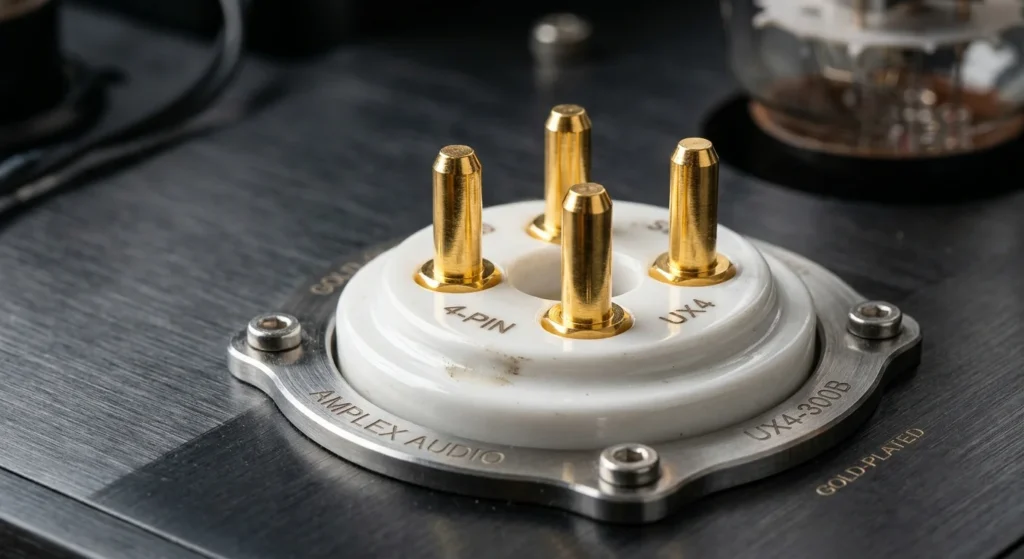
Glazed ceramic UX4 vacuum tube sockets with gold-plated contacts for high-end triode audio amplifiers.

You need the right vacuum tube sockets to build a reliable amplifier or restore vintage audio gear. Loose socket contacts cause thermal stress, microphonics, and intermittent signal dropouts.

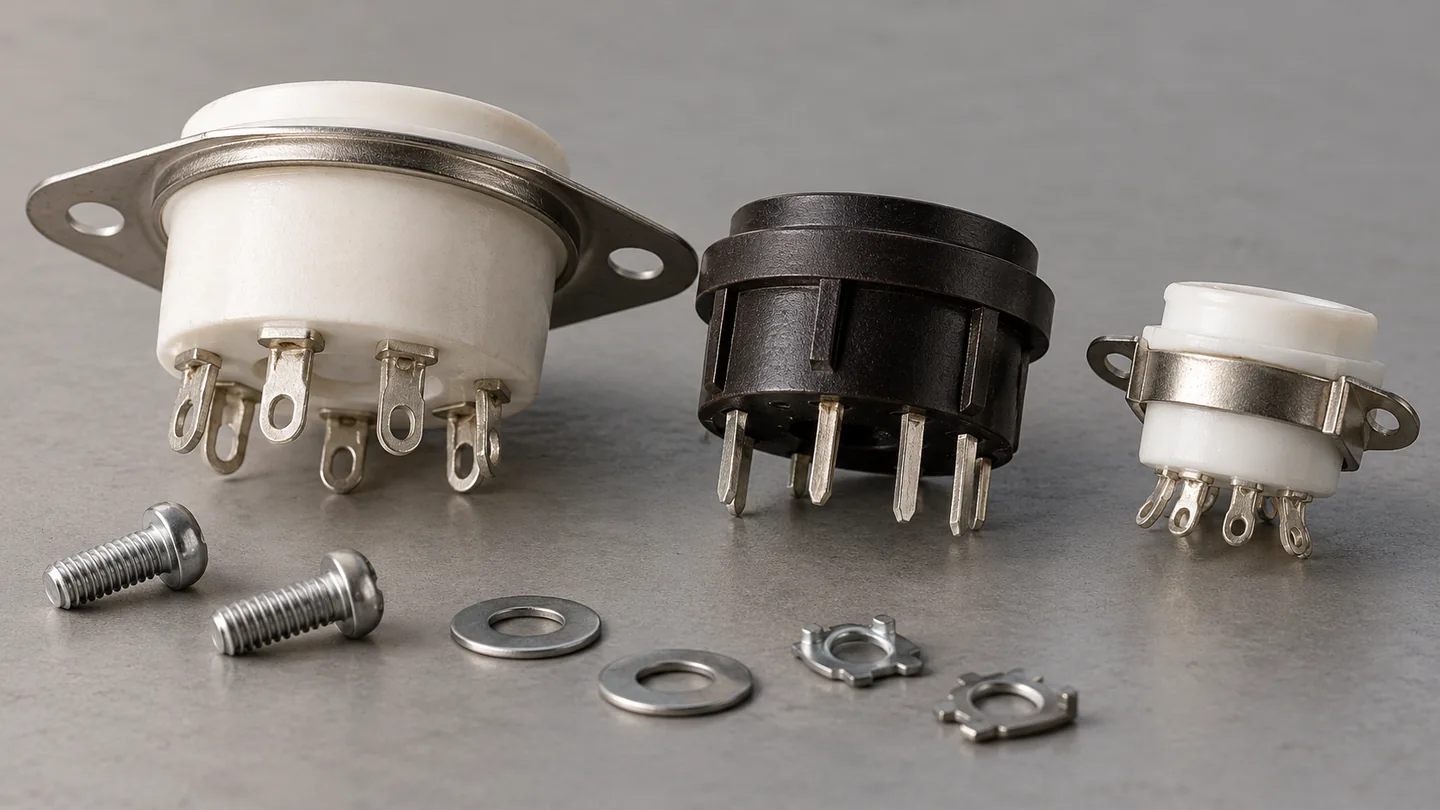
When you plan your layout, you choose between chassis mount sockets for hand-wired builds and PC mount options for circuit boards. An 8-pin Octal socket handles high-power output tubes like 6L6s and EL34s. Meanwhile, a 9-pin Noval socket fits smaller preamp tubes like 12AX7s. You should also install an aluminum tube shield to block RF noise in high-gain preamp stages. Ceramic bases handle heat better than molded phenolic plastic. Phosphor bronze pins maintain tight clamping force through hundreds of thermal cycles.

We bench-tested socket designs from major suppliers, including Ruby Tubes and Surplus Sales of Nebraska. Compare retention force, solderability, and heat tolerance below to pick the best hardware for your next project.

Key Criteria for Evaluating Vacuum Tube Sockets

When you measure contact resistance after fifty thermal cycles, structural build quality immediately separates budget hardware from industrial components. You need specific retention values and temperature ratings to prevent signal dropouts in high-gain audio circuits.

  • Heavy-Duty Ceramic Chassis Mount Sockets: Premium ceramic tube socket units from suppliers like Surplus Sales of Nebraska feature thick steatite bodies and heavy-gauge phosphor bronze contacts. Consequently, these chassis mount designs withstand continuous operating temperatures above 200°C without cracking or insulating loss. You obtain an average pin retention force of 1.2 to 1.8 kilograms per contact pin. As a result, heavy Octal socket power tubes like EL34s remain locked in place during transport.

  • Molded Phenolic PC Mount Sockets: Compact phenolic or Micalex sockets, commonly supplied by Ruby Tubes, target dense circuit board layouts, Because the molded plastic body flexes slightly, it absorbs mechanical stress during tube insertion and protects thin copper traces. However, phenolic material degrades faster under sustained high heat. Therefore, you should limit these PC mount designs to cooler preamp stages housing a 9-pin Noval socket.

  • Contact Metallurgy and Plating Options: Stamped tin-plated contacts oxidize quickly under thermal cycling, which increases contact resistance over time. Premium sockets use silver-plated phosphor bronze or beryllium copper contacts instead. As a result, silver plating keeps contact resistance below 5 milliohms and simplifies high-temperature soldering on the bench. For high-vibration guitar amps, pairing a ceramic base with a spring-loaded tube retainer ensures stable bias voltage under heavy drive conditions.

Primary Vacuum Tube Socket Types by Pin Configuration

To select the right component for your build, you must match these structural properties against your amplifier’s chassis layout and mechanical load. When you evaluate market options, consider how these specific configurations perform under real bench conditions.

  • Belton Micalex 9-Pin Noval Socket (PC Mount): This component works exceptionally well in dense PCB designs. Glass-fiber reinforced Micalex provides higher heat resistance than standard phenolic plastic. Phosphor bronze contacts maintain tight clamping pressure over years of tube swaps. As a result, it accepts a twist-lock tube shield to block stray RF interference in high-gain preamp stages.

  • Heavy-Duty Ceramic Octal Socket (Chassis Mount): For high-voltage power sections, a heavy-duty ceramic tube socket remains the industry standard. Industrial suppliers like Surplus Sales of Nebraska stock these thick ceramic bases with top-flange or bottom-flange metal brackets. Direct chassis mounting radiates heat away from sensitive internal wiring. In high-vibration combo amps, pairing this socket with a spring-loaded tube retainer prevents heavy power tubes from walking out under load.

  • Ruby Tubes Phenolic PC Mount Series: These budget-friendly options fit quick production repairs and low-wattage circuits. The slightly flexible body absorbs mechanical stress during installation, which protects thin PCB copper traces from cracking. However, you should avoid placing these phenolic sockets in high-bias output stages where temperatures regularly exceed 150°C.

UX4 (4-Pin) Sockets for Vintage Triodes and Power Tubes

When you step up to direct-heated power triodes like a 300B or 2A3, standard phenolic material breaks down under the heavy thermal load, making high-spec UX4 sockets mandatory. Large output tubes generate substantial heat at the base, Because of this heat, your socket choice directly impacts tube life and bias stability.

  • Glazed Ceramic Chassis Mount UX4 (Machined Gold Contacts): Heavy industrial ceramic bases handle extreme temperatures above 200°C without cracking. Machined brass contacts with gold plating provide low contact resistance and stop oxidation. You should secure these chassis mount sockets with stainless steel hardware. This prevents mechanical flexing when you insert thick-pin power tubes.

  • Steatite Porcelain UX4 with Spring Collets: Steatite offers superior dielectric strength at high voltages. Spring-loaded collet contacts grip uneven vintage tube pins tighter than stamped metal leaf contacts. As a result, this design prevents high-voltage arcing between the plate and grid pins during transient voltage spikes.

  • Molded Micalex UX4 Sockets: These sockets combine mechanical shock absorption with solid heat tolerance, While they handle heat better than phenolic, they soften if plate current runaway occurs. Use Micalex for lower-wattage vintage triodes like the 45 or 27. However, you should stick to a heavy-duty ceramic tube socket for high-bias power stages.

For high-vibration builds, pair ceramic chassis mount UX4 sockets with a heavy-duty tube retainer. This mechanical coupling keeps large glass envelopes seated firmly and prevents contact wear over years of operation.

B7G (7-Pin) Miniature Sockets

When you step down from heavy four-pin power bases to B7G (7-pin) miniature sockets, physical pin spacing shrinks significantly. Small-envelope tubes like the 6X4 rectifier or 6AU6 pentode dump heat into a compact footprint. Selecting the right B7G socket determines whether your low-level preamp stage remains quiet or develops high-voltage tracking.

  • Steatite Ceramic Chassis Mount B7G Sockets: Steatite ceramic provides excellent dielectric isolation between closely spaced miniature pins. You should choose chassis mount ceramic sockets with integrated shield base skirts for high-gain circuits. These sockets withstand heat past 200°C without tracking or carbonizing during plate over-current events. As a result, fitting a twist-lock tube shield over the skirt grounds external RF interference and locks the glass envelope against severe shock.

  • Molded Micalex PC Mount B7G Sockets: Micalex PC mount sockets absorb mechanical strain when you press small-signal tubes into a circuit board. Consequently, they protect fragile copper traces from lifting during routine maintenance, While Micalex lacks the ultimate temperature rating of a ceramic tube socket, it easily handles standard preamp heat. Make sure your board layout incorporates mechanical mounting screws so insertion forces do not fatigue the solder joints.

  • Beryllium Copper Leaf Contacts: Standard stamped tin contacts loosen after repeated tube insertions. Superior B7G sockets feature heat-treated beryllium copper contacts plated with silver or gold. These spring contacts maintain high contact pressure on thin glass-seal pins over thousands of hours, Because they preserve tight physical tension, they eliminate intermittent contact crackle in high-vibration combo amps.

Octal Socket (8-Pin) Standards for Audio Power Amplifiers

Transitioning from miniature signal layouts to high-power output stages requires socket hardware capable of handling high plate voltages and severe thermal load. You should select a heavy-duty ceramic Octal socket with thick silver-plated phosphor bronze contacts for high-wattage power amplifiers running EL34 or 6L6 tubes. Consequently, ceramic bodies withstand localized envelope temperatures over 250°C without warping or developing conductive arc paths between adjacent pins. For Chassis mount designs, choose sockets with steel mounting flanges and heavy spring clips. As a result, the physical mechanical lock prevents heavy output tubes from backing out of their sockets during road transport.

When designing printed circuit boards for power stages, evaluate PC mount octal designs against mechanical strain requirements. Molded phenolic sockets provide higher mechanical flexibility and vibration absorption compared to rigid ceramics, Because phenolic material flexes slightly under mechanical load, it reduces stress on copper board traces during tube replacements. However, phenolic material degrades faster under sustained extreme heat. For high-bias Class-A output stages, you should specify a ceramic tube socket to avoid long-term heat charring.

  • Belton Molded Micalex Octal Sockets: You get exceptional mechanical pin tension and low stray capacitance with these sockets. As a result, they excel in mid-power push-pull amplifiers where thermal dissipation stays under control. Make sure your board layout incorporates chassis standoffs to prevent circuit board flexing.

  • Machined Ceramic Octal Sockets: Solid ceramic bodies paired with gold-plated spring contacts deliver maximum voltage isolation. Consequently, they eliminate arc-over in high-voltage KT88 power amplifiers running plate voltages above 500V. Combine them with a spring-loaded tube retainer to secure high-mass glass envelopes, While a smaller Noval socket benefits from a full metal tube shield assembly to block noise, octal power stages rely on open airflow and mechanical retention clips. Make sure your chassis layout leaves ample space around each socket base to promote convective cooling across the power tubes.

Socket Material Selection: Ceramic, Phenolic, and Micalex

Beyond layout spacing, you must evaluate socket materials directly against your circuit’s operating temperature and electrical stress. Selecting the wrong material causes socket carbonization, voltage arc-over, or cracked circuit board traces.

  • Ceramic Tube Sockets (Steatite): You should specify a steatite ceramic tube socket for high-power Octal sockets running above 400V. Ceramic withstands temperatures over 200°C without burning. As a result, it stops high-voltage arcing in heavy output stages. However, ceramic lacks mechanical flex. Consequently, socket insertion force can crack a stiff PC mount board if you leave the board unsupported.

  • Micalex Sockets: You should choose molded Micalex for Noval socket preamp designs and high-vibration builds. Micalex handles heat far better than phenolic while absorbing mechanical impact during tube changes. As a result, Micalex PC mount sockets protect thin copper traces from lifting under heavy strain.

  • Phenolic Sockets: You can use phenolic sockets in budget restoration work or low-heat driver circuits. Phenolic provides adequate insulation at moderate temperatures. However, prolonged exposure to heat degrades the resin binder. As a result, phenolic contacts loosen over time and form conductive carbon paths under high voltage.

Select chassis mount styles for heavy power tubes, and pair delicate Noval sockets with a firm tube retainer or tube shield where vibration threatens contact integrity.

Heat Dissipation and Dielectric Performance

Evaluating socket performance under thermal stress requires direct comparison of dielectric strength and heat transfer properties. High-power output tubes generate substantial thermal energy that transfers directly into the socket pins.

  • Ceramic (Steatite) Construction: A steatite ceramic tube socket provides a dielectric breakdown rating above 15 kV/mm at 200°C. As a result, it withstands extreme thermal radiation from EL34 or KT88 Octal socket output tubes without structural breakdown. The material conducts excess heat away from the pin contacts efficiently. Consequently, it prevents contact oxidation in high-current power stages.

  • Micalex Molded Compounds: Molded Micalex yields a dielectric rating near 12 kV/mm while maintaining high mechanical strength, Because of this strength, it absorbs shock during tube insertion better than ceramic. As a result, Micalex Noval socket PC mount designs dissipate moderate heat without cracking adjacent solder pads or thin copper traces.

  • Phenolic Resins: Standard phenolic delivers roughly 8 kV/mm of dielectric insulation under cold conditions. However, continuous exposure to temperatures over 120°C degrades the resin binder matrix. As a result, dielectric strength drops rapidly, causing conductive carbon paths between adjacent pins under high plate voltages.

Mounting style further impacts thermal management. A chassis mount socket transfers heat directly into the metal enclosure, lowering contact temperature. Conversely, PC mount sockets isolate thermal energy on the circuit board. As a result, heavy-duty power circuits require ceramic or Micalex materials to protect the circuit board from heat degradation.

Contact Metallurgy: Gold-Plated vs. Silver and Tin Contacts

Beyond insulation substrate selection, contact metallurgy determines long-term pin impedance and noise performance across thermal cycles.

  • Gold-Plated Beryllium Copper Contacts: Gold plating resists atmospheric oxidation permanently. As a result, gold contacts prevent signal micro-flicker in low-level preamplifier Noval socket applications. However, soft gold layers rub off after repeated tube insertion cycles. Consequently, base copper exposure causes localized oxidation under high operating temperatures. You should specify gold plating primarily for low-current grid circuits where voltage stability overrides mechanical wear.

  • Silver-Plated Phosphor Bronze Contacts: Silver provides the lowest initial electrical resistance among commercial socket contacts, Because silver reacts with airborne sulfur compounds, it forms a surface tarnish layer over time. Fortunately, high pin wiping pressure scrapes away this non-conductive sulfide film during tube insertion. As a result, silver contacts maintain superior current transfer in high-power Octal socket stages.

  • Tin-Plated Spring Steel Contacts: Tin coatings offer a budget option for light-duty audio circuits. However, continuous thermal cycling above 100°C accelerates fretting corrosion at the contact boundary. As a result, micro-fretting builds non-conductive tin oxide layers that increase contact resistance. Consequently, this resistance causes intermittent bias drift and pop noise in power stages.

When building heavy-duty chassis mount or PC mount gear, match silver contacts with high-current output tubes. Reserve gold contacts for delicate input stages to maintain a silent noise floor.

Mounting Styles: Chassis Mount vs. PC Mount Sockets

Beyond contact plating, you must evaluate physical mechanical strength when choosing between chassis mount and PC mount hardware for high-power amplifiers, Because high-current tubes transfer significant thermal energy to the surrounding chassis, direct chassis mounting remains the superior choice for high-wattage power stages.

  • Heavy-Duty Ceramic Chassis Mount Octal Socket: A ceramic tube socket handles severe thermal loads without structural softening, Because ceramic isolates heat away from surrounding components, chassis mount configurations allow you to wire high-power output tubes safely. Furthermore, top-mount flange designs let you secure a spring tube retainer directly to the metal chassis. Consequently, this mechanical arrangement holds heavy power tubes securely during transport.

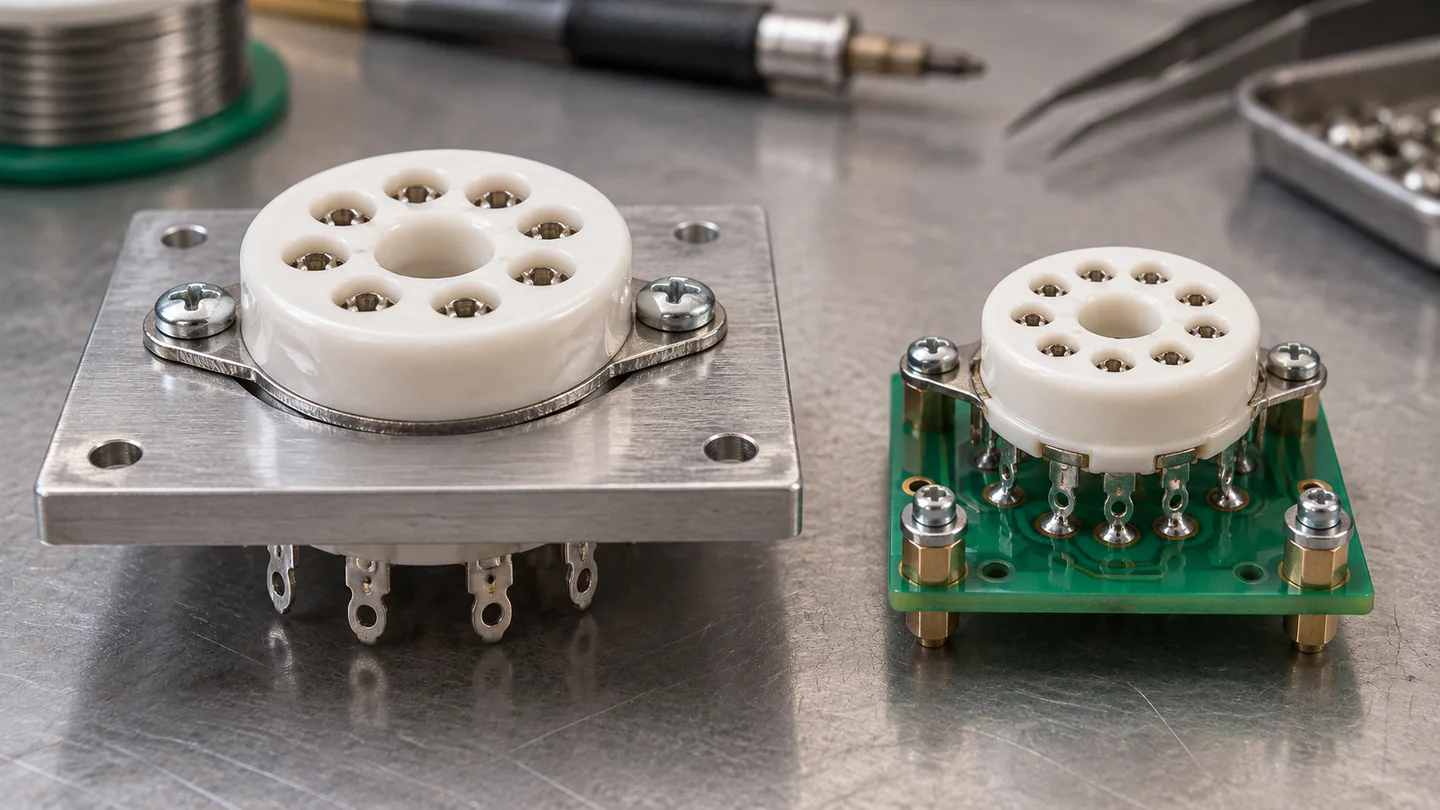
  • Micalex or Ceramic PC Mount Noval Socket: For low-noise preamp circuits, a PC mount Noval socket allows clean, efficient PCB integration, Because preamp tubes generate minimal ambient heat, solder joints remain stable under standard operating conditions. You can ground a twist-lock metal tube shield directly to the PCB ground plane. As a result, this shield blocks external electromagnetic interference from entering high-impedance grid pins.

  • Bottom-Mount Chassis Octal Socket: Bottom-mount chassis sockets provide convenient access in hand-wired builds, Because the socket mounts beneath the chassis opening, lead lengths to control potentiometers remain extremely short. Consequently, shorter wire runs reduce stray capacitance and preserve high-frequency signal clarity in custom audio gear.

Surface and Sub-Chassis Mounting Techniques

When you select a mounting style for high-performance builds, top-surface chassis mounting offers distinct mechanical advantages over sub-chassis mounting, Because surface-mounted chassis sockets place the mounting flange above the metal cutout, the chassis bears the full mechanical load when you insert or remove tubes. As a result, you eliminate strain on the mounting screws and prevent metal fatigue around the cutout edges.

Sub-chassis mounting lowers the physical tube height inside the enclosure. Consequently, this technique provides extra clearance in shallow rack cases while maintaining short wire runs, Because the socket sits beneath the metal panel, you must use high-grade ceramic tube socket designs to maintain proper electrical isolation between pin terminals and raw chassis edges.

  • Surface-Mounted Ceramic Octal Socket: This layout handles heavy power tubes best, Because the top flange rests directly against the panel, mechanical downward force distributes evenly across the metal. You can install a spring-loaded tube retainer onto the outer mounting holes to prevent tube walk under high vibration.

  • Sub-Chassis Mounted Noval Socket: This setup works exceptionally well for small-signal triodes in compact audio gear, Because sub-chassis placement sinks the base pin line below the panel surface, a push-and-twist tube shield locks directly into a grounded metal baseplate mounted above the cutout. As a result, this physical barrier isolates delicate input stages from ambient magnetic hum and radio frequency interference.

Printed Circuit Board Integration and Mechanical Stress Relief

When you integrate these components directly onto circuit boards rather than using traditional chassis mount wiring, mechanical stress management becomes your primary design priority, Because direct thermal transfer from miniature triodes degrades FR4 material, a ceramic tube socket with elevated solder pins lifts the tube base clear of the board. Consequently, solder joints experience minimal thermal expansion cycling over long operating periods. When you push a valve into an unreinforced PC mount Noval socket, insertion force flexes the copper traces. As a result, choosing sockets with wide solder pads and thick pins prevents trace lifting during maintenance, Because heavy octal power tubes exert substantial leverage, standard PC mount designs often fail under repeated tube swaps. A traditional chassis mount Octal socket eliminates this failure point by transferring mechanical loads directly to the panel cutout. However, if your layout requires a PC mount Octal socket, select designs with integral metal mounting ears that bolt to the frame. Consequently, mechanical forces bypass the solder joints and route directly into the enclosure walls, Because high-gain stages pick up cabinet vibration, mechanical retention choice directly impacts signal purity. Installing a spring-loaded tube retainer onto a ceramic tube socket secures large power tubes against vibration walk. For small-signal Noval socket layouts, combining a base-mounted tube retainer with a grounded tube shield eliminates microphonics while blocking ambient electromagnetic hum.

Essential Accessories: Tube Shields, Retainers, and Adapters

Because shielding and retention hardware attach directly to the socket body, your choice of base material dictates overall mechanical stability. Glazed ceramic tube socket models handle high heat better than phenolic alternatives. Consequently, ceramic substrates prevent surface tracking when high voltages arc across adjacent pins.

  • Glazed Ceramic Sockets: Because ceramic withstands extreme operating temperatures, these sockets suit high-dissipation power stages. Premium Noval socket variants include integral spring-steel base rings. As a result, a metallic tube shield locks firmly into place to provide direct grounding.

  • Micalex and Molded Phenolic Sockets: Micalex offers superior dielectric insulation at radio frequencies compared to standard phenolic materials, Because phenolic degrades under prolonged thermal stress, you should limit its use to low-power signal stages. Consequently, high-power Octal socket positions require ceramic or Micalex construction to survive long duty cycles.

  • Chassis Mount vs. PC Mount Hardware: Heavy-duty chassis mount sockets route mechanical stresses into the enclosure panel. PC mount sockets rely on circuit board traces for support. As a result, top-tier PC mount designs utilize reinforced mounting ears. These ears transfer physical forces directly to the chassis frame.

When you select hardware for high-vibration environments, match the base socket with a heavy-gauge stainless steel tube retainer, Because aluminum shield covers compress dampening springs directly against the valve glass, microphonic feedback drops dramatically in sensitive preamplifier stages.

Selecting the Right Tube Retainer for High-Vibration Environments

To secure those spring-compressed glass envelopes against intense vibration, you must evaluate how socket designs interface with retainer hardware.

  • Ceramic Noval Socket with Shield Base:
    Because high-gain preamp tubes generate localized thermal stress, a ceramic tube socket handles heat without warping. Consequently, the pin contacts remain aligned during heavy mechanical shock. You should pair a Noval socket with a chassis mount base collar. As a result, the twist-lock aluminum tube shield grounds ambient hum and clamps the valve firmly in place.

  • Micalex Octal Socket with Spring Retainer:
    Power stages require maximum structural stability, Because Octal socket power tubes experience strong physical vibration in road amplifiers, a Micalex chassis mount socket provides high dielectric insulation and mechanical stiffness. You must attach a spring-loaded stainless steel tube retainer directly to the socket flange. Consequently, the retainer springs prevent heavy tubes like EL34s or 6L6s from loosening in their receptacles.

  • Reinforced PC Mount Ceramic Sockets:
    Standard PC mount sockets transfer mechanical fatigue directly into delicate solder joints. As a result, continuous chassis vibration breaks circuit connections over time. You should select PC mount sockets featuring metal mounting ears that bolt directly to the enclosure frame, Because these metal ears absorb physical strain, your circuit board traces stay intact during transit.

Using Socket Adapters and Noise-Reduction Shields

Beyond raw mechanical isolation, your socket selection directly dictates shield compatibility and high-frequency noise rejection, Because a glazed ceramic Noval socket withstands extreme thermal cycling without structural degradation, it remains the top choice for high-gain preamp stages. You can easily attach a grounded twist-lock aluminum tube shield to its metal collar. As a result, ambient hum stays well below your signal floor while the ceramic body prevents high-voltage arc tracking between pins.

For high-power amplifier stages, a Micalex Octal socket offers distinct electrical advantages, Because Micalex maintains superior dielectric strength under heavy RF loads, high plate voltages will not degrade the insulation between contacts. You should pair this socket with a dual-spring stainless steel tube retainer for chassis mount applications. Consequently, the retainer holds heavy power tubes firmly during transit while the Micalex base absorbs thermal spikes.

Standard phenolic PC mount sockets perform less effectively under continuous thermal load, Because phenolic resin absorbs atmospheric moisture over time, leakage currents gradually increase between adjacent pins. As a result, you must restrict phenolic sockets to low-power drive stages where physical heat remains minimal.

FAQ About vacuum tube sockets

What is the difference between Octal and Noval vacuum tube sockets?

You distinguish octal and noval sockets by pin count and alignment method. You mount octal sockets to fit larger eight-pin power tubes. You align these tubes using a central plastic keyway in the middle of the base. You choose noval sockets for smaller miniature tubes with nine thin pins in a circle. You align noval tubes by matching the pin gap to the blank space on the socket.

You find octal sockets in power amp stages driving tubes like the 6L6. You encounter noval sockets in preamp stages holding tubes like the 12AX7. When you install a noval tube, line up the wide pin gap and press the glass base into place to prevent bent pins.

Are ceramic tube sockets superior to phenolic or plastic sockets?

You gain superior heat resistance and better high-voltage insulation when you choose ceramic sockets. You see phenolic material degrade over time under heat, where the plastic cracks and conducts electricity. You can use phenolic or plastic sockets for small preamp tubes like a 12AX7 because these tubes generate minimal heat.

When you build or repair a high-power amplifier running EL34 output tubes, select ceramic sockets. You prevent heat from carbonizing the socket base, which protects your output transformer from a direct short circuit.

How do vacuum tube socket adapters work for tube swapping?

You plug a tube adapter into your amplifier’s original socket and insert your alternative tube into the top of the adapter. Manufacturers wire the top socket pins to different bottom pins inside the adapter casing. With this setup, you re-route electrical pathways to match the new tube pin layout without soldering new sockets into your chassis. Amp designers align each pin path, such as grid and plate connections, so you send proper voltages to each terminal.

For example, you can use an adapter to run an eight-pin 6SN7 tube in a standard nine-pin 12AX7 socket. Check your transformer specs before swapping, because larger replacement tubes draw more heater current from your power supply.

Disclaimer: The technical data and parameters provided are based on common industry scenarios and personal experience. Always verify with specific manufacturer datasheets before practical application.

Leave a Comment

Your email address will not be published. Required fields are marked *

Scroll to Top