
The tube number alone cannot tell you whether a replacement needs a bias adjustment. The amplifier’s circuit and the maker’s instructions decide. Check the exact model before ordering and include a technician’s bias service in the budget if the maker requires it.
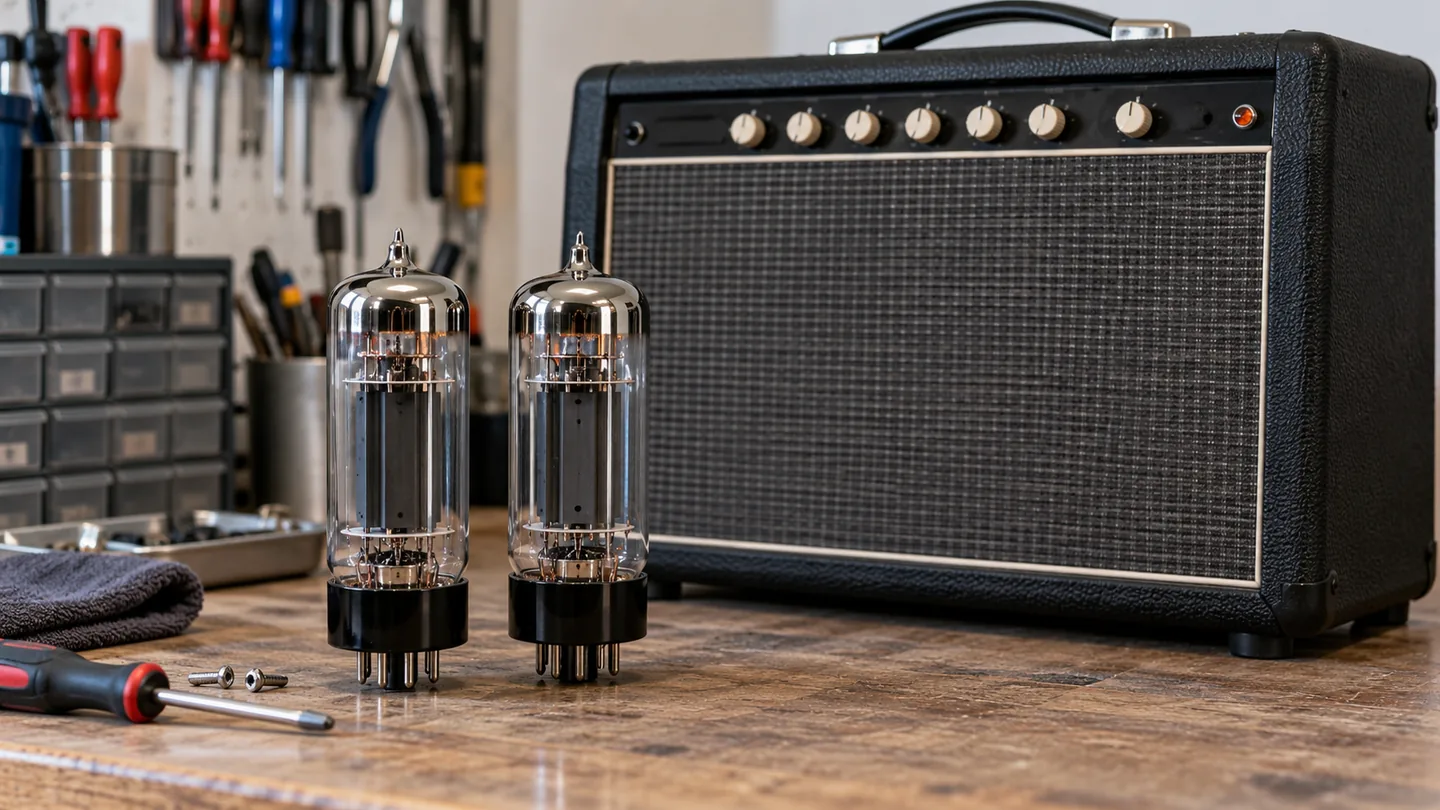
Illustrative image; not a photograph of a specific product.
What the question usually hides
A Reddit discussion asks whether the same tube type still needs biasing. In another thread, an owner wonders whether muddy sound calls for new tubes or a bias check. These are two decisions: confirming a fault and setting the operating point after a replacement. Changing bias is not a universal cure for vague tonal changes.
Manufacturers document distinct designs. Marshall says the JVM410’s power valves need biasing when replaced, while its 1974X support page says replacement valves do not require biasing because that model is cathode biased. MESA describes its own selection system, which assumes tubes tested to its specified range; the Badlander 100 manual separately requires its EL34/6L6 bias-switch setting to match the installed type. “No adjustment” therefore does not mean that tube choice or an available bias switch can be ignored. None of these policies should be transferred to an unrelated amplifier.
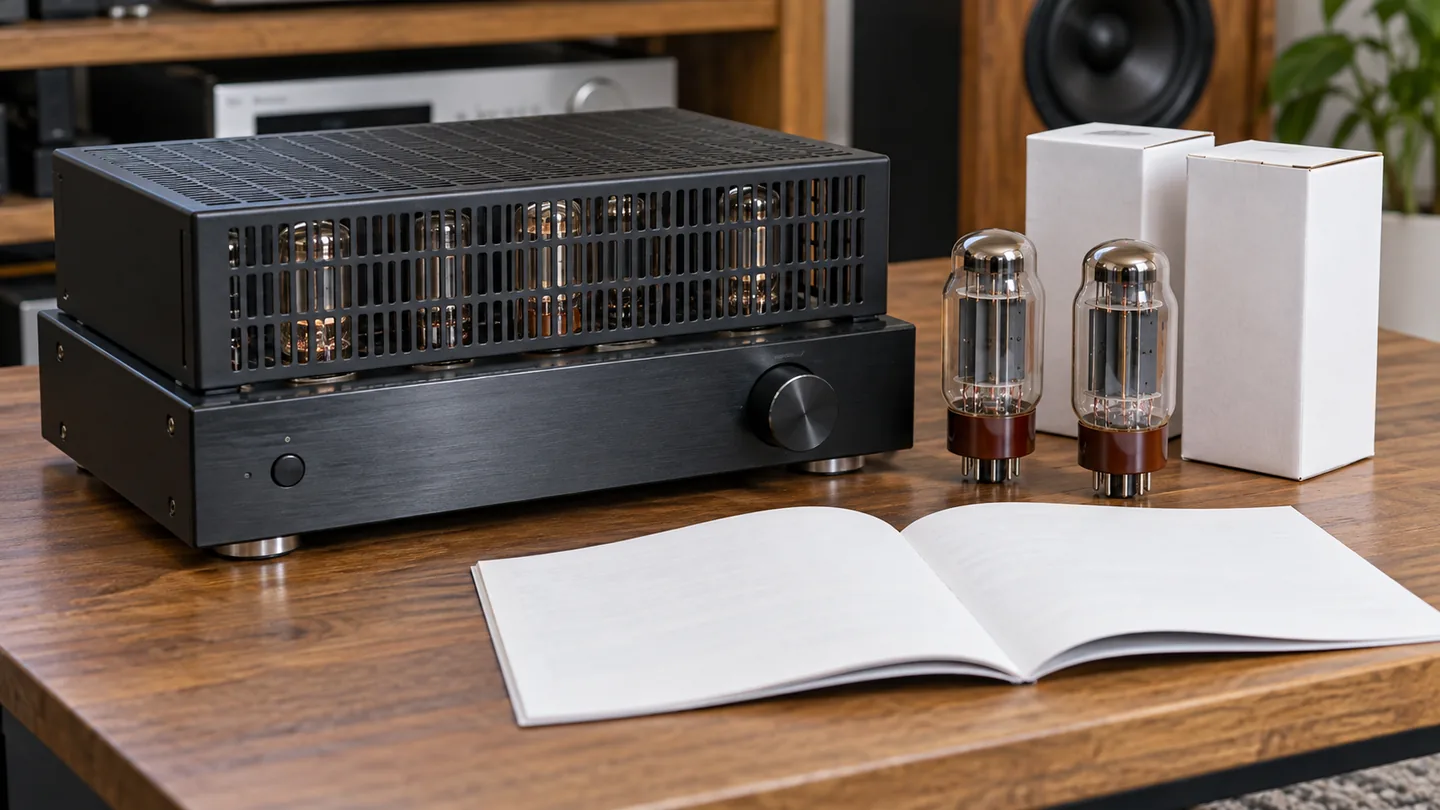
A safe replacement decision
- Confirm the exact model and revision from the chassis label and manual.
- Identify the original power-tube type and maker-approved replacements.
- Find the manufacturer’s instruction on matching, grading, and bias after replacement.
- Check whether the maker specifies an external tube-type switch, an adjustable bias procedure, or selected replacement tubes. Follow only the user-accessible steps in that exact manual; if internal measurements or adjustment are required, arrange qualified service.
- If the original symptom includes red-plating, a blown fuse, loud hum, or burning smell, ask for diagnosis before installing another set.
Do not confuse fixed bias with no bias adjustment. Fixed bias names a circuit approach; it does not say whether a particular amplifier needs an adjustment, a specified tube grade, or a switch change. Conversely, cathode bias does not license every power-tube substitution.
Before paying, write down the approved tube type, required set size or grade, and any bias service. If a tube failed abnormally, arrange diagnosis as well; a replacement order alone will not explain why it failed.
Sources
- Reddit: Bias with the same tube type?
- Reddit: Could bias drift?
- Marshall: JVM410
- Marshall: 1974X
- MESA/Boogie: Badlander 100 owner’s manual — model-specific EL34/6L6 bias-switch instruction.
- MESA/Boogie: selected replacement tubes — manufacturer’s explanation of its tube-selection policy.