
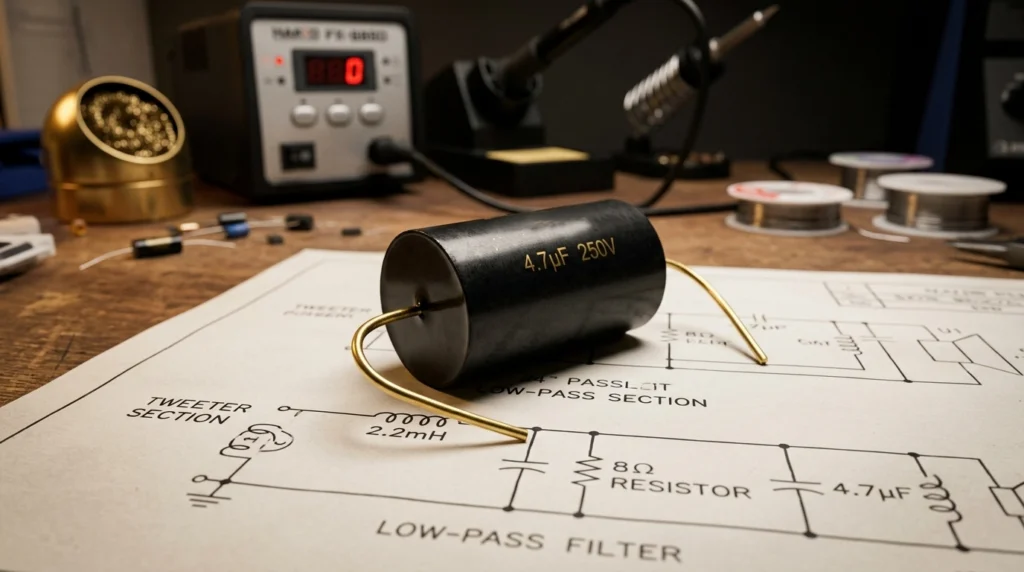
Upgrading your crossover components is the most direct way to improve loudspeaker clarity. If you are looking for premium audio capacitors for sale, you need components that handle high voltage and maintain low equivalent series resistance (ESR).
As a bench technician, I know that selecting the right capacitor directly changes your system’s output. Premium brands offer distinct physical designs and dielectric materials. For instance, the Jantzen Audio Z-Cap delivers excellent transient response in high-frequency circuits. Meanwhile, Mundorf film capacitors and ClarityCap options provide the precise capacitance values required for critical signal paths.
To get the best results, you must match the voltage ratings and tolerances to your schematic. Our stock features fully tested, premium components ready for your next restoration project. Compare pricing and specifications below to find the exact match for your upgrade.
Choosing the Right Premium Audio Capacitors for Sale
To find that exact match, you must first narrow down your selection based on the physical and electrical demands of your circuit. When you browse premium audio capacitors for sale, you will quickly find that different brands serve highly distinct roles on the test bench. For instance, demanding speaker building projects require robust crossover components that can handle high AC currents without thermal runaway. Consequently, choosing between a Jantzen Audio Z-Cap, a Mundorf MCap EVO Oil, or a ClarityCap metallized polypropylene option depends entirely on your exact circuit placement. On the bench, I categorize these parts by their construction, dielectric efficiency, and target application.
| Brand & Series | Dielectric Material | Typical Application | Key Bench Advantage |
|---|---|---|---|
| Mundorf MCap EVO Oil | Oil-impregnated Polypropylene | High-frequency crossover networks | Enhanced micro-dynamics and low ESR |
| Jantzen Audio Superior Z-Cap | High-grade Metallized Polypropylene | Tweeter series signal paths | Fast transient response, ultra-low inductance |
| ClarityCap CSA Series | Polypropylene with CopperConnect | Critical signal paths & midranges | Minimizes internal mechanical resonance |
As a direct result of these physical differences, each capacitor series changes how your driver behaves. For this reason, you need to match your budget and performance goals to the engineering profile of the component. If you are rebuilding a high-frequency network, you must prioritize low-loss dielectrics to preserve detail. Conversely, if you are working on large woofer shunts, a more cost-effective but stable film capacitor is often the smarter practical choice. Take a look at the core specifications below to plan your purchasing strategy.
Mundorf: German-Engineered Precision (EVO Oil & Supreme Series)
To execute a precise upgrade, you should start by evaluating the Mundorf MCap EVO Oil and Supreme series. When searching for premium audio capacitors for sale, you must understand how these two designs function on the test bench. The MCap EVO Oil utilizes an asymmetrical winding process that reduces the physical footprint while maintaining low internal resistance. Consequently, this design minimizes signal loss in high-frequency crossover networks.
If your project demands absolute phase accuracy, you need to step up to the Mundorf Supreme series instead. This series uses a specialized induction-free winding technique where two separate capacitor coils are interleaved, Because these coils run in opposite directions, their parasitic inductances cancel each other out. As a direct result, you get incredibly fast transient response times in critical series tweeter paths.
In terms of sourcing, these components offer exceptionally tight tolerances, often within two percent. This precision ensures that your left and right speaker channels remain perfectly matched. For this reason, prioritizing these German-engineered parts prevents channel imbalance issues during your speaker building projects, While the Supreme series carries a premium price, the EVO Oil serves as a highly cost-effective alternative for midrange shunts. Ultimately, you must balance your component budget against the specific circuit slot to maximize your return on investment.
Jantzen Audio: High-End Crossover Components (Amber Z-Cap)
If you decide to allocate a significant portion of that budget to the critical series tweeter path, you must evaluate Jantzen Audio crossover components next. As a direct result of their specialized copper-foil construction, these parts offer distinct advantages for high-frequency filtering.
Specifically, you need to source the Amber Z-Cap when designing reference-grade speaker building projects. This capacitor utilizes pure copper foil interleaved with ultra-thin polypropylene dielectric films. For this reason, you achieve exceptionally low equivalent series resistance (ESR) and minimal dielectric absorption, Because copper foil adds significant physical mass, you must secure these heavy components mechanically to your layout board. As a direct result, you prevent microphonic vibrations from modulating the audio signal inside the pressurized speaker cabinet.
| Capacitor Series | Foil / Electrode Material | Voltage Rating (VDC) | Recommended Crossover Slot | Relative Cost |
|---|---|---|---|---|
| Amber Z-Cap | Pure Copper Foil | 200 VDC | Tweeter Series | Premium |
| Alumen Z-Cap | Pure Aluminum Foil | 100 VDC | Midrange Series / Tweeter | High-End |
| Superior Z-Cap | Metallized Polypropylene | 800 VDC | Tweeter Series / Shunts | Mid-Range |
When purchasing these parts, you must match the physical footprint to your crossover board space. The Amber Z-Cap is significantly larger than standard metallized film options like ClarityCap or the Mundorf MCap EVO Oil. For this reason, you need to measure your layout clearances before finalizing your purchase. Ultimately, integrating these Jantzen Audio components into your passive networks ensures maximum signal preservation where your budget permits.
ClarityCap & Solen: Reliable Performance for Custom Builds
When your budget limits the use of premium Jantzen Audio or Mundorf parts, you must pivot to industrial-grade workhorses like ClarityCap and Solen. As a direct result, you secure highly reliable crossover components without overspending on diminishing returns. For critical high-frequency signal paths, you need to select the ClarityCap CSA series, which utilizes unique copper-purity end caps. For this reason, you achieve minimal ESR and clean transient propagation without paying the premium price of a pure copper foil Z-Cap.
Conversely, for parallel shunt positions or low-pass woofer networks, you must use Solen Fast Caps. As a direct result, you manage budget efficiency while maintaining low dielectric loss where high capacitance values are mandatory.
| Capacitor Series | Primary Dielectric / Feature | Typical Tolerance | Best Application Slot | Cost-to-Performance Ratio |
|---|---|---|---|---|
| ClarityCap CSA | Metallized Polypropylene / CopperConnect | ±3% | Tweeter Series / Midrange | Excellent |
| Solen Fast Cap (PPE) | Metallized Polypropylene / Fast-rise geometry | ±5% | Woofer Shunts / Power Supplies | Maximum Value |
When building crossovers with these parts, you need to orient the Solen capacitors away from large air-core inductors. For this reason, you prevent stray magnetic fields from inducing crosstalk in your filter networks. If your speaker building goals require precise channel matching, you must hand-measure these capacitors with a dedicated LCR meter before installation. As a direct result, you ensure the left and right speakers remain perfectly symmetrical, even when using budget-friendly audio capacitors for sale.
Key Specifications for Audiophile Capacitor Upgrades
Selecting these components from the wide selection of audio capacitors for sale requires a strict analysis of your system’s voltage and capacitance requirements. For this reason, you must verify the DC voltage rating (VDC) of any replacement capacitor to ensure it exceeds your circuit’s peak operating voltage by a minimum of 50%. As a direct result, you ensure long-term dielectric stability and prevent catastrophic insulation breakdown under high-power transient conditions.
When sourcing crossover components for DIY speaker building, you must match the physical dimensions of premium options to your available cabinet space. For instance, high-quality metallized film designs like the Mundorf MCap EVO Oil or the Jantzen Audio Amber Z-Cap offer exceptional electrical parameters. their physical size is often triple that of standard electrolytic parts. Consequently, you must plan your layout before purchasing.
If you are sourcing parts for a passive filter network, prioritize low tolerance ratings to preserve your crossover slopes:
-
Tweeter Networks: Select Jantzen Audio or ClarityCap parts with a ±3% tolerance or better to maintain precise high-frequency imaging.
-
Low-Frequency Shunts: Standard ±5% metallized polypropylene parts remain the most practical choice to control costs while maintaining low loss.
Ultimately, sourcing the right audio capacitors for sale comes down to balancing raw electrical specifications against your project’s physical and economic constraints. By avoiding overly hyped exotic materials and focusing strictly on low dissipation factors and tight tolerances, you can achieve reference-grade system performance without unnecessary expense.
Understanding Capacitance and Voltage Ratings (VDC)
To transition these performance goals into a physical build, you must calculate the exact capacitance and DC voltage (VDC) ratings required for your circuit. Buying premium parts without verifying these parameters wastes both budget and chassis space.
In passive crossover networks, capacitance values are fixed by your crossover frequency math. However, the voltage rating of your audio capacitors for sale determines their physical size and reliability, While a speaker signal is AC, crossover components are rated in VDC.
For this reason, you must select VDC ratings that exceed your system’s peak AC voltage by at least 1.5 times. As a direct result, you ensure the dielectric material remains stable under sustained thermal and electrical stress.
For high-voltage tube amplifier coupling, you will need 400VDC to 630VDC parts. Conversely, for speaker building projects, 250VDC is typically the cost-effective sweet spot. The table below outlines how to match your application to specific premium options.
| Application | Typical Capacitance | Recommended VDC | Recommended Series |
|---|---|---|---|
| Tweeter High-Pass Filter | 1.0 µF – 10 µF | 250V – 800V | Jantzen Audio Amber Z-Cap / Mundorf MCap EVO Oil |
| Midrange / Woofer Shunt | 10 µF – 100 µF | 100V – 250V | ClarityCap CSA / Solen Fast Cap |
| Tube Coupling / Bypass | 0.01 µF – 1.0 µF | 400V – 630V | Mundorf Supreme / Jantzen Alumen Z-Cap |
Do not pay a premium for high VDC ratings where they are not required. A 630V capacitor is physically larger than a 250V equivalent. This size difference complicates your layout and increases lead inductance. Keep your selections mathematically aligned with your actual circuit demands to maximize performance per dollar.
Dielectric Materials: Film vs. Electrolytic
Achieving this mathematical alignment requires a strict technical assessment of film versus electrolytic dielectrics, as this choice directly dictates both your component budget and circuit distortion. Consequently, when browsing premium audio capacitors for sale, you must select the dielectric material based on its position in the signal path rather than subjective marketing descriptions.
For speaker building projects, non-polarized electrolytic (NPE) capacitors offer high capacitance in compact, inexpensive packages. However, these components suffer from higher dissipation factors and parasitic resistance. Therefore, you should restrict electrolytics to parallel shunt positions in low-pass woofer networks where their higher Equivalent Series Resistance (ESR) is less detrimental to system performance.
In contrast, critical signal paths and high-frequency crossover components demand film capacitors. Metallized polypropylene (PP) options, such as the Jantzen Audio Z-Cap series or ClarityCap CSA, provide exceptionally low dissipation factors and long-term parameter stability. For high-frequency networks, upgrading to a premium Mundorf MCap EVO Oil capacitor minimizes dielectric absorption and ensures precise signal transmission.
| Parameter | Metallized Polypropylene Film | Non-Polarized Electrolytic (NPE) |
|---|---|---|
| Dissipation Factor (at 1 kHz) | < 0.0002 | 0.0500 to 0.1000 |
| ESR (Equivalent Series Resistance) | Extremely Low (mΩ range) | Moderate to High (Ω range) |
| Parameter Drift Over Time | Negligible (< 1% over decades) | High (dielectric dries out) |
| Relative Cost per µF | High | Low |
As a practical rule, do not buy expensive film capacitors for high-value parallel shunts where a budget-friendly alternative performs identically. Instead, allocate your upgrade budget to high-pass series positions where low-loss film capacitors yield measurable performance gains.
Applications of Audio Grade Capacitors in Hi-Fi Systems
finding the right audio capacitors for sale requires targeting specific circuit nodes rather than replacing every component blindly. For this reason, your purchasing decisions must be guided by objective performance metrics and physical space limitations. If you are sourcing parts for speaker building, you will primarily look for low-loss crossover components like the Jantzen Audio Alumen Z-Cap or ClarityCap CSA. These parts offer the low dissipation factors required to preserve signal integrity at critical high-frequency junctions.
In contrast, tube coupling upgrades demand entirely different electrical profiles. For example, upgrading a high-voltage path with a Mundorf MCap EVO Oil capacitor ensures excellent thermal stability under high electrical tension. To achieve the best return on investment, you must verify the physical footprint of these premium components against your circuit layout before completing your purchase. Over-specifying voltage ratings increases physical size, which often prevents a clean installation. Therefore, when evaluating premium components for your next project, prioritize precise tolerances and low equivalent series resistance (ESR) to ensure measurable hardware optimization.
Specifically, Jantzen Audio options provide exceptional value for passive crossover networks, while Mundorf products excel in high-voltage decoupling. For this reason, reputable retailers categorize these products by voltage rating, dielectric material, and lead configuration to simplify your selection. Focusing strictly on these physical and electrical parameters prevents costly layout revisions during assembly.
Optimizing Speaker Crossover Networks
Applying these physical and electrical parameters directly informs how you select crossover components for speaker building projects. When sourcing audio capacitors for sale, you must distinguish between high-pass series positions and parallel shunts. Consequently, allocating premium, low-loss film capacitors to series paths yields measurable performance gains. For parallel shunts, however, budget-friendly options perform identically to premium components. Therefore, do not waste capital on over-specified parts where basic electrical properties suffice.
For this reason, analyze the schematic to determine the exact capacitance values and physical dimensions required before making a purchase. For critical high-pass tweeter networks, prioritize the Jantzen Audio Alumen Z-Cap or ClarityCap CSA. These components provide the incredibly low dissipation factors needed to preserve high-frequency detail. If your circuit board space is limited, choose the compact Mundorf MCap EVO Oil. This series provides high thermal stability and premium performance in a smaller footprint.
The table below compares the primary premium crossover components available for purchase:
| Capacitor Series | Optimal Crossover Position | Key Metric (Dissipation Factor) | Physical Size Profile | Relative Cost |
|---|---|---|---|---|
| Jantzen Audio Alumen Z-Cap | Series (High-Pass) | Extremely Low (< 0.0001) | Large cylindrical | High |
| ClarityCap CSA | Series / Parallel Midrange | Low (< 0.0007) | Standard axial | Moderate |
| Mundorf MCap EVO Oil | Series (Compact Layouts) | Low (< 0.0015) | Slim radial/axial | Moderate |
| Standard Polypropylene (Solen) | Parallel Shunt (Woofer) | Standard (< 0.0050) | Medium axial | Low |
In summary, optimize your budget by reserving high-cost components for the direct signal path. Consequently, you will achieve the best measurable performance return without overspending on parallel shunts.
Upgrading Tube Amplifiers and Preamps
Applying this exact budget allocation strategy to tube electronics requires transitioning from low-voltage crossover components to high-voltage audio capacitors for sale. Specifically, you must isolate the high DC bias voltages of the plate from the grid of the following tube stage. For this reason, coupling positions demand low-loss film capacitors with high voltage ratings and exceptionally low leakage current. If you select an under-specified capacitor, leakage current will shift the operating bias of the subsequent tube stage. Consequently, this bias shift causes severe harmonic distortion or catastrophic thermal runaway. Therefore, allocate your budget toward premium, high-voltage film series to ensure long-term circuit stability.
When sourcing components for tube amplifiers, prioritize physical size constraints alongside electrical specifications. For example, upgrading an amplifier with Mundorf MCap EVO Oil or Jantzen Audio Z-Cap series requires verifying the chassis clearance first. These premium film capacitors are significantly larger than the vintage paper-in-oil or electrolytic units they replace. As a result, you must measure the lead spacing and vertical clearance on the circuit board before finalized purchases.
The table below outlines the high-voltage options suitable for tube amplifier and preamplifier upgrades:
| Capacitor Series | Voltage Rating (VDC) | Capacitance Range (µF) | Target Position | Price Tier |
|---|---|---|---|---|
| Mundorf MCap EVO Oil | 450V – 650V | 0.01 – 100 | Interstage Coupling | Moderate |
| Jantzen Audio Silver Z-Cap | 800V – 1200V | 0.10 – 22 | High-Voltage Grid Coupling | High |
| ClarityCap ESA | 250V – 630V | 0.10 – 10 | Preamplifier Output Stage | Moderate |
For power supply decoupling positions, you do not need ultra-exotic series. Instead, select reliable, high-temperature electrolytic capacitors with low equivalent series resistance to suppress hum. Save your premium film components exclusively for the interstage coupling paths where they directly protect and preserve the audio signal.
What to Look for When Browsing Audio Capacitors for Sale
When buying premium audio capacitors for sale, match each component to its exact circuit role to avoid wasting money. Specifically, purchasing high-voltage film capacitors for low-voltage speaker crossovers is an expensive engineering error. For this reason, you need to segregate your shopping list by application.
For speaker building and crossover networks, focus on high-current handling and low dissipation factor. Consequently, non-polarized, high-capacitance parts like the Jantzen Audio Z-Cap series or ClarityCap options are highly effective crossover components. These parts manage the heavy current demands of passive speaker filters without degrading the signal.
Alternatively, if you are upgrading a tube amplifier’s signal path, focus on voltage-rated film designs. Specifically, the Mundorf MCap EVO Oil series provides the excellent dielectric strength required for coupling high-voltage plate stages.
As a result of these distinct physical demands, never buy a capacitor based on marketing buzzwords alone. Instead, prioritize verified datasheets containing ESR ratings, physical dimensions, and lead configurations. Whether you are rebuilding a vintage amplifier or assembling new speaker crossovers, buying the correct component ensures circuit reliability.
Tolerances and ESR (Equivalent Series Resistance)
Securing this circuit reliability requires a strict evaluation of capacitor tolerances and Equivalent Series Resistance (ESR) when browsing audio capacitors for sale. Specifically, loose component tolerances degrade stereo imaging by shifting crossover filter slopes between your left and right channels. For this reason, premium crossover components like the Jantzen Audio Z-Cap series offer tight 2% tolerances to preserve acoustic symmetry. Consequently, using mismatched, high-tolerance parts in speaker building projects results in an uneven frequency response.
Equivalent Series Resistance (ESR) represents another critical metric because it dictates energy loss within the component. As a result of high ESR, a capacitor generates unwanted thermal dissipation and dampens transient response. Instead of installing generic industrial parts, system builders should select low-ESR options designed for audio signal paths. Specifically, the Mundorf MCap EVO Oil or various ClarityCap series provide the exceptionally low ESR required for clean high-frequency pass-through.
The table below outlines the electrical performance benchmarks you must target when sourcing these components:
| Application | Recommended Dielectric | Target Tolerance | Target ESR | Recommended Series |
|---|---|---|---|---|
| Speaker Crossover | Metallized Polypropylene | \le 5% (Ideally 2%) | < 0.05 \Omega | Jantzen Audio Z-Cap / ClarityCap |
| Tube Signal Coupling | Oil-Impregnated Film | \le 10% (Ideally 5%) | < 0.5 \Omega | Mundorf MCap EVO Oil |
By analyzing these metrics, you ensure your upgrades deliver measurable electrical improvements rather than subjective, unrepeatable changes.
Matching Budget to Sonic Improvement
matching your budget to these electrical improvements requires a systematic cost-benefit analysis of the audio capacitors for sale on the market today. In high-demand series signal paths, premium crossover components like the Jantzen Audio Alumen Z-Cap provide the lowest measurable losses. Conversely, parallel shunt positions do not require the same ultra-low ESR thresholds to maintain overall system performance. Therefore, you can optimize your budget allocation by selecting cost-effective ClarityCap units for shunt networks while reserving premium Mundorf options for critical series pathways. Specifically, this targeted approach prevents over-spending on speaker building projects without compromising acoustic symmetry.
The table below assists in prioritizing your component budget based on physical placement and electrical demands:
| Budget Tier | Typical Price Range (USD) | Representative Series | Recommended Placement | Critical Performance Benefit |
|---|---|---|---|---|
| Standard Precision | 2 – 10 | ClarityCap CSA / Solen | Parallel Shunt Networks | Cost-effective \le 5% Tolerance |
| High-Performance | 10 – 45 | Jantzen Audio Alumen Z-Cap | Series Tweeter Crossovers | Low ESR (< 0.05 \Omega), \le 3% Tolerance |
| Ultra-Premium | 45 – 150+ | Mundorf MCap EVO Oil | Tube Coupling / Reference Series | High Voltage (VDC), Ultra-Low Inductance |
As a result of this tiered strategy, you achieve the highest possible return on investment. Ultimately, your component purchasing decisions should align with verifiable electrical schematics rather than arbitrary price tags.
Audiophiles highly recommend polypropylene capacitors. This is because they offer exceptionally low dielectric absorption and minimal distortion. The polypropylene film ensures a clean, neutral signal path. It is the gold standard for crossover networks and coupling applications. Using them preserves the natural warmth of your music.
FAQ About audio capacitors for sale
How do premium audio capacitors improve sound quality?
When evaluating premium audio capacitors for sale, understanding their physical impact on signal path integrity explains how these components mathematically improve acoustic output. Specifically, premium options from brands like Mundorf and Jantzen Audio minimize phase shift and insertion loss along the audio path. Standard commercial-grade capacitors often exhibit loose manufacturing tolerances of 10% or higher. Consequently, using mismatched capacitors shifts the crossover filter slopes between your left and right channels, degrading your system’s stereo imaging.
By selecting high-tolerance crossover components such as the Jantzen Z-Cap or ClarityCap series for your next speaker building project, you preserve acoustic symmetry. In addition, premium series like the MCap EVO Oil feature advanced dielectric structures that lower equivalent series resistance (ESR). As a result of this reduced ESR, the capacitor minimizes thermal dissipation and unwanted high-frequency signal damping. Ultimately, these objective electrical improvements deliver a flatter frequency response and clearer transient reproduction across the audio spectrum.
What is the difference between film capacitors and electrolytic capacitors in crossovers?
Achieving this level of signal precision requires analyzing the structural differences between film and bipolar electrolytic audio capacitors for sale on the market. These two technologies differ fundamentally in their internal materials, which directly dictates their electrical performance as crossover components in speaker building.
| Specification / Attribute | Non-Polarized Electrolytic (NPE) | Metallized Film (e.g., Polypropylene) |
|---|---|---|
| Typical Tolerance | ±10% to ±20% | ±1% to ±5% |
| Equivalent Series Resistance (ESR) | High (> 0.5 Ω, increases over time) | Ultra-low (< 0.05 Ω, highly stable) |
| Lifespan & Stability | Degrades over time due to electrolyte dry-out | Virtually unlimited; highly stable |
| Relative Cost | Low (budget-friendly) | Moderate to High |
| Optimal Crossover Placement | Parallel woofer shunt circuits | Series tweeter and midrange high-pass filters |
Standard electrolytic capacitors rely on a liquid or gel electrolyte to achieve high capacitance values. Consequently, they suffer from higher internal resistance and wide manufacturing tolerances. This high ESR acts as an unintended resistor in series with your speaker driver. As a result of this added resistance, the crossover filter point shifts and dampens high-frequency response.
Conversely, premium film capacitors utilize solid plastic dielectrics, such as polypropylene, Because there is no liquid electrolyte to dry out, these components maintain their electrical properties indefinitely. Ultimately, selecting film options like ClarityCap or the Jantzen Audio Z-Cap series for critical high-pass filters prevents phase distortion and keeps the crossover slopes perfectly aligned.
How do I choose the correct voltage rating for my audio upgrade?
To maintain this alignment under dynamic electrical loads, you must match the replacement capacitor’s voltage rating to your circuit’s peak operating conditions. When sourcing premium audio capacitors for sale, selecting an inadequate voltage rating causes dielectric breakdown. Consequently, the component will fail, which can damage downstream voice coils or transformer windings.
For passive speaker building, the AC signal peaks can exceed nominal amplifier power ratings, Because of these voltage spikes, engineers apply a safety factor of at least double the expected peak AC voltage. Ultimately, this safety margin prevents non-linear distortion caused by voltage-induced capacitance drift.
To simplify your selection process, use the table below to match your circuit requirements with the correct voltage tier and premium component series:
| Target Application | Minimum Rated Voltage (VDC) | Ideal Premium Capacitor Option |
|---|---|---|
| Solid-State Crossover Components | 100V – 250V | Jantzen Audio Standard Z-Cap / ClarityCap |
| High-Power Speaker Building | 400V | Mundorf MCap EVO Oil |
| Tube Amplifier Signal Coupling | 400V – 630V+ | Mundorf Supreme / Jupiter Condenser |
Using a higher voltage rating than necessary does not degrade the signal. it does increase the physical size of the component. Therefore, you must verify the physical layout space of your crossover network or chassis before purchasing. Choosing the correct rating ensures long-term reliability and maintains the exact crossover slopes calculated in your original system design.