
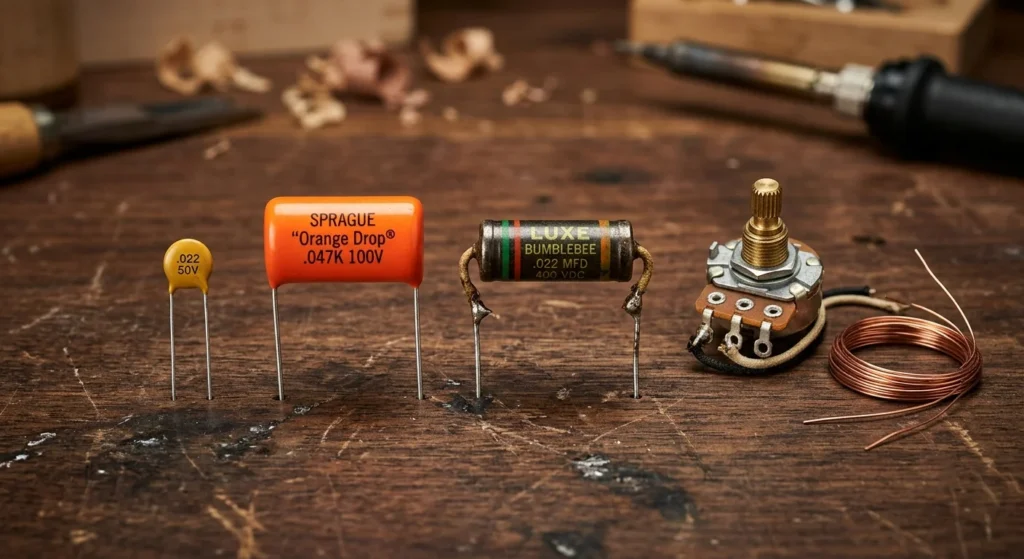
You turn your tone knob, but the passive circuit relies on your guitar capacitor types. These components roll off high treble frequencies by routing signal noise to ground.
Standard ceramic capacitors offer functional filtering in basic factory guitars. For tighter tolerances, polypropylene capacitors like the classic Orange Drop deliver predictable signal attenuation. Vintage paper-in-oil capacitors give you smooth high-end roll-off because their wrapped foil layers alter voltage bleed.
As a result, your tone control depends on capacitance values measured in microfarads (µF). Installing a 0.047 µF cap dumps more treble to ground than a 0.022 µF unit. Lower values preserve midrange clarity when you roll off the potentiometer. You control your instrument’s final frequency response by pairing the right dielectric material with your pickup impedance. Test these options to build your ideal tone circuit.
Understanding Low-Pass Filters in Guitar Tone Knob Circuits
To build that ideal tone circuit, you need to master how a standard tone knob creates a variable resistor-capacitor (RC) low-pass filter. When you roll down your tone potentiometer, you decrease resistance between the guitar’s signal path and the capacitor lead. This resistance drop routes high-frequency audio signals through the capacitor directly to ground, leaving lower frequencies to travel out through your output jack.
The cutoff frequency dictates the exact point where this high-end roll-off begins. You determine this threshold using the resistance of your potentiometer and the rating of the component measured in microfarads (µF). For instance, combining a 500k ohm potentiometer with a 0.022 µF capacitor sets a higher frequency cutoff than pairing a 250k ohm potentiometer with a 0.047 µF cap.
your humbucker pickups interact directly with this passive network across the entire rotation of the pot. Even with the control set to 10, a minor fraction of high treble bleeds through the circuit. You control the exact balance of treble retention and signal roll-off by matching your pickup impedance with precise capacitor specs.
How Capacitance Value Shapes Frequency Roll-Off
You alter this cutoff point directly when you select a component value measured in microfarads (µF). The physical rating determines how wide of a frequency band your tone knob dumps to ground.
As a result, a higher value like a 0.047 µF capacitor lowers the cutoff frequency deep into the upper-midrange spectrum. When you dial down your potentiometer, this higher capacitance strips away harsh treble while pulling down fundamental mid frequencies. This produces a warm, dark response that tames overly bright single-coil pickups.
Conversely, a lower value like a 0.022 µF capacitor maintains a much higher corner frequency. You retain vital midrange punch while sweeping the control because the filter only targets extreme top-end sheen, Because of this response, humbucker pickups typically rely on 0.022 µF components to avoid muddying their naturally low resonant peak.
If you drop down to a 0.015 µF rating, you shift the filter point even higher up the spectrum. In practice, this narrow filtering preserves pick attack and vocal clarity throughout the pot’s sweep. You effectively transform the control into a targeted filter that removes glassy harmonics without flattening your signal dynamics.
Why Voltage Ratings Affect Cavity Fit, Not Audio Tone
While capacitance shifts your tone knob corner frequency, a capacitor’s voltage rating alters physical size rather than filtering behavior. Electric guitar pickups produce tiny alternating current signals that peak around two volts. Consequently, any component rated for 50 volts easily handles your passive circuit without saturation.
Manufacturers build 400V and 600V components with thicker internal insulation layers. This extra material enlarges the physical outer casing of the capacitor. As a result, a 600V unit occupies far more space than a 50V version with the same microfarad rating.
When you wire a high-voltage component into your harness, you gain zero dynamic range or tonal clarity. Instead, the oversized shell crowds your potentiometer lugs and squeezes adjacent wiring. In shallow guitar cavities, large units can even block the control cavity cover from sitting flush. You should choose 50V to 100V components to keep your wiring clean and preserve cavity space.
Breaking Down Main Guitar Capacitor Types by Dielectric Material
Once you clear cavity space for your components, evaluate how the dielectric material affects circuit performance. The dielectric is the insulating layer separating the conductive plates inside every capacitor.
When you adjust your tone knob, this insulating layer determines how the component shunts high frequencies to ground. Different dielectric materials like ceramic, polypropylene film, and oil-soaked paper exhibit distinct manufacturing tolerances and electrical stability.
In passive circuits, these tolerances dictate your actual cutoff frequency. Ceramic capacitors often feature broad tolerance ranges up to 20 percent. A rated 0.022 µF ceramic unit frequently measures at 0.018 µF or 0.026 µF on your meter. This variance shifts your filter threshold unexpectedly.
Polypropylene capacitors like the Orange Drop standard maintain tight 5 percent tolerances. Consequently, film caps deliver repeatable roll-off behavior across your humbucker pickups. Paper-in-oil capacitors use legacy designs that introduce small amounts of equivalent series resistance. Understanding these construction traits helps you select the correct component for your guitar.
Ceramic Capacitors: Budget Standard and High-End Transparency
Ceramic capacitors dominate factory guitar cavities because guitar manufacturers buy them for pennies. You usually find cheap ceramic discs in import instruments and budget production guitars. As a result, these standard discs rely on low-grade Class 2 dielectric materials such as Z5U or Y5V. These budget dielectrics change their capacitance value based on signal voltage and ambient temperature. Consequently, a cheap ceramic disc alters your cutoff frequency as you play louder or softer. These components also exhibit piezoelectric properties, meaning they convert physical body vibrations inside your control cavity into electrical noise.
Instead of settling for noisy budget discs, you can install high-grade Class 1 C0G or NP0 ceramic capacitors. These precision components deliver rock-solid electrical stability without microphonic interference. C0G dielectrics maintain their exact microfarads (µF) rating across all temperature changes and signal levels. As a result, they send unwanted high frequencies to ground without adding harmonic distortion. When you roll back your tone knob, a C0G ceramic capacitor yields an exceptionally transparent roll-off. You get ultimate tonal clarity inside a compact shell that easily fits crowded control routs.
Polypropylene Capacitors and Film Types: The Orange Drop Standard
If you have extra room in your control cavity, polypropylene capacitors give you consistent electrical performance. Most guitar techs recognize Orange Drop capacitors as the benchmark for custom rewiring.
Manufacturers build Orange Drop units using two primary film dielectrics. Series 715P and 716P Orange Drops use polypropylene film. Consequently, these units exhibit minimal dissipation factors and tight ±5% capacitance tolerances. The physical film layers hold their precise microfarads (µF) rating across all operating temperatures. As a result, your tone knob rolls off high frequencies at the exact theoretical cutoff point every time you adjust the pot.
Series 225P Orange Drops use polyester film instead. Polyester allows a smaller physical shell than polypropylene. However, polyester exhibits higher dielectric absorption at audio frequencies.
Polypropylene capacitors maintain rock-solid stability inside your control cavity. You get a predictable frequency roll-off when you pair a.022 µF polypropylene cap with humbucker pickups. Instead of guessing where your treble drops, you gain absolute control over your passive filter circuit.
Paper-in-Oil Capacitors: Vintage Warmth and Smooth Frequency Response
While polypropylene capacitors deliver rigid theoretical precision, paper-in-oil capacitors introduce physical dielectric traits that alter the shape of your passive roll-off curve. Manufacturers construct these vintage-style components by saturating kraft paper in mineral oil and hermetically sealing it between metal foil sheets. This oil-impregnated structure exhibits higher dielectric absorption and elevated Equivalent Series Resistance (ESR) compared to modern film dielectrics. Consequently, the higher ESR dampens the sharp resonant peak that forms between the pickup coils and the capacitor when you turn down your tone knob. As a result, the circuit attenuates high frequencies along a soft slope rather than dropping treble off a sharp cliff.
This damped electrical response changes how your guitar sounds across the entire sweep of the pot. Standard ceramic capacitors can drop high frequencies rapidly, but a paper-in-oil component preserves upper-midrange clarity as the control rolls back. In addition, the internal foil layers in oil-filled units produce slightly higher parasitic inductance. Consequently, sharp high-frequency transients round off smoothly without losing note definition. When you solder a.022 µF paper-in-oil capacitor into a guitar with humbucker pickups, you flatten harsh pick attack while retaining complex vocal mids in your signal path.
Choosing the Right Microfarads (µF) Value for Your Pickups
Matching tone with physical dielectric specs requires looking beyond construction materials to capacitance values measured in microfarads (µF), While dielectric materials alter response curves through internal resistance, the numerical rating determines your exact cutoff frequency.
When you turn down your tone knob, the pot and capacitor form a variable low-pass filter. Consequently, higher microfarad values shift the cutoff frequency lower into the audible spectrum. As a result, a larger value bleeds off more high and upper-midrange frequencies to ground. Lower values restrict the filtering action strictly to the extreme top end. Consequently, you preserve core midrange frequencies while removing high-frequency glare.
Your guitar pickups dictate which capacitance value delivers the best signal balance. High-output humbucker pickups already display lower resonant peaks and dark tonal profiles. Therefore, paired humbucker circuits require precise capacitance values to avoid muffled audio output. Conversely, bright single-coil pickups benefit from larger values that smooth out piercing treble spikes. Selecting the right microfarads gives you full control over how your tone pot shapes your sound.
.015 µF: Subtle Roll-Off and High-End Clarity for Neck Pickups
Neck position humbucker pickups detect maximum string vibration, which inherently generates heavy lower-midrange energy. Consequently, standard tone circuits often make neck pickups sound muffled when you roll off the high end. Installing a.015 microfarads (µF) capacitor solves this signal congestion by raising the low-pass cutoff point.
As a result, the circuit filters out piercing high-frequency spikes while preserving critical upper-midrange frequencies. Therefore, your note articulation stays crisp even when you reduce the tone knob setting below half. Guitar luthiers frequently wire a.015 µF polypropylene capacitor or modern Orange Drop into the neck position of dual-humbucker guitars. Consequently, you gain a smooth, usable pot sweep without losing fundamental chord clarity. This spec works exceptionally well for jazz, blues, and high-gain lead playing where tracking dynamic pick attack remains essential.
.022 µF: The Universal Standard for Humbuckers and Modern Single-Coils
While a.015 µF capacitor preserves extreme treble detail, the.022 microfarads (µF) value serves as the industry baseline for standard tone circuits. This capacitance value strikes an ideal balance between broad high-end attenuation and midrange retention. Consequently, bridge position humbucker pickups benefit from a predictable frequency roll-off when you turn the tone knob down. The.022 µF value places the circuit cutoff point near the upper-midrange border. As a result, turning down the pot smooths out brittle harmonic spikes without smothering your core note fundamental.
Luthiers routinely pair this specification with 500k ohm potentiometers in dual-humbucker guitars. Therefore, you maintain clear pick dynamics while gaining effective control over high-frequency glare. Modern single-coil pickups, especially hotter bridge units, also mate well with a.022 µF component wired to a 250k pot. Consequently, the combination prevents bright single-coils from sounding excessively shrill under heavy amplifier saturation. Installing a high-tolerance Orange Drop polypropylene capacitor ensures consistent dielectric performance and stable capacitance across the entire control sweep.
.047 µF: Deep, Dark Warmth Ideal for Bright Stratocasters and Jazz Tones
Increasing the capacitance further to.047 microfarads (µF) shifts the filter cutoff frequency significantly lower into the audio spectrum. As a result, this higher capacitance value bleeds off upper-midrange frequencies along with treble spikes when you rotate the tone knob down. Consequently, vintage single-coil circuits traditionally rely on a.047 µF capacitor to tame the piercing high-end response of bright Stratocasters.
Pairing a.047 µF value with standard 250k ohm potentiometers creates a steep treble attenuation curve. Therefore, small physical adjustments on the tone control produce immediate, noticeable changes in high-frequency output. Jazz guitarists frequently choose this higher value for humbucker pickups to eliminate aggressive transient peaks. As a result, fully rolling back the control produces a dense, dark tone that retains clear low-end warmth without creating muddy signal mud.
You can select specific capacitor materials to alter how this heavy roll-off feels during play. A.047 µF paper-in-oil capacitor provides a smooth, gradual transition near the cutoff boundary. Consequently, players who adjust their controls during live performances gain precise control over subtle treble shading. Alternatively, budget ceramic capacitors roll off treble rapidly, yielding a sharp frequency drop suited for dedicated rhythm playing.
Comprehensive Specification Matrix for Guitar Tone Capacitors
To select the right component for your passive circuit, you must evaluate how dielectric materials handle signal bleed when you turn the tone knob down. Ceramic capacitors use basic disc construction with wide capacitance tolerances, often varying by up to 20 percent from their rated microfarads (µF) value. Consequently, a rated.022 µF ceramic cap may bleed off more upper-midrange frequencies than expected. As a result, your tone control might feel abrupt or muddy near the bottom of its sweep.
Polypropylene capacitors, such as the Sprague or Vishay Orange Drop, utilize film foils that offer precise 5 percent tolerances. Therefore, the frequency cutoff point stays consistent regardless of temperature changes inside the control cavity. When paired with humbucker pickups, an Orange Drop capacitor maintains tight control over the treble roll-off slope. Consequently, you retain articulate note attack even when you attenuate bright high frequencies.
Paper-in-oil capacitors feature Kraft paper saturated with mineral oil wrapped in a sealed metal tube. Therefore, this construction introduces a tiny amount of self-inductance that rounds off aggressive transient spikes. As a result, players seeking vintage tonal characteristics prefer paper-in-oil construction for a smoother perceived response across the entire pot sweep.
-
Ceramic Capacitors: Extremely compact footprint with lower cost. Wide tolerance drift creates noticeable variation between individual units.
-
Polypropylene Capacitors: High stability with low signal distortion. Precise tolerances ensure reliable cutoff points for modern circuits.
-
Paper-in-Oil Capacitors: Hermetically sealed vintage design. Smooth frequency attenuation tames harsh high-frequency transients.
FAQ About guitar capacitors types
Does the capacitor material affect tone when the tone pot is set to 10?
You will not hear a difference in capacitor material when you set your tone knob to 10. When you turn the knob up, you introduce high resistance that keeps your guitar signal out of the capacitor. You hear your pickup tone and pot load, not the foil or paper inside the cap. You get identical sound from paper-in-oil and orange drop capacitors at full treble.
If you want extra brightness with your knob on 10, replace your standard tone pot with a no-load pot. You bypass the capacitor at setting 10, sending crisp high-end clarity straight to your amplifier.
Will a higher voltage capacitor ruin the sound of my electric guitar?
No, a higher voltage capacitor will not change or ruin your guitar’s tone. Voltage ratings tell you the maximum electrical pressure a component tolerates before failing. Your guitar pickups produce less than one volt, so a 50-volt capacitor and a 600-volt capacitor perform the same in a tone circuit. The microfarad rating shapes your sound, not the voltage.
Watch out for physical size instead. High-voltage units, like a 600-volt Orange Drop capacitor, take up far more space than tiny 50-volt ceramic discs. If you install a massive capacitor inside a shallow control cavity, such as a Fender Stratocaster, you will struggle to screw the pickguard down without pinching wires. Check your control cavity depth before buying components.
Select a.047 µF guitar capacitor when you want a dark tone as you roll back your tone pot. You hear sharp treble peaks from single-coil pickups. Fender installed.047 µF capacitors in vintage Stratocasters to tame high-end harshness and build thick lead sounds. Choose a.022 µF tone cap if you prefer a subtle treble roll-off. You retain clear midrange frequencies across the entire sweep, keeping your guitar punchy at low dial settings.
Telecaster players pair a.022 µF tone capacitor with 250k pots to soften bridge pickup bite without sacrificing note definition. Clip temporary alligator leads to your tone potentiometer lugs. Test both capacitor values through your rig before you solder the final component into your circuit.