
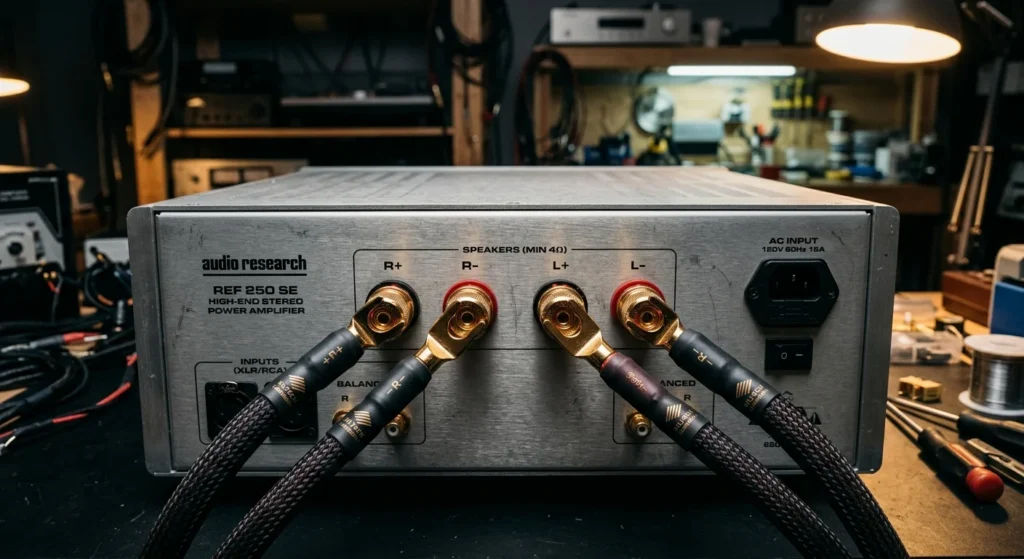
Stock amplifier binding posts often introduce unwanted resistance and magnetic interference into your signal path. Replacing nickel-plated factory brass with high-purity copper upgrades immediately improves current delivery and preserves high-frequency detail.
Budget options like Dayton Audio provide gold-plated bodies and reliable nylon insulation for routine bench builds. High-end WBT NextGen posts feature low-mass, non-magnetic conductors that prevent signal storage distortions.
Beyond metal purity, physical clamping force matters during installation and daily operation. Quality anti-rotation mechanisms lock the post body directly to the chassis. This design prevents internal wiring from twisting when you torque heavy spade connectors or spring-loaded banana plugs. On high-power studio gear, technicians often swap traditional speaker terminals for lockable SpeakOn connectors.
You can evaluate mechanical grip, conductor mass, and housing insulation to pick the exact connector upgrade for your amplifier budget.
Technical Criteria for Selecting High-Performance Speaker Terminals and Binding Posts
Evaluating speaker terminals requires balancing electrical conductivity, corrosion resistance, and physical robustness. You must first analyze the base metal composition of the terminal core. High-purity tellurium copper offers roughly 93% IACS (International Annealed Copper Standard) conductivity. Standard brass terminals, by contrast, deliver only 26% to 28% IACS due to their heavy zinc content. Consequently, swapping brass for copper significantly reduces contact resistance at the output stage.
As a direct result of lower resistance, high-current peaks pass through to the speaker cable without measurable voltage drops across the terminal body. You also need to select the right plating layer to prevent surface oxidation over time. Gold plating provides stable, long-term corrosion resistance with low insertion friction. Rhodium plated surfaces offer superior scratch resistance, which preserves the total contact area when you regularly swap heavy spade connectors or banana plugs.
In addition to metallurgy, housing geometry dictates how effectively the post suppresses inductive distortions. Traditional heavy brass posts generate eddy currents when high-frequency AC audio signals flow through their dense metal mass. High-performance designs, such as WBT NextGen posts, use a low-mass conductor suspended in fiberglass-reinforced polymer. This reduced physical volume minimizes magnetic hysteresis while maintaining high clamping force on raw wire or spade connectors.
Finally, evaluate the chassis mounting hardware before installing new posts on an amplifier. Solid nylon step-washers prevent direct electrical contact with aluminum or steel enclosures. Integrated anti-rotation pins lock the assembly securely, preventing the post from spinning when you apply high torque to heavy speaker cables.
Metallurgy, Conductivity, and Plating: Pure Copper, Rhodium Plated, Gold, vs. Brass
Selecting the right core conductor material directly impacts signal integrity long before you torque the terminal down on the chassis. Standard commercial speaker terminals rely on free-machining C36000 brass, While brass offers high tensile strength for tight clamping, its electrical conductivity measures roughly 26% IACS (International Annealed Copper Standard). This low rating creates measurable insertion resistance under high current, which reduces the amplifier’s damping factor control over your woofers.
Upgrading to oxygen-free pure copper or tellurium copper increases conductivity to between 93% and 101% IACS. Tellurium copper allows precise CNC machining of terminal threads while keeping signal loss negligible, Because pure copper is soft, manufacturers form high-end posts using thin sheet pressings rather than turned solid stock. This approach reduces overall conductor mass while preserving pure copper’s superior transfer efficiency.
The choice of surface plating determines how well the terminal maintains low contact resistance over years of use. Direct gold plating applied without an underlying nickel substrate prevents magnetic distortion while offering excellent oxidation resistance. Standard budget posts, including entry-level brass options from suppliers like Dayton Audio, often use nickel barrier layers that introduce thin-film non-linearities.
For systems where you frequently swap spade connectors or banana plugs, rhodium plated posts provide superior mechanical durability. Rhodium features a much higher Vickers hardness rating than gold. Consequently, it resists physical abrasion from repeated clamping without flaking off to expose the raw copper base beneath.
Eliminating Eddy Currents and Magnetic Hysteresis
Beyond surface plating durability, total metal mass in the conductor path dictates how the terminal interacts with alternating magnetic fields. When high-amplitude audio signals pass through solid metal speaker terminals, the dynamic magnetic field induces circular electrical loops called eddy currents inside the post body.
These induced currents generate secondary magnetic fields that lag behind the signal. As a result, they store and release energy out of phase, creating high-frequency phase smearing and measurable non-linear distortion.
Designers eliminate this energy storage by drastically reducing metal volume. Low-mass designs like WBT NextGen replace heavy turned brass stock with a thin, continuous copper strip housed inside a non-conductive polymer shell. By removing excess conductive mass, this construction prevents eddy currents from forming while preserving high contact pressure for spade connectors and banana plugs.
Magnetic hysteresis poses another technical barrier when mounting posts to steel chassis plates. Ferrous metals retain residual magnetization during signal transitions, altering the signal envelope. You eliminate hysteresis losses by using non-magnetic mounting washers to isolate the pure copper signal path from steel enclosures, ensuring clean signal transfer from the amplifier output stage.
Anti-Rotation Mechanisms and Mechanical Isolation
Beyond magnetic isolation, maintaining a secure physical connection between speaker terminals and the chassis requires specific mechanical design features. High-torque tightening of spade connectors often causes unkeyed binding-posts-easy-guide/”>binding posts to twist inside the mounting hole. This rotation places direct shear stress on internal solder joints. Over time, that stress causes cracked joints or sheared internal wiring.
To prevent this mechanical failure, premium posts utilize D-profile threads or keyed indexing pins. A D-flat milled directly into the threaded barrel matches a corresponding keyed cutout on the chassis or isolation washer. Consequently, the assembly locks into place and accepts maximum clamping force without rotating.
Keyed Washer / Chassis Notch
     ┌─────────────┐
     │   ┌─────┐   │
     │   │     │   │  <-- D-Flat Milled Barrels Prevent Rotation
     │   └───┬─┘   │
     └───────┼─────┘
             └─── Mechanical Anti-Torque Lock
Mechanical isolation also protects signal transfer from microphonic distortion caused by structural chassis vibrations. High-end designs like the WBT NextGen series integrate elastomeric dampening rings directly into the mounting structure. These compliant polymer washers absorb low-frequency cabinet resonances before they reach the conductor interface.
Also, proper isolation hardware prevents physical contact between the conductive post and the chassis wall. Step washers made of fiber-reinforced polymers center the terminal barrel inside the panel cutout. This precise centering maintains a uniform air gap. It prevents short circuits to grounded enclosures while securing banana plugs and heavy cables under high tension.
Comparing the Best Amplifier Binding Posts Across All Price Points
These exact mechanical isolation tolerances determine whether upgrade Speaker Terminals improve signal transfer or fail under heavy cable loads. Engineers evaluate replacement posts by analyzing conductor mass, metallurgy, and contact mechanics.
High-end upgrades like the WBT NextGen series, ETI Research, and Viborg use low-mass pure copper conductors inside rigid polymer bodies, Because these ultra-low-mass designs remove excess metal, they eliminate eddy currents and signal storage distortion. As a result, transient audio signals pass through the junction without time-smearing. Rhodium Plated pure copper posts offer high surface hardness. Thus, they resist wear when you torque down heavy Spade Connectors. Alternatively, gold-plated copper variants yield low contact resistance for standard Banana Plugs.
Budget and DIY favorites like the Dayton Audio BPA-38 utilize machined brass construction. Consequently, these units provide high structural strength and accommodate high clamping torque at a lower price point. However, the higher mass and nickel underplating in standard brass hardware create small magnetic storage effects. This approach trades ultimate signal purity for physical durability.
Evaluating these trade-offs requires matching the terminal design to your specific chassis layout and cable strain requirements:
-
Low-Mass Pure Copper (WBT NextGen, ETI Research, Viborg): Delivers maximum signal fidelity and eliminates magnetic distortion. Requires precise torque during installation to protect the polymer housing.
-
Machined Solid Brass (Dayton Audio BPA-38): Yields maximum mechanical tension and accepts extreme clamping forces. Introduces minor eddy current losses due to increased conductor volume.
Select your terminal hardware based on cable weight and internal chassis clearance. A proper match ensures a gas-tight mechanical bond that maintains low contact resistance for years.
High-End Audio Grade: WBT NextGen, ETI Research, and Viborg
When you upgrade to high-end Speaker Terminals, low-mass designs eliminate stored energy and inductive distortion. The WBT NextGen series leads this category by utilizing a single-piece, ultra-thin pure copper conductor encased in a glass-fiber reinforced polymer body, Because WBT removes excess metallic mass around the signal path, these posts minimize eddy current formation. The integrated torque-limiting mechanism prevents over-tightening when securing heavy Spade Connectors. This mechanical limiter protects both the copper core and the internal solder joints from destructive shear forces.
ETI Research takes a different structural approach with its Kryo binding posts. Instead of polymer housings, ETI engineers use a hollow tellurium copper conductor paired with a non-magnetic brass body shell. As a result, the signal flows exclusively through the high-conductivity copper core while the outer shell provides physical rigidity. ETI applies direct silver plating topped with a Rhodium Plated finish. This process prevents oxidation without introducing an intermediate nickel layer. Consequently, the conductor preserves low contact resistance when accepting standard Banana Plugs.
By contrast, Viborg offers a cost-effective alternative that replicates premium metallurgy. Their pure red copper posts feature direct rhodium plating over an oxygen-free copper substrate. By omitting the traditional nickel barrier beneath the outer plating, Viborg eliminates magnetic non-linearity at the terminal interface. Therefore, these posts yield low contact resistance and stable signal transfer at a lower price point. However, because Viborg posts retain higher conductor mass than WBT NextGen models, they exhibit slightly higher energy storage during high-current transient spikes.
Budget & DIY Favorites: Dayton Audio BPA-38 and Heavy-Duty Brass Options
While high-end copper options minimize energy storage, budget-focused DIY Speaker Terminals like the Dayton Audio BPA-38 rely on machined brass construction. Brass features lower bulk electrical conductivity—roughly 26% to 28% IACS—compared to pure copper, Because brass alloys incorporate zinc, manufacturers accept reduced signal transfer efficiency to gain mechanical tensile strength. Consequently, heavy-duty brass options handle high mounting torque without stripping threads or shearing internal joints.
The Dayton Audio BPA-38 uses gold plating over a solid brass substrate. As a result, the outer layer resists surface oxidation while providing tight contact pressure for Banana Plugs and Spade Connectors. However, the higher metallic mass of these posts increases capacitive energy storage and eddy current formation during high-voltage transients. Therefore, brass binding posts exhibit small measurable signal losses compared to ultra-low-mass WBT NextGen designs.
For budget DIY amplifier upgrades, these solid brass connectors offer high durability and reliable physical stability, Because the insulated nylon shoulder washers isolate the post from the metal enclosure, you prevent chassis grounding faults. Consequently, DIY builders achieve a secure mechanical mount on thick enclosure panels without paying the high cost of pure copper assemblies.
Technical Specifications and Value Comparison
Evaluating these cost-to-performance trade-offs requires analyzing electrical measurements against mechanical longevity. When you upgrade stock amplifier binding posts, you evaluate bulk conductivity, contact resistance, and mass. Stock amplifiers frequently ship with cheap nickel-plated brass Speaker Terminals, Because brass exhibits high electrical resistance, stock terminals dissipate low-level signal details as heat. As a result, upgrading to Rhodium Plated pure copper assemblies reduces contact resistance across the interface.
High-end connectors like WBT NextGen posts utilize ultra-thin copper signal paths, Because these conductors minimize metal volume, they eliminate transient energy storage during high-current peaks. Consequently, you achieve lower intermodulation distortion compared to heavy solid brass terminals from Dayton Audio. However, pure copper posts require higher manufacturing tolerances and precision machining. Therefore, premium signal posts cost significantly more per unit than standard commercial alternatives.
For mid-tier builds, low-mass tellurium copper posts provide a balanced compromise, Because tellurium copper retains roughly 90% IACS conductivity, it maintains high signal transfer efficiency. Consequently, the material withstands high clamping forces from heavy Spade Connectors without stripping threads. Pro audio systems utilize SpeakOn Connectors for high-stage durability. However, high-fidelity home amplifiers rely on ultra-low-mass binding posts to maximize signal fidelity for Banana Plugs.
Step-by-Step DIY Speaker Terminal Installation and Upgrade Process
Executing an upgrade on factory speaker terminals requires balancing material efficiency against physical build constraints, Because stock brass terminals add measurable contact resistance, replacing them with high-purity copper posts improves transient current delivery. Consequently, you achieve cleaner low-frequency dynamics under demanding speaker loads, Because entry-level posts from Dayton Audio feature heavy brass bodies, they offer exceptional thread durability at a low cost. Therefore, budget-focused DIY builders gain reliable clamping force for heavy Spade Connectors. However, brass exhibits lower overall electrical conductivity than pure copper alternatives.
When you upgrade high-resolution amplifiers, WBT NextGen connectors solve this conductive bottleneck by using minimal metal mass, Because these ultra-thin, Rhodium Plated copper conductors eliminate unwanted eddy currents, signal dissipation drops across the entire audio spectrum. Consequently, your amplifier delivers superior high-frequency clarity without adding harshness.
If your chassis layout permits, evaluate connector geometry before buying. Standard Banana Plugs require secure internal spring tension to maintain low contact resistance over time. Pro audio builds rely on SpeakOn Connectors for locking durability. However, high-fidelity home amplifiers perform best with low-mass copper binding posts. Selecting the right terminal material directly optimizes the signal path between your output stage and loudspeaker cables.
Chassis Clearance, Thread Length, and Panel Hole Sizing
When you measure your amplifier panel for upgraded Speaker Terminals, physical clearance dictates which terminal geometry actually fits, Because heavy aluminum backplates often exceed 6 mm in thickness, short-threaded posts fail to extend far enough through the panel. Consequently, you cannot thread the internal locknut securely onto the post shaft. Therefore, you must calculate the exact usable thread length before purchasing premium WBT NextGen upgrades.
In practice, mounting these connectors requires precise panel hole sizing. Standard aftermarket assemblies demand an 11.5 mm mounting hole to accommodate stepped shoulder washers, Because these nylon washers isolate the conductor from the chassis, clearance slop allows the terminal body to twist. Consequently, the assembly loses clamping force when you tighten heavy Spade Connectors.
For instance, upgrading stock connectors to heavy-duty Dayton Audio or Rhodium Plated posts alters internal component spacing, Because compact chassis layouts place filter capacitors close to the rear panel, extended post tails can touch adjacent internal wiring. Therefore, you must maintain at least a 6 mm air gap between the terminal tail and nearby circuit traces. This physical clearance protects signal integrity when heavy speaker cables exert leverage on external Banana Plugs.
Signal Termination Methods: Direct Soldering vs. Crimped Fastons
Because internal signal loss occurs at physical junctions, your termination method dictates long-term electrical efficiency. Directly soldering the wire to the terminal tail eliminates mechanical junction resistance. Consequently, solder forms an airtight bond that prevents copper oxidation over years of high-current thermal cycling.
Heavy solid-brass posts act as massive heat sinks. As a result, soldering thick brass requires high-wattage irons that often melt surrounding nylon insulating washers. In contrast, low-mass Speaker Terminals like WBT NextGen utilize thin copper conductors. Therefore, these lightweight post tails accept solder rapidly without burning the mounting hardware.
Crimped Faston disconnects eliminate heat application and simplify future board replacements. However, standard nickel-plated Fastons rely entirely on mechanical spring tension, Because amplifier vibration and heat cycles alter metal tension, push-on terminals degrade over time. This tension loss increases contact resistance and introduces signal distortion.
Therefore, you must use high-force crimp tools with gold-plated or Rhodium Plated phosphor bronze connectors if you select push-on disconnects. For maximum signal integrity and structural stability, direct soldering remains the preferred technical standard.
Matching Binding Posts with Premium Cable Terminations
Once you finalize your internal wire connections, you must evaluate how upgraded Speaker Terminals handle physical loads from premium speaker cables. Upgrading stock nickel-plated brass terminals to high-purity copper posts reduces overall junction resistance across the output stage.
Standard brass posts contain high zinc concentrations, Because zinc reduces electrical conductivity, standard jacks introduce measurable signal loss under high current demands. Consequently, replacing stock hardware with low-mass, Rhodium Plated copper terminals like the WBT NextGen improves signal transfer efficiency. Low-mass designs restrict eddy current formation inside the terminal body. As a result, your amplifier maintains better transient response and high-frequency phase alignment.
Budget-friendly options like Dayton Audio binding posts provide strong mechanical clamping for standard Spade Connectors and Banana Plugs. However, solid-brass designs retain heat and require higher mechanical torque to secure tightly against the chassis panel.
When you attach heavy audiophile cables, cantilever leverage exerts continuous twisting force on the post. Therefore, high-performance replacement posts integrate keyed anti-rotation shoulder washers or flat-milled shaft threads. Without anti-rotation geometry, external cable torque turns the post chassis inside the mounting hole. Consequently, internal solder joints twist, fracture, and create intermittent open circuits.
For high-vibration environments or maximum connection security, switching from binding posts to chassis-mount SpeakOn Connectors eliminates physical strain entirely, Because SpeakOn latching mechanisms drop mechanical tension on the conductors to zero, they transfer cable weight directly to the amplifier chassis rather than internal terminal tails.
Banana Plugs vs. Spade Connectors: Compatibility and Contact Pressure
Upgrading your amplifier speaker terminals directly changes how effectively the post exerts clamping force on spade connectors and spring tension on banana plugs. Standard brass posts rely on flat thumbscrews that compress spades unevenly across threaded shafts. Consequently, uneven surface pressure increases interface resistance and allows micro-vibrations to loosen the connection over time. High-performance terminals like WBT NextGen solve this issue by using integrated torque-limiting caps. As a result, the terminal applies an exact, repeatable clamping force to solid copper spade connectors without crushing the metal or stripping the shaft threads.
When you use banana plugs, contact pressure relies entirely on the internal spring tension of the plug against the post bore. Lower-grade binding posts feature oversized internal tolerances that drop contact surface area. Therefore, current density spikes across small contact points inside the terminal socket. Upgraded rhodium plated copper posts maintain tight machining tolerances inside the center bore, Because the inner diameter matches standard 4mm banana plugs precisely, the connector maintains uniform radial pressure along the entire barrel length. Consequently, this precise fit minimizes contact impedance and prevents signal degradation caused by mechanical play.
When you install high-purity copper or rhodium-plated binding posts, you improve electrical conductivity at the terminal interface. Hanging heavy speaker cables with spade connectors or banana plugs applies constant mechanical leverage to the terminal shaft. Standard binding posts rely on a single nut and lock washer to grip the chassis wall. Cable weight and room vibration loosen this hardware over time, which cracks internal solder joints and causes micro-ohm resistance spikes.
You avoid these mechanical failure points when you install Neutrik SpeakOn NL4 connectors. When you insert and twist a SpeakOn plug into the chassis socket, the glass-reinforced bayonet mechanism locks the connector body to the amplifier frame. The structural housing absorbs all cable tension, keeping mechanical strain off the silver-plated internal spring clips. The sealed housing blocks atmospheric oxygen to prevent surface oxidation, maintaining a 1.5-milliohm contact resistance through 5,000 insertion cycles.
Use WBT-0708 Cu NextGen posts when you build static equipment racks that require minimal signal distortion for heavy-gauge wire. Dayton Audio BPA-38G posts offer a solid option for low-power DIY enclosures on stable shelves. When you build subwoofer cabinets or pro audio racks, choose SpeakOn latching connectors to ensure gas-tight current delivery under extreme vibration.
FAQ About amplifier binding posts
Do upgraded amplifier binding posts noticeably improve audio fidelity?
You will not hear a difference in sound quality when you replace standard amplifier binding posts with expensive alternatives. You get clean signal transfer from basic gold-plated posts because current travels a fraction of an inch through the fitting. You gain smoother threads and better durability from upgraded posts, but you will not hear any audio changes. You hear a sound improvement only when you replace broken or rusted terminals that interrupt the electrical flow.
Save your money and inspect your speaker wire instead. Snip off dull, tarnished wire ends to expose fresh copper, then screw the post cap down hard on the bare wire for maximum contact.
How do I prevent binding posts from spinning or loosening on the chassis?
To stop binding posts from spinning, you lock the internal nut against the chassis wall with proper hardware. You place an external-tooth lock washer between the inside chassis wall and the hex nut. When you tighten the nut, you force the washer teeth into the metal chassis to stop rotation. You insert a plastic shoulder washer into the panel hole to center the post.
Hold the front of the post with padded pliers while you turn the inner nut using a socket wrench. Apply a drop of blue threadlocker to the internal threads before you attach the nut. You protect the connection from the pull of heavy speaker cables while retaining the ability to disassemble the parts with hand tools.
What is the main difference between WBT-0703Cu and WBT-0702.01 TopLine posts?
The main difference comes down to metal mass and sound clarity. WBT built the 0703Cu with a low-mass pure copper conductor to prevent signal distortion from eddy currents. The 0702.01 TopLine post uses a classic high-mass metal alloy body built for extreme physical strength and heavy clamping force.
Choose the 0703Cu for the cleanest sound with standard speaker wires. If you use heavy, thick audiophile cables that put physical stress on your amplifier terminals, buy the 0702.01 instead. Its thick brass-alloy body anchors heavy cables securely so the connection never sags or loosens.