
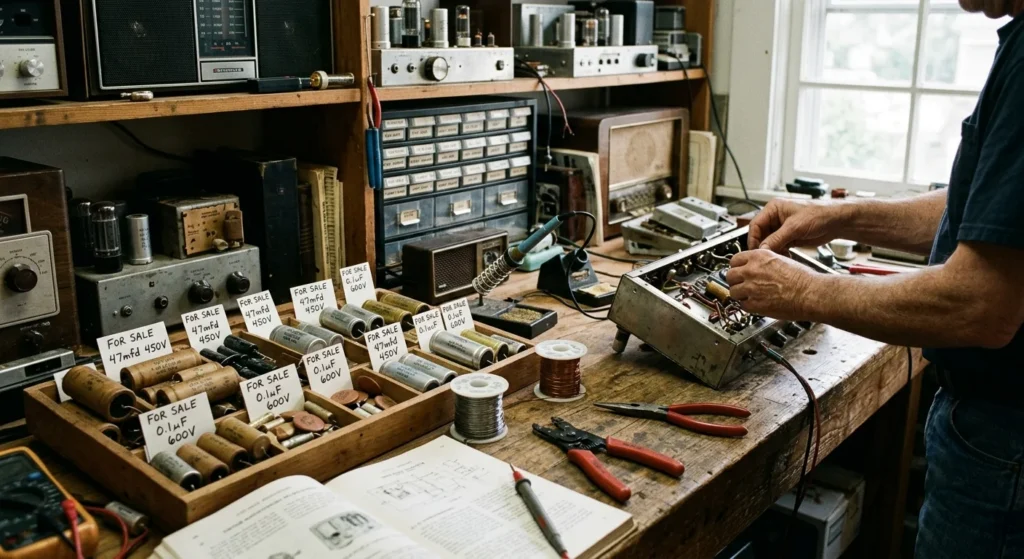
More importantly, finding authentic vintage radio capacitors-for-amplifier-case-study/”>capacitors for sale requires precise matching against your original receiver schematics. Old paper and wax units in classic tube radios fail, leaking direct current into delicate grids and ruining transformers. You need high voltage capacitors built to handle tough chassis thermal conditions. Trusted suppliers like JustRadios and Antique Electronics Supply stock correct axial film capacitors and durable orange dip capacitors.
In addition to film components, replacement electrolytic capacitors must match exact voltage ratings to eliminate line hum. Counterfeit sellers on open marketplaces often rebrand under-rated parts that short out under high plate voltage. Always verify lead length, capacitance tolerance, and working limits before you heat up your soldering iron. Direct replacement parts preserve proper circuit alignment and protect sensitive coils. Sourcing from vetted technical distributors keeps your recapping project safe, accurate, and reliable.
Essential Types of Vintage Radio Capacitors for Sale
You must buy high voltage capacitors directly from specialized restoration houses rather than unverified third-party liquidators. General-purpose electronics vendors often supply components built for low-voltage digital circuits. Consequently, these components break down under the intense heat and high DC plate voltages inside tube radios. Specialized suppliers stock parts specifically rated for classic chassis environments, ensuring your paper wax replacement components match original physical and electrical requirements.
In practice, when sourcing components, focus on finding vetted inventory that matches your receiver schematic diagrams. Reliable distributors verify the tolerance, insulation resistance, and dielectric strength of their inventory before listing parts for sale.
-
Specialty Restoration Vendors: Vendors like JustRadios and Antique Electronics Supply stock dedicated axial film capacitors and orange dip capacitors designed with long leads for point-to-point chassis wiring.
-
Industrial Component Distributors: Distributors such as Mouser and Digi-Key carry modern high-voltage electrolytic capacitors and safety-rated caps from top manufacturers, guaranteeing fresh factory inventory.
-
Unverified Online Sellers: Avoid buying cheap component assortments or New Old Stock (NOS) parts from unknown storefronts. NOS paper or electrolytic caps degrade on the shelf and will short out when powered up.
As a result, purchasing factory-fresh parts from trusted suppliers protects your receiver coils and keeps high voltages contained safely. Always cross-reference the working voltage and lead orientation before completing your order.
Axial Film Capacitors and Orange Dip Capacitors (630V to 15kV)
At the same time, when purchasing axial film capacitors and orange dip capacitors for tube radios, verify that every replacement meets or exceeds original paper wax working voltages. Always select a minimum 630V rating for standard grid-coupling and bypass circuits. Lower voltage ratings break down under high plate voltage and burn out delicate RF transformer coils.
For example, for specialized high voltage applications, source film units rated from 1kV up to 15kV. Always confirm that orange dip radial capacitors fit the physical chassis layout before soldering. Bending short radial leads repeatedly fractures the epoxy coating and creates direct short circuits to the chassis.
As a result, verify lead length before ordering axial film capacitors for point-to-point chassis wiring. Modern industrial film caps often feature short leads meant for printed circuit boards. These short leads force unnecessary wire splices that increase short-circuit risks near tube sockets.
Cross-reference your parts directly with receiver schematic diagrams to confirm capacitance values and working limits. Modern polyester and polypropylene film capacitors offer tight tolerances that stabilize circuit alignment. As a result, installing fresh high voltage capacitors stops direct current leakage and protects delicate vintage components.
High-Voltage Electrolytic Capacitors and Multi-Section Can Units
Meanwhile, while film capacitors protect low-voltage signal paths, main power supply filter networks depend entirely on high-voltage electrolytic capacitors to smooth out AC ripple. Always purchase factory-fresh electrolytic units rated for 450V to 500V working DC. Installing shelf-aged New Old Stock (NOS) electrolytic cans causes immediate dielectric breakdown that destroys rectifier tubes and burns out power transformers.
By contrast, you must match multi-section twist-lock can capacitors to your exact original mechanical footprint before ordering. Verify the physical chassis diameter and mounting tab orientation, otherwise modern replacement cans will not sit flush or align with ground tabs. Reputable restoration distributors sell authentic multi-section cans built with modern high-temperature internal film elements that fit vintage chassis cutouts.
In addition, measure your local mains voltage before selecting replacement voltage thresholds. Modern household wall outlets run higher than historical standards, pushing B+ filter voltages above legacy schematic diagrams. Therefore, choose 500V rated electrolytic capacitors for primary reservoir stages, because standard 450V components break down under initial turn-on voltage surges.
In addition, if exact multi-section can replacements are unavailable, install discrete terminal strips inside the chassis underneath the original can. Solder individual axial electrolytic capacitors directly to these terminal tie-points. Never leave replacement leads floating without mechanical support, or loose high-voltage connections will short directly against the chassis frame.
Line Safety Capacitors (X1/Y2 and X2 AC Ratings)
Order designated X1/Y2 line safety capacitors for line-to-chassis positions, otherwise a shorted standard component will energize the metal radio cabinet with lethal mains voltage. Consequently, never substitute standard high voltage capacitors or orange dip capacitors across AC power lines, because standard DC film dielectrics cannot self-heal under AC transients and will short out.
Specifically, source authentic safety components directly from established restoration suppliers or major electronic distributors. Otherwise, unverified components will break down under high AC line surges. Verify official safety agency stamps, such as UL, VDE, or CSA, printed on the capacitor body before soldering, or uncertified knockoffs will overheat and catch fire during power spikes.
When reviewing schematic diagrams for vintage tube radios, select X2 rated capacitors for direct line-to-line filtering across the power transformer primary. As a result, line noise drops without risking a short circuit across the AC plug. Use X1/Y2 rated caps as your primary paper wax replacement for any line-to-ground position, because Y2 capacitors fail open instead of welding into a dead short. Finally, check terminal lead length and casing dimensions before buying radial safety caps, or forced mounting will fracture the outer epoxy insulation and expose raw AC mains wiring.
How to Match Specs When Recapping Vintage Tube Radios
Beyond inspecting mechanical tolerances, order high voltage capacitors exclusively from established restoration vendors like JustRadios and Antique Electronics Supply or major distributors like Mouser and Digi-Key. As a result, you avoid unverified marketplace counterfeit components that break down under full operational loads. Never purchase New Old Stock (NOS) paper wax replacement parts or shelf-aged electrolytics, because vintage dielectrics dry out over decades and will short out instantly upon power-up.
In addition, match every component tolerance strictly to the original schematic diagrams before finalizing your purchase. Source fresh production axial film capacitors for signal coupling, along with 105°C-rated electrolytic capacitors for power filter stages. Check that all axial film components specify clear working voltage limits on the body rather than vague part numbers. Always verify voltage limits on a high-voltage insulation tester before soldering, otherwise cheap knockoff orange dip capacitors will fail under heavy DC B+ voltages and destroy your output transformer. Insist on certified modern stock from proven suppliers, or unverified parts will overheat and catch fire inside your tube radios.
Translating Legacy Working Voltages (WVDC) to Modern Ratings
Select your replacement stock based on strict modern voltage equivalents to handle unpredictable AC line swells in vintage tube radios. Legacy schematic diagrams specify working voltage DC (WVDC) under vintage line conditions of 110V to 115V AC. Modern mains voltages frequently exceed 122V AC, which increases internal node voltages proportionally. As a result, you must systematically step up legacy voltage ratings when purchasing paper wax replacement parts.
More importantly, to ensure long-term stability, replace older 400 WVDC paper caps with fresh 630V axial film capacitors. High voltage capacitors rated for 630V provide the mandatory dielectric headroom required during cold power-up surges. Furthermore, upgrade legacy 150 WVDC power supply filter units to modern 160V or 250V electrolytic capacitors. Never substitute lower-voltage commercial stock to save money, because undersized capacitors will suffer immediate dielectric punch-through and destroy your audio output transformer.
When buying orange dip capacitors or axial film components, verify that the vendor guarantees transient surge ratings above the listed working voltage. Consequently, you protect critical circuit paths against high-voltage spike damage. Match every purchased component’s rated DC voltage against peak surge calculations before installation, otherwise voltage breakdown will short the B+ rail directly to chassis ground.
Converting Historical Capacitance Units (mfd/mmfd to µF/pF)
In practice, alongside correct voltage headroom, you must accurately translate historical capacitance markings before ordering replacement stock. Vintage schematic diagrams for tube radios continuously list capacitance values in obsolete notation that confuses untrained builders.
For example, legacy chassis stamps print “MFD” or “mfd” to represent modern microfarads (µF). Do not misread this stamp as millifarads. Installing a component three orders of magnitude too large will destroy your power supply instantly. Similarly, historical documentation prints “MMFD” or “mmfd” for micromicrofarads, which converts directly to modern picofarads (pF). A legacy 250 MMFD component equals a modern 250 pF capacitor.
At the same time, when sourcing paper wax replacement components, you will rarely find exact numerical matches in modern production runs. Modern axial film capacitors and orange dip capacitors adhere to standard E-series manufacturing values. Substitute legacy 0.05 µF paper units with standard 0.047 µF axial film caps. Likewise, replace vintage 0.02 µF ratings with modern 0.022 µF high voltage capacitors. These minor numerical variances sit well within original 20 percent circuit tolerances.
For high-voltage electrolytic capacitors in power supply filter circuits, step up to the next highest modern standard value. Replace a legacy 20 mfd filter unit with a modern 22 µF high-voltage capacitor. Never downsize filter capacity, because excessive ripple voltage will overheat the rectifier tube and ruin your power transformer. Always verify converted capacitance values with a calibrated digital meter before soldering any replacement component into the chassis.
Individual Component Matching vs. Pre-Packaged Recapping Kits
For example, after verifying your converted measurements, choose your sourcing strategy carefully before buying replacement parts for tube radios. You will frequently encounter pre-packaged recapping kits online that promise convenient, single-bag solutions. Reject these generic kits immediately. Cheap kits frequently contain sub-standard components with insufficient voltage ratings or short radial leads that strain fragile terminal strips. Installing mismatched or inferior capacitors will cause dielectric punch-through, shorting your B+ rail directly to ground and destroying your audio output transformer.
Instead, insist on individual component matching through established restoration distributors like JustRadios or Antique Electronics Supply. Match each schematic diagrams node directly to high-grade axial film capacitors rated for at least 630V. For power supply filtering, purchase name-brand high voltage capacitors with 105°C temperature ratings to withstand high internal cabinet heat.
As a result, when executing a paper wax replacement project, select 630V axial film capacitors or quality orange dip capacitors individually. Reputable distributors test their component stock and maintain fresh inventory. As a direct result, you eliminate the threat of installing shelf-aged or counterfeit electrolytic capacitors into sensitive radio circuits. Always cross-check every purchased unit against your target schematic diagrams prior to soldering.
How to Read Schematic Diagrams for Vintage Capacitor Replacement
Meanwhile, before you solder a single lead into your tube radios, buy replacement stock exclusively from specialized vendors who guarantee fresh manufacturing dates. Generic marketplace sellers often liquidate shelf-aged New Old Stock (NOS) inventory or mislabeled components. To prevent catastrophic circuit failure, purchase high voltage capacitors directly from dedicated restoration houses like JustRadios or Antique Electronics Supply. NOS paper wax replacement stock deteriorates silently over decades on a shelf. As a direct result, installing these degraded units causes immediate dielectric breakdown and shorted high-voltage lines under full operating load.
Verify that your supplier stocks fresh axial film capacitors and premium orange dip capacitors rated for at least 630V DC. For heavy filtering duties, select name-brand electrolytic capacitors rated for 105°C operation rather than standard 85°C consumer grades. Consequently, your restored power supply will handle elevated modern AC line voltages without drying out or overheating. Always cross-reference every part number against your schematic diagrams before submitting an order. Sourcing proven, freshly manufactured components protects your irreplaceable audio output transformer and guarantees reliable operation.
Locating Original Capacitance and Working Voltages on Legacy Diagrams
More importantly, match your schematic diagrams directly to verified part numbers when you source high voltage capacitors for tube radios. Verify the precise voltage and capacitance specs on your schematic diagrams before buying components. Never substitute cheap consumer-grade parts for specialized components, because inadequate ripple ratings cause thermal runaway in power filters.
In practice, when purchasing axial film capacitors and orange dip capacitors, demand full datasheets from the supplier to confirm dielectric strength. Generic marketplace vendors frequently label 400V parts as 630V components. As a direct consequence, installing under-rated capacitors in B+ lines triggers immediate dielectric failure, which destroys the power transformer.
At the same time, cross-reference all electrolytic capacitors against the circuit requirements. Buy only fresh stock with 105°C thermal ratings to withstand chassis heat. Furthermore, reject any vendor selling paper wax replacement stock from old inventories, because shelf-aged units short out under high voltage.
Check vendor credentials thoroughly before placing an order. Rely on specialized restoration houses that stock fresh factory inventory. Consequently, you protect your circuit from catastrophic failure and preserve your vintage chassis.
Upgrading to Modern High Voltage Capacitors Safely
Select established suppliers like JustRadios or Antique Electronics Supply when purchasing modern high voltage capacitors for tube radios. Generic marketplace vendors often distribute shelf-aged inventory or mislabeled film components. For this reason, buy axial film capacitors and orange dip capacitors directly from specialized restoration distributors.
Verify that every replacement component matches or exceeds the working voltage listed on your schematic diagrams. Never substitute lower-rated components into high-voltage filtering stages. If you install under-rated caps, voltage spikes breach the dielectric layer. As a result, the shorted component destroys the power transformer and scorches surrounding chassis wiring.
Audit all modern electrolytic capacitors for fresh production dates before soldering them into the circuit. Shelf-stored NOS electrolytic units dry out over time and fail rapidly under standard operating loads. Consequently, insist on factory-fresh inventory rated for 105°C thermal conditions. Strictly avoid any vendor offering old paper wax replacement units, because aged paper stock leaks heavy DC current under high voltage.
Sourcing Authentic Vintage Radio Capacitors Without Fraud Risks
To secure authentic components without risking dielectric breakdown, purchase your high voltage capacitors directly from established restoration specialists or authorized industrial distributors. You must buy axial film capacitors and orange dip capacitors rated for 630V DC minimum from vendors who explicitly publish original manufacturer datasheets. Generic online sellers frequently re-label low-voltage parts or pass off surplus paper wax replacement stock as modern film units. For this reason, order your electrolytic capacitors from dedicated suppliers who guarantee factory-fresh inventory with verifiable date codes.
When recapping vintage tube radios, select high-grade units that directly match the operational requirements shown on your schematic diagrams. Furthermore, source your safety-critical components only from recognized distributors like Antique Electronics Supply, JustRadios, Mouser, or Digi-Key. Specialized vendors test batch tolerances and maintain controlled warehouse environments. Consequently, you prevent thermal breakdown caused by degraded dielectric layers.
Never purchase unbranded multi-section can capacitors from unverified auction listings. If you install unvetted components, excessive ripple current overheats the capacitor, boils the electrolyte, and destroys your power transformer. Demand clear batch numbers and current production runs before you solder any high-voltage part into a classic chassis.
You need suppliers who know vintage tube circuits. Specialized vendors stock axial film and orange drop capacitors built for point-to-point chassis wiring. These components feature long lead lengths and 600-volt working ratings that match your schematic specifications.
Generic Distributors
Industrial distributors like Mouser and Digi-Key provide full manufacturer datasheets and lot numbers. These suppliers focus on radial capacitors for printed circuit boards. When you mount radial parts in a point-to-point chassis, attach wire extensions to avoid tension on solder lugs.
Unverified Marketplace Sellers
Third-party marketplace sellers list mislabeled parts. Surplus traders store old stock in unconditioned sheds, where heat breaks down the internal dielectric. Demand factory test sheets and date codes before buying high-voltage electrolytic capacitors. If a seller hides date codes, choose another source. You keep your power transformer safe when you buy fresh components from verified electronics distributors.
Identifying Counterfeit, Out-of-Spec, or NOS Shelf-Aged Components
Before installing any component into vintage tube radios, you must audit the part for physical age and dielectric integrity. New Old Stock (NOS) components and vintage paper wax replacement inventory have degraded over decades on the shelf. The internal liquid electrolyte in old stock electrolytic capacitors dries out over time. Consequently, these dried parts leak heavy DC current and spike internal resistance instantly upon power-up.
Also, fraudulent online vendors frequently re-sleeve low-voltage parts to pass them off as high voltage capacitors. You will destroy your power transformer if you install a counterfeit cap rated for 100V DC into a 450V plate circuit.
Audit all incoming axial film capacitors and orange dip capacitors using an insulation resistance tester at full rated voltage. Reject any part that exhibits measurable DC leakage.
Enforce these mandatory testing steps before wiring components to your chassis:
-
Test Equivalent Series Resistance: Measure every electrolytic capacitor on an ESR meter. High resistance causes excessive ripple current, boils the electrolyte, and explodes the capacitor case.
-
Inspect Outer Sleeves and Markings: Reject components with smudged date codes, sanded plastic, or swollen shrink casing. Legitimate factory parts feature crisp laser etching and verifiable batch codes.
-
Verify Dielectric Withstand Voltage: Apply full working voltage using a high-voltage megohmmeter. Standard digital multimeters use low-voltage batteries that fail to reveal high-voltage dielectric breakdown.
FAQ About vintage radio capacitors for sale
Why must paper and wax capacitors always be replaced during radio restoration?
You need to replace vintage paper and wax capacitors because the paper inside absorbed moisture over the decades. Cracks in the outer wax allowed damp air to enter the casing. When you turn on an unrestored chassis, that trapped water routes high voltage into delicate circuits, burning out expensive parts like your power transformer.
Replace these units using modern polyester film capacitors rated for 630 volts. Clip and solder them one at a time so you maintain the correct wiring path. Taking a photo of the underside of the chassis gives you a clear map before you heat your soldering iron.
Can I replace lower-voltage vintage capacitors with modern 630V film caps?
You can swap lower-voltage vintage paper caps with modern 630V film capacitors. Engineers printed voltage ratings to state the maximum voltage a part tolerates. When you install a 630V cap in a circuit designed for 200V, you create a strong safety buffer that prevents future shorts. You will hear no difference in audio tone or radio performance.
Focus on matching capacitance values. If you remove a leaky 0.05 microfarad wax cap from an All-American Five tube radio, solder a modern 0.047 microfarad 630V yellow film capacitor into the spot. Measure lead lengths before cutting, and keep your soldering iron clear of nearby cloth wire.
What makes X1/Y2 safety capacitors necessary for vintage AC radio power lines?
Original paper and wax capacitors in vintage radios degrade with age and short out. When an old line capacitor fails, it connects live wall voltage to the metal frame of the radio. Touching an exposed metal screw or chassis on an unrestored set delivers a severe electric shock.
Modern X1/Y2 safety capacitors eliminate this danger because they fail open during electrical surges. If a high voltage spike destroys a Y2 capacitor, the component breaks the circuit connection without energizing the metal frame. When you restore a radio power line, swap the original line-to-ground paper capacitor with a 0.01 microfarad Y2 safety capacitor.