
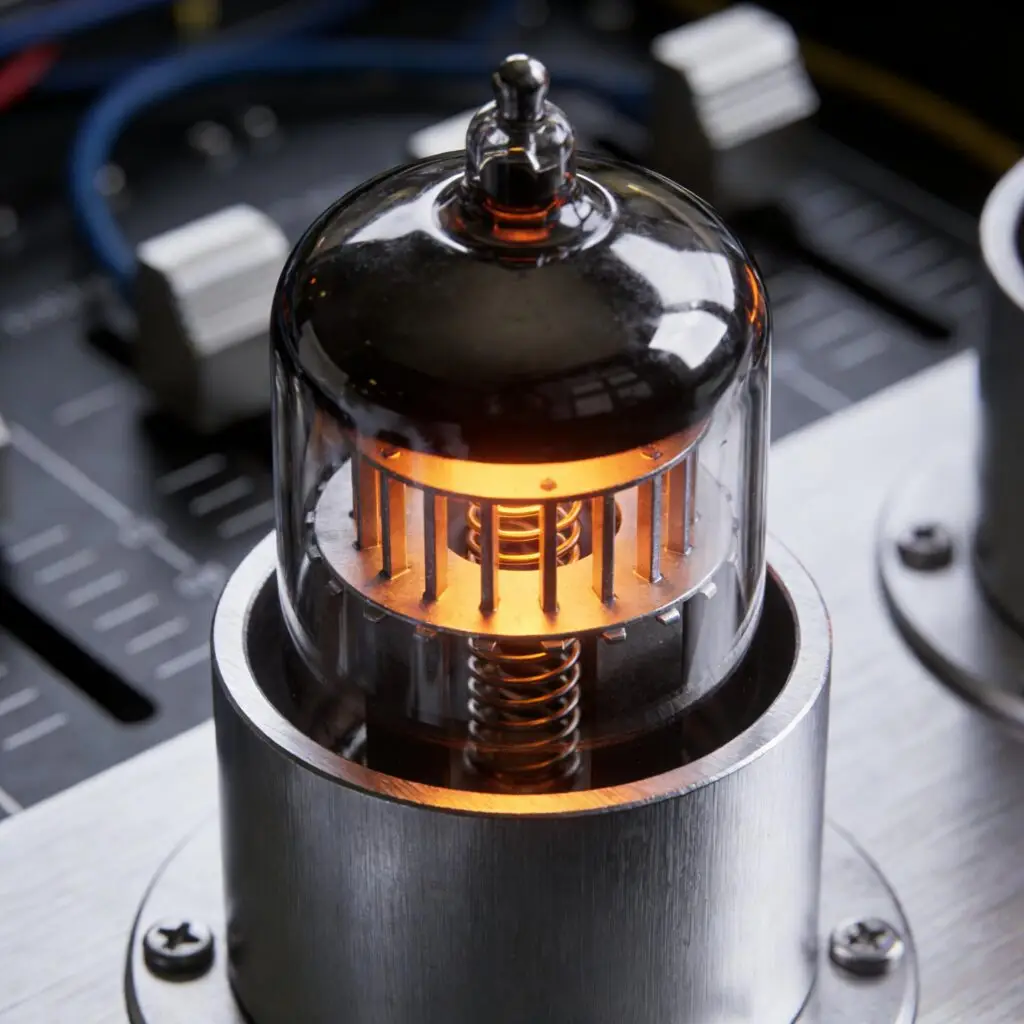
Nothing kills a pristine guitar solo or a warm hi-fi session quite like the intrusive buzz of Radio Frequency Interference (RFI) or the piercing ring of microphonics. At the heart of most preamp stages lies the 12ax7, a high-gain powerhouse that is unfortunately a magnet for unwanted environmental noise. If you’re struggling with a degraded signal-to-noise ratio, the solution often lies in a simple yet critical component: the 12ax7 vacuum tube shield.
These metallic covers do more than just protect the glass; they create a sophisticated Faraday cage that intercepts electromagnetic interference (EMI) before it can pollute your audio. In this guide, we’ll break down the technical science of tube shielding, clarify the vital differences between electronic hum and mechanical microphonics, and provide practical installation steps to help you achieve the ultra-quiet signal path and crystal-clear tone your amplifier deserves.
Related Reading: 12ax7 vacuum tube shields
What Exactly is a 12AX7 Vacuum Tube Shield?
At its core, a 12AX7 vacuum tube shield is a precision-engineered metal cylinder—typically fabricated from aluminum, copper, or nickel-plated steel—designed to encapsulate the preamp tube and isolate it from the surrounding environment. Because the 12AX7 is a high-mu triode with a high voltage gain (roughly 100), the internal grid is incredibly sensitive; even the smallest stray signal can be amplified into audible noise.
The shield’s primary function is to act as a Faraday cage. This conductive enclosure intercepts external electromagnetic fields and redirects them to the amplifier’s chassis ground through a specialized “skirted” socket base. By creating this electrostatic barrier, the shield prevents Electromagnetic Interference (EMI) and Radio Frequency Interference (RFI)—such as hum from power transformers or “hash” from Wi-Fi routers—from entering the signal path.
Beyond electrical isolation, shields also address microphonics. While EMI is an airborne electrical phenomenon, microphonics are mechanical; they occur when physical vibrations cause the tube’s internal elements to move, creating a metallic ringing or howling. Most high-quality 12AX7 shields feature an internal tension spring. This spring provides a mechanical damping effect by applying downward pressure on the glass envelope, shifting the tube’s resonant frequency and reducing its sensitivity to cabinet vibrations.
For optimal performance, the shield must be paired with a compatible base that is properly grounded to the chassis. Without this ground path, the shield can inadvertently act as an antenna, worsening the very interference it was meant to stop. In high-gain guitar amplifiers or sensitive phono stages, installing these shields is often the single most effective way to improve the signal-to-noise ratio and preserve the purity of your tone.
The Faraday Cage Effect: How Shields Block Radio Frequency Interference (RFI)
To understand how a 12AX7 vacuum tube shield functions, one must first grasp the physics of the Faraday cage. At its core, a tube shield acts as a conductive enclosure that redirects external electromagnetic fields around its exterior, preventing them from penetrating the sensitive internal electrodes of the tube. Because the 12AX7 is a high-mu (high-gain) triode, it is exceptionally sensitive to even minute voltages. Without shielding, the tube’s control grid acts like a literal antenna, picking up stray Radio Frequency Interference (RFI) and Electromagnetic Interference (EMI) from the environment.
When an external electromagnetic field—emitted by everything from Wi-Fi routers and cell phones to nearby power transformers—encounters the metal shield, it induces a distribution of electric charges on the shield’s surface. This redistribution creates an opposing field that cancels out the interference within the interior space. For this “cage” to be effective, however, it must be properly coupled to the amplifier’s chassis ground. Most 12AX7 shields utilize a pressurized internal spring or a twist-lock mechanism that ensures a low-resistance path to the ground plane. This allows the intercepted RFI to be drained safely away from the signal path.
While microphonics refers to mechanical vibrations physically shaking the tube’s internal elements, RFI/EMI is a purely electronic intrusion. By installing a shield, you effectively isolate the high-impedance input stage of your amplifier from the “electronic smog” of the modern world. This drastic reduction in the noise floor improves the signal-to-noise ratio, ensuring that the only thing being amplified is your instrument’s tone, rather than the local radio station or a 60Hz hum. For high-gain circuits where the 12AX7’s output is cascaded into further gain stages, this electrostatic protection is not just an aesthetic choice—it is a technical necessity for professional-grade audio fidelity.
Eliminating Electromagnetic Hum in High-Gain Preamp Stages
In high-gain guitar amplifiers and audiophile preamps, the first gain stage (typically labeled V1) is the most vulnerable point in the entire signal chain. Because the 12AX7 is a high-mu triode designed for significant voltage amplification, it possesses an inherent sensitivity to its environment. Any electromagnetic interference (EMI) or 50/60Hz hum induced into the tube’s internal elements at this stage is amplified exponentially by every subsequent gain stage in the circuit.
Electromagnetic hum often originates from the stray magnetic fields generated by large power transformers or AC heater lines running in close proximity to the preamp section. Without a shield, the 12AX7’s internal structure—specifically the high-impedance control grid—acts as an antenna, capturing these fluctuating fields. By installing a grounded metal shield, you enclose the tube in a protective barrier that intercepts this radiation. The shield shunts the induced current directly to the chassis ground, preventing it from coupling with the audio signal.
While microphonics are a mechanical issue—where physical vibrations cause the tube’s internals to “ring”—EMI hum is a purely electrical phenomenon. Utilizing a shield is the most effective way to improve the signal-to-noise ratio (SNR) in high-gain environments. In cascaded gain architectures, where the noise floor is naturally elevated, shielding V1 is a technical necessity to ensure that the “hiss” and “hum” do not overwhelm the musicality of the preamp. For maximum efficacy, ensure the shield’s base is clean and makes a firm, low-resistance electrical connection with the chassis to maintain the integrity of the ground path.
Combating Microphonics: Can a Shield Reduce Mechanical Vibration?
While the primary engineering goal of a 12AX7 shield is to create a grounded Faraday cage, its physical construction offers secondary mechanical benefits. Microphonics occur when the internal elements of the tube—specifically the grid wires or the plate structure—vibrate in response to external mechanical energy. This transforms the tube into a transducer, injecting “ringing” or howling feedback into the high-gain signal path.
A high-quality shield addresses this through mechanical dampening and mass loading. Most professional-grade shields, particularly the classic spring-loaded or twist-lock varieties, exert consistent downward pressure on the apex of the glass envelope. By coupling the tube more tightly to the socket and the chassis, the shield increases the effective mass of the component and shifts its resonant frequency. This mechanical tension can significantly reduce the amplitude of vibrations caused by high-volume speaker cabinets or cooling fans, effectively lowering the noise floor in sensitive preamp stages.
However, a distinction must be made between external vibration and internal structural failure. While a shield can mitigate the “chatter” caused by a vibrating chassis, it cannot fix a tube with loose internal spacers or a damaged heater filament. For players facing extreme mechanical feedback in high-gain combo amplifiers, the shield serves as a critical first line of defense. It provides the structural stability necessary to prevent the 12AX7 from becoming a literal microphone while simultaneously blocking the airborne RFI that high-gain stages are prone to. For the best results, ensure the internal tensioning spring of the shield is making firm contact with the tube’s glass tip; this contact is the bridge that translates mechanical energy away from the sensitive internal electrodes and into the dampened mass of the chassis.
Anatomy of a Tube Shield: Spring-Loaded vs. Bayonet Mounting Systems
While the material composition of a shield provides the physical barrier against RFI, the mounting system determines how effectively that interference is drained to the ground and how securely the tube is decoupled from mechanical vibration. For 12AX7 tubes, mounting systems generally fall into two categories: the classic bayonet (twist-lock) system and the spring-tensioned friction fit.
The bayonet system is the gold standard for high-gain applications. It utilizes a specialized socket base equipped with two or three protruding pins that mate with “J-shaped” slots at the bottom of the shield’s sleeve. This “twist-and-lock” mechanism ensures a high-pressure, metal-on-metal contact between the shield and the chassis. This connection is critical; without a low-impedance path to the ground, the shield cannot function as a Faraday cage and may actually act as an antenna, worsening the hum. Furthermore, these shields almost always feature an internal compression spring at the top of the “can.” This spring applies downward pressure on the glass envelope, locking the tube into its pins to prevent “creep” and providing a mechanical dampening force that helps suppress the resonant frequencies that trigger microphonics.
In contrast, simpler spring-loaded friction systems or snap-on shields rely on the lateral tension of the metal sleeve itself to grip the socket base. While these are easier to install and remove, they often lack the superior electrical continuity and vibration-dampening qualities of the bayonet style. For the V1 input stage of a high-gain amplifier—where signal-to-noise ratio (SNR) is most fragile—the bayonet mounting system is essential. It provides the necessary mechanical stability to eliminate “tube rattle” while ensuring the electrical integrity required to keep the noise floor at a minimum.
Strategic Placement: Why the V1 Position Demands the Most Protection
In the architecture of a vacuum tube amplifier, the V1 position—the first preamp tube the signal encounters after the input jack—functions as the critical gatekeeper of your tone. Because tube amplifiers utilize cascading gain stages, any noise, hum, or Radio Frequency Interference (RFI) introduced at V1 is exponentially amplified by every subsequent stage in the circuit. If the V1 tube lacks adequate shielding and picks up a faint 60Hz hum from a nearby power transformer or electromagnetic interference from a cellular device, that noise is treated as a primary signal. It is boosted alongside your guitar’s notes, resulting in a degraded signal-to-noise ratio that is impossible to rectify later in the signal chain.
The V1 position is uniquely vulnerable because the incoming signal from your pickups is at its lowest voltage level, often measured in millivolts. At this initial stage, the disparity between the delicate musical signal and external electromagnetic “trash” is at its narrowest. By installing a shield on the V1 tube, you are establishing a grounded Faraday cage at the point of maximum sensitivity. This is especially vital in high-gain designs where the V1 stage utilizes both triodes of a 12AX7 to drive the gain to aggressive levels; without a shield, the high input impedance of this stage effectively acts as an antenna for RFI.
From a practical maintenance perspective, the V1 position demands the highest-quality, most secure shield in your inventory. While shielding downstream tubes (like the phase inverter or secondary gain stages) provides incremental benefits, the cumulative noise reduction achieved by securing the V1 position offers the most significant improvement to your amp’s floor noise. Protecting this first stage ensures the foundation of your signal remains pure before it undergoes the heavy lifting of high-voltage amplification.
Thermal Management: Do Shields Cause 12AX7 Tubes to Overheat?
A common concern among tube enthusiasts is whether enclosing a 12AX7 in a metal cylinder leads to premature failure due to heat buildup. To address this, we must distinguish the thermal profile of small-signal preamp tubes from that of power tubes. A 12AX7 typically dissipates less than 2 watts of total power. Unlike high-wattage power tubes (such as the EL34 or 6L6) that generate intense infrared radiation and require massive convection currents, the 12AX7 operates at a significantly lower thermal equilibrium.
In most applications, the shield acts as a minor thermal insulator, but it rarely pushes a 12AX7 beyond its rated glass envelope temperature. In fact, standard aluminum shields can serve as a secondary heat sink. While the stagnant air trapped between the glass and the shield creates a slight thermal barrier, the metal housing conducts heat toward the chassis. High-performance shields often feature a blackened internal finish, which is scientifically more efficient at absorbing radiant heat from the tube and dissipating it outward than a polished reflective surface.
The engineering trade-off is a matter of priorities: the drastic reduction in the noise floor—achieved by blocking RFI and EMI—far outweighs the negligible increase in operating temperature. For V1 and V2 preamp stages, where signal-to-noise ratio is the defining metric of performance, the thermal impact is statistically insignificant regarding the tube’s lifespan. Unless you are operating in an enclosure with zero airflow and high ambient temperatures, the shield’s role in protecting the sensitive grid and cathode structures from interference is the far more critical factor for high-fidelity audio. Using a spring-loaded shield also provides a physical contact point that facilitates heat transfer via conduction into the amplifier’s grounded chassis.
Improving Signal-to-Noise Ratio: The Impact on Audio Clarity and Definition
The pursuit of high-fidelity audio or a pristine guitar tone is essentially a battle against the “noise floor.” In high-gain preamp stages, the 12AX7—a high-mu dual triode—acts as a double-edged sword: it provides the necessary voltage gain but also functions as a sensitive antenna for parasitic interference. By implementing a dedicated vacuum tube shield, you are effectively lowering the noise floor, which directly improves the Signal-to-Noise Ratio (SNR).
When RFI and EMI are permitted to penetrate the tube’s glass envelope, they intermingle with the low-level audio signal at the grid. Because this interference is introduced at the start of the signal chain, the noise is amplified exponentially by every subsequent gain stage. A properly grounded shield creates a robust Faraday cage that shunts these unwanted electromagnetic frequencies to the chassis ground before they can be modulated into the signal path. The result is a “blacker” background—a technical state where the absence of hum and hiss allows the primary signal to stand out with greater prominence.
This improvement in SNR has a profound impact on audio clarity and definition. With the masking effect of 60Hz hum and high-frequency “hash” removed, the subtle nuances of the performance—such as the complex harmonic overtones of a tube’s saturation point or the delicate decay of a note—become strikingly audible. Furthermore, the transient response feels faster and more “defined” because the leading edge of audio signals is no longer competing with a bed of electronic interference. In professional applications, shielding the V1 stage is the most cost-effective way to ensure that your signal remains high-definition from the first stage of amplification to the final output.
Compatibility Guide: Ensuring a Proper Fit for Different 12AX7 Brands
While the 12AX7 is standardized as a 9-pin miniature (B9A) tube, physical dimensions vary slightly between manufacturers and eras. These tolerances are crucial when selecting shields, as an improper fit can negate the Faraday cage effect or even damage the component. Most shields are designed for the standard T6.5 envelope, but height is where the most significant discrepancies occur. For instance, vintage Telefunken “smooth plate” or Mullard long-plate 12AX7s often feature a slightly taller glass profile compared to modern JJ Electronics or Tung-Sol reissues.
When using spring-loaded shields, a tube that is even 2mm taller than average can compress the internal damping spring too tightly. This puts excessive downward pressure on the tube pins and the ceramic socket, potentially leading to stress fractures in the glass “nipple” or causing the pins to lose contact over time. Conversely, if a tube is too short—a common trait in some Eastern European variants—the internal spring won’t engage, failing to provide the mechanical damping necessary to combat microphonics.
Furthermore, ensure your socket base matches your shield mounting style. A vintage “twist-lock” (bayonet) base will not accept a modern “slip-on” friction-fit shield. If you are “tube rolling” between different brands, check for shoulder clearance; some boutique 12AX7 variants have wider glass bases that may snag on the bottom of a narrow shield. For optimal performance, the shield must maintain a 360-degree ground contact with the socket base while allowing for a slight air gap around the glass to prevent thermal runaway. Always test the fitment by hand; it should be firm enough to stay seated under heavy vibration but loose enough to remove without stressing the PCB or chassis.
How to Properly Install and Ground Your Vacuum Tube Shields
Proper installation of a 12AX7 shield is as much about electrical continuity as it is about mechanical fit. To begin, identify your socket type: most high-gain amplifiers utilize either a bayonet-style locking base or a tension-fit collar. When sliding the shield over the tube, ensure the internal damping spring—if your shield utilizes one—seats firmly against the top of the glass envelope. For bayonet mounts, a firm downward press and clockwise twist are required to lock the shield into the lugs. This mechanical tension is critical; a loose shield can vibrate against the glass, paradoxically introducing mechanical noise rather than eliminating it.
The most vital aspect of installation, however, is the integrity of the ground path. For the shield to function as a Faraday cage, it must be electrically bonded to the amplifier’s chassis ground. If the shield is “floating” (disconnected from ground), it ceases to block interference and may instead act as an antenna, attracting RFI and hum. Use a digital multimeter to verify continuity between the outer surface of the shield and the amplifier chassis; the resistance should be near zero ohms.
In vintage restorations or DIY builds, ensure the metal socket base is making clean contact with the aluminum or steel chassis. Oxidation is the enemy of a good ground; if you notice a spike in floor noise, clean the contact points between the shield and the socket base with a high-quality deoxidizing agent. By ensuring a low-impedance path to ground, you effectively drain EMI and RFI away from the sensitive grid of the 12AX7, maximizing your signal-to-noise ratio and ensuring the tube operates in a dead-quiet environment.
Common Myths: Does Shielding Negatively Affect Your Amplifier’s Tone?
Among purists and “tone seekers,” a persistent debate exists regarding whether 12AX7 shields subtly degrade the high-frequency response of an amplifier. The most common myth is that shielding “dulls” the tone or “chokes” the dynamics of a high-gain preamp stage. To understand the reality, we must look at the physics of parasitic capacitance.
When you place a grounded metal cylinder around a vacuum tube, you technically create a small amount of stray capacitance between the tube’s internal elements and the shield. In theory, increased capacitance can act as a low-pass filter, potentially rolling off extreme high-frequency content. However, in the context of a 12AX7 operating at audio frequencies, this added capacitance is typically measured in the low picofarads—often less than 2–5 pF. Compared to the tube’s own Miller effect capacitance or the capacitance of a standard ten-foot guitar cable (which can exceed 300 pF), the impact of a shield on the frequency response is mathematically negligible and generally sits well above the range of human hearing.
The perception of “lost tone” is often more psychoacoustic than electronic. Noise, RFI, and electromagnetic hiss add a layer of “false brightness” or grit to the signal. When a shield effectively lowers the noise floor, the resulting signal is cleaner and darker by comparison. Some players interpret this newfound clarity as a loss of “sparkle,” when in reality, they are simply hearing the pure signal without the interference artifacts. In high-gain circuits, particularly at the V1 position, any theoretical loss in high-end air is vastly outweighed by the massive improvement in signal-to-noise ratio. Far from killing your tone, a properly grounded shield preserves the integrity of your signal by ensuring that the only thing your speakers reproduce is your playing, not the local radio station or 60-cycle mains hum.
Troubleshooting Shield Issues: Dealing with Rattles and Poor Ground Contact
While a 12AX7 shield is a primary defense against interference, it can become a source of noise if its mechanical or electrical integrity fails. The most common mechanical issue is the “shield rattle”—a sympathetic vibration where the metal cylinder makes intermittent contact with the glass envelope or the socket base. Because the V1 stage is highly sensitive, these micro-vibrations are amplified into audible “tinkling” or “rushing” sounds. To remedy this, ensure the internal tension spring is not fatigued; it must exert constant downward pressure to decouple the tube from mechanical resonance. In persistent cases, applying high-temperature silicone O-rings to the glass before sliding on the shield can provide the necessary dampening to kill parasitic vibration.
From an electrical standpoint, a shield only functions as a Faraday cage if it maintains a low-resistance path to the chassis ground. If oxidation, corrosion, or dust accumulates on the shield’s base or the socket’s mounting clips, the shield becomes “electrically floating.” Instead of shunting RFI and EMI to the ground, a floating shield acts as a parasitic antenna, potentially worsening hum by coupling external fields directly into the tube’s internal structure.
Troubleshooting requires verifying “ohmic contact” with a multimeter. Set your meter to the continuity or low-resistance setting and measure the path between the outer shield and the amplifier chassis; any reading above one ohm indicates a grounding failure. Use a specialized contact cleaner like DeoxIT on the mounting lugs and the interior rim of the shield to restore conductivity. If you are using a bayonet-style mount, ensure the “twist-lock” provides enough friction to bite through surface oxidation, ensuring the electromagnetic seal remains absolute.
Have questions or your own tips to share? Drop a comment below!