
Choose an output transformer for the circuit first. Start with the amplifier schematic and output stage, then check the required primary load, single-ended or push-pull construction, power rating, DC current allowance, and speaker taps. A larger unit may change low-frequency behavior; it cannot reliably cure harsh distortion whose cause has not been diagnosed.
That distinction comes directly from a 5E8A Tweed Twin builder’s question on r/diytubes: the amp sounded fuzzy and gutless, and the builder wondered whether a “beefier” output transformer would solve it. The thread shows a real decision; it does not prove the transformer was faulty or that a replacement would fix that amp.
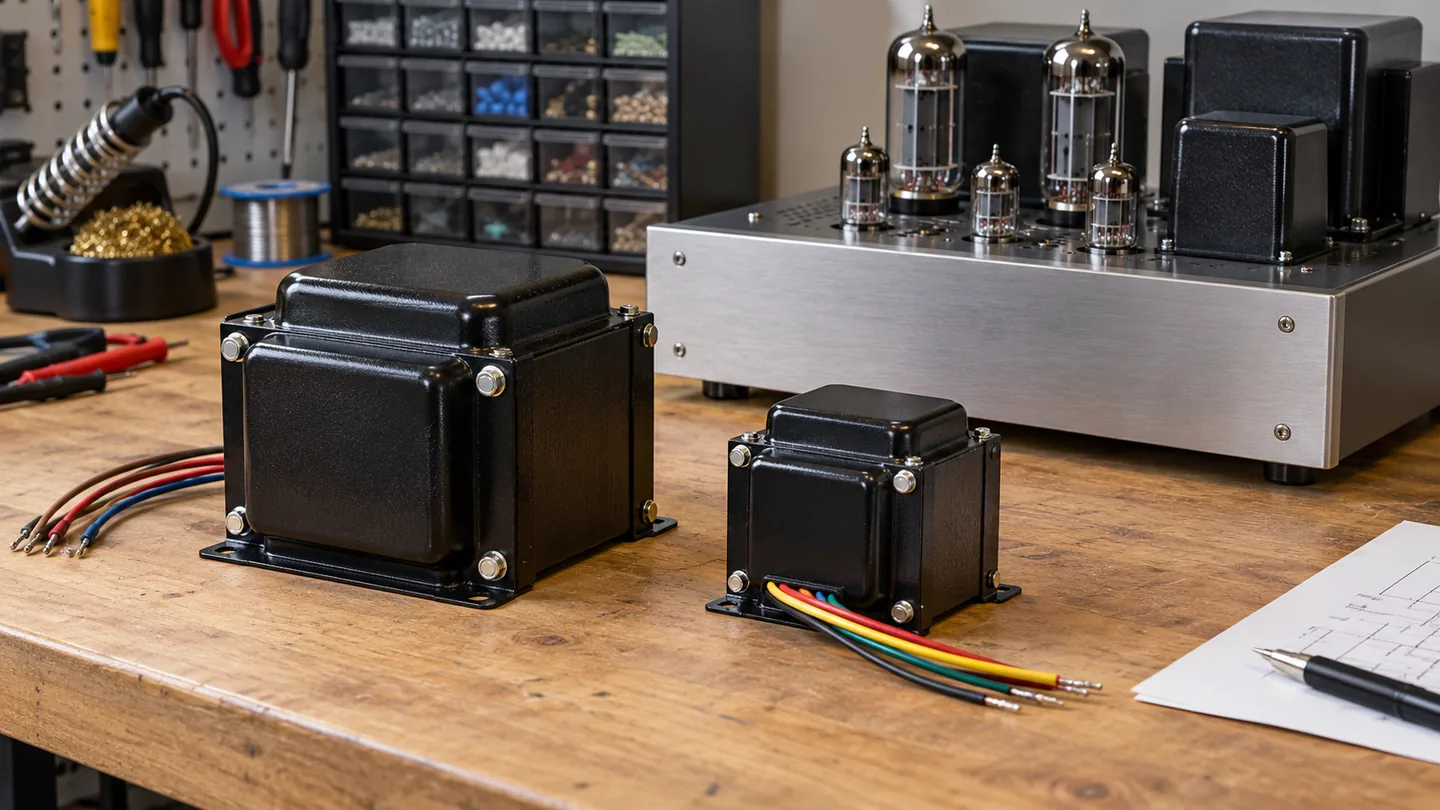
Illustrative image; not a photograph of a specific product.
Match the circuit before comparing transformer size
The primary impedance is the load reflected to the output tubes when the specified speaker load is connected to the corresponding secondary tap. It is not the winding’s DC resistance. If the design calls for a particular primary load, choosing an attractive transformer with a substantially different load changes the tube’s operating conditions. A technician should check the schematic and the output tube data before approving a substitution.
Topology matters just as much. A single-ended output stage carries standing DC through its primary and needs a transformer designed for that service. Hammond’s 1629SEA specification, for example, lists a 100 mA maximum primary DC bias alongside its 6,500-ohm primary and 30 W audio rating. These are ratings for that part, not targets for another circuit. A push-pull output stage has a different winding arrangement and typically a center-tapped primary. Hammond’s tube output transformer listings separate these categories rather than treating wattage as the only selection criterion. A push-pull part should not be assumed suitable for a single-ended circuit because its wattage looks generous.
For the speaker side, record the cabinet’s nominal impedance and the amp’s intended output connection. Hammond’s 1750C specification, for example, lists 5,000/8,000-ohm primary options, a 3.2-ohm secondary, and a 5 W rating for a single-ended design. It is an example of why a wattage number alone does not identify a compatible transformer, not a suggested Tweed Twin replacement. Where the candidate has multiple secondary taps, use the connection scheme in the amplifier documentation, including any feedback connection tied to a particular tap.
Will a larger output transformer add bass or headroom?
Compare published response at rated power rather than relying on weight. Hammond’s 125SE series specifies 100 Hz–15 kHz at full rated power within ±1 dB, and points readers to another series for wider response. This illustrates a specified bandwidth difference between product families; it does not predict an audible result in the Tweed Twin or establish how either part behaves in a different circuit. Cabinet, speaker, coupling network, output-stage bias, and feedback can also affect what a player hears as thin, harsh, or compressed.
For the Tweed Twin question, ask first for the exact transformer part number, schematic revision, speaker impedance, and whether the symptom appears clean, overdriven, or with one cabinet only. These details separate a sourcing decision from fault diagnosis. If the transformer overheats, smells, or has visibly damaged insulation, stop using the amp and seek qualified service.
A purchasing checklist that avoids a costly mismatch
Ask the supplier or technician to confirm the circuit topology, required primary impedance, rated output power, permissible primary DC current where applicable, secondary taps, mounting footprint, lead identification, and any feedback wiring requirements. Compare the specific candidate’s current datasheet with the original circuit documentation. If either is unavailable, state the gap before buying; a model family name or informal “equivalent” label is not enough.
Do not choose an oversized unit when the real goal is to fix an unidentified distortion fault, or choose a physically convenient unit whose load or topology is wrong. Tube amplifiers can retain hazardous voltage after being unplugged. Internal inspection and transformer replacement belong with a qualified technician. A customer can still make the process efficient by supplying the model, schematic, existing part number, and cabinet details before the visit.
Sources
- Reddit: Choosing a guitar amp output transformer — demand evidence and the builder’s context.
- Hammond electronic transformer catalog — manufacturer categories and selection data.
- Hammond 1750C — example of a model-specific primary, secondary, and power listing.
- Hammond 1629SEA — example with a stated maximum primary DC bias.
- Hammond 125SE series — example of a published frequency-response range at rated power.