
Check a replacement tube amp filter capacitor position by position against the amplifier schematic. Identify the reservoir, downstream filter, and any multi-section can connections first. Then compare capacitance, maximum operating voltage, rectifier limits, ripple current, temperature, polarity, and physical mounting for that position. An owner can collect the amp model and service details for a qualified technician; internal replacement is high-voltage work.
In a r/ToobAmps filter-capacitor discussion, an owner asked which brand to buy, gave target capacitances, and wondered whether older stock was acceptable. Commenters disagreed about brands and materials. The thread establishes a real shopping question, but its replies cannot validate a replacement for an unidentified circuit position or prove that old stock remains serviceable.
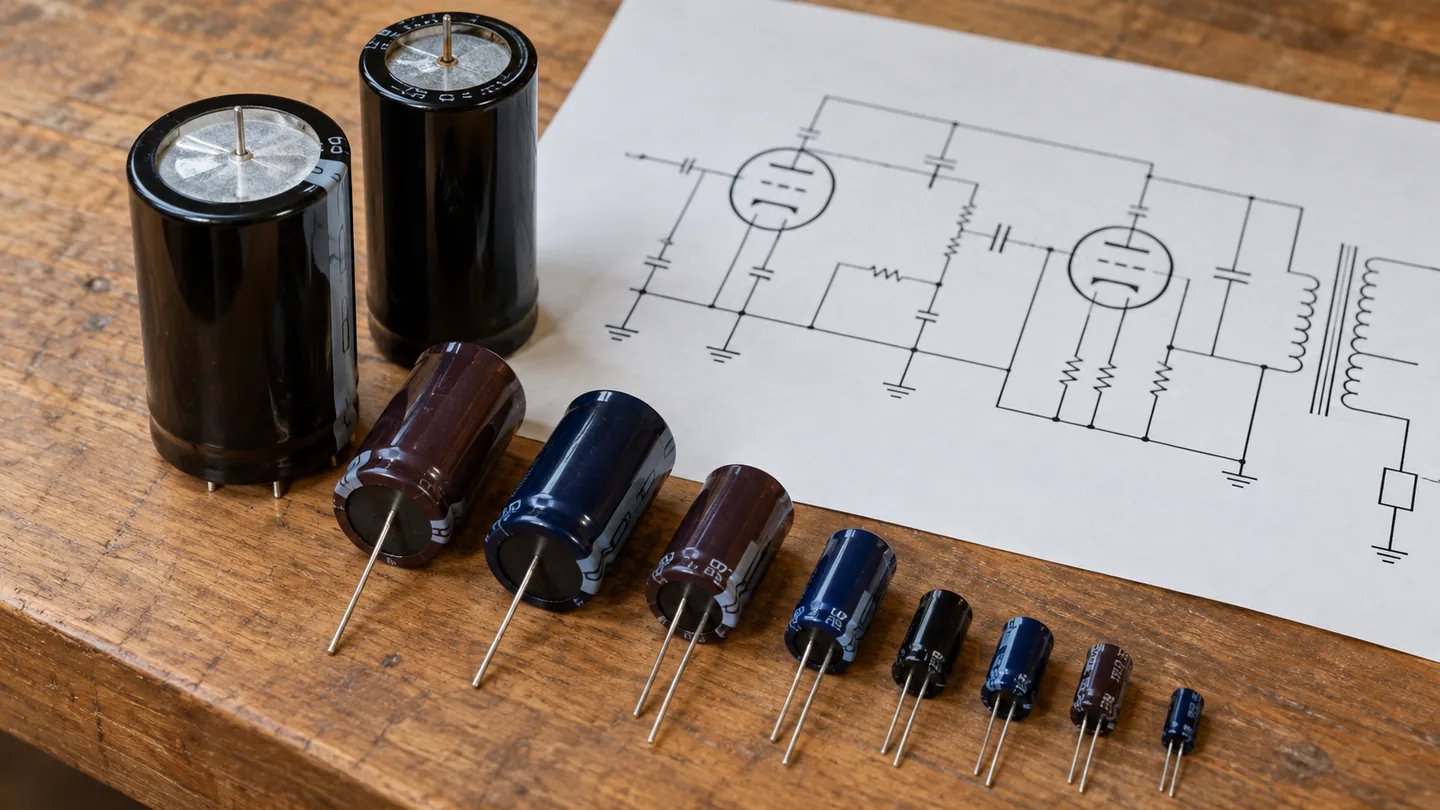
Illustrative image; not a photograph of a specific product.
Map the original circuit before shopping
A service list should give each schematic reference, supply node, original value, proposed part number, and unresolved condition. List each multi-section can connection separately. Resolve differences between the schematic and actual amplifier before approving parts.
| Schematic question | Replacement check | Stop if unknown |
|---|---|---|
| Which filter position is this? | Record the reference designator and connected supply node. | Circuit revision or wiring differs from the drawing. |
| What stress does it see? | Check maximum voltage, ripple current, and local temperature. | Only a typical voltage or brand name is known. |
| How is it mounted? | Confirm polarity, terminal type, dimensions, and secure fit. | A lead or can would need an improvised unsupported mount. |
Separate voltage rating from capacitance
Voltage rating is the capacitor’s limit under specified conditions. A candidate must withstand the voltage it will actually encounter, including relevant startup or unloaded conditions; the value printed on an old capacitor is a clue, not a full modern design review. A higher voltage rating is not inherently a problem if the component otherwise fits and meets the circuit needs. A lower rating should never be justified by a typical operating reading alone.
Capacitance deserves its own check. A larger first filter capacitor can change rectifier charging stress, so “more µF for tighter bass” is not a universal upgrade. For example, the JJ GZ34S rectifier datasheet lists 60 µF for capacitor-input operation alongside particular transformer-voltage, current, and series-resistance conditions. It is a limit for that rectifier in the specified context, not a universal first-filter target or approval to increase an existing value to 60 µF. Identify the actual rectifier and check its requirements and the amplifier design. Downstream filter sections can have different roles and voltages. Preserve the original topology and document each position before selecting parts; a multi-section can capacitor is not one interchangeable value.
Compare each proposed part’s datasheet
TDK’s aluminum electrolytic capacitor technical information explains that permissible ripple current is specified for defined temperature conditions and that useful life depends on voltage, current, ambient temperature, and cooling. That is why two capacitors with the same capacitance and voltage marking may be poor substitutes for one another. The exact series datasheet is needed for ripple rating, endurance conditions, dimensions, and terminal style.
Price and brand do not establish compatibility. Compare exact series datasheets under the same conditions. A temperature label alone cannot predict life in a cramped chassis. If offered older stock, request its exact series and storage history when available, then check the maker’s storage guidance. TDK notes that leakage current can rise after voltage-free storage; its guidance is product-specific, so age alone cannot validate or condemn another brand’s part. Assessment or reforming of a questionable high-voltage capacitor belongs to qualified service, not an owner-level shopping test.
Fit and safety are part of selection
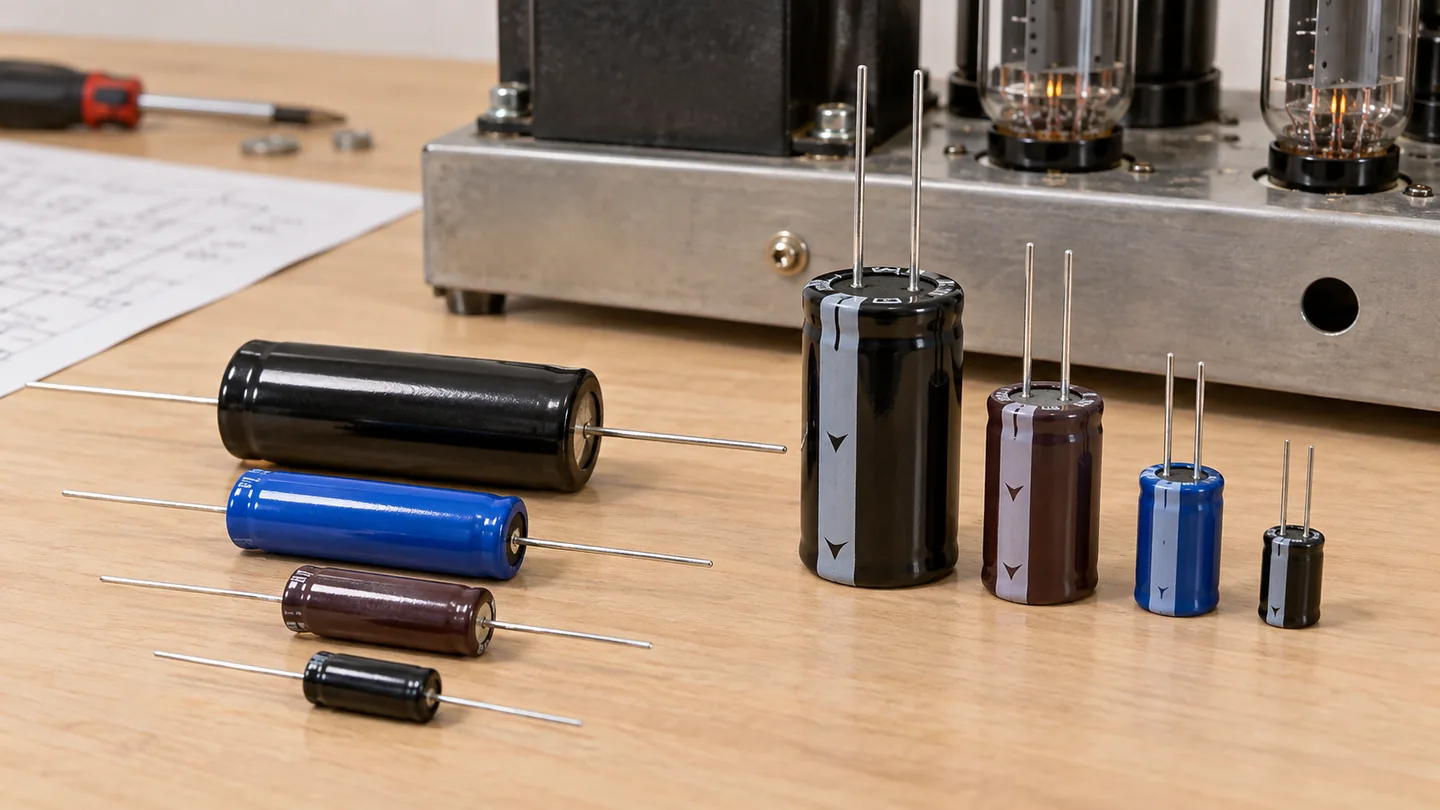
An axial part, radial part, snap-in part, and chassis-mounted can may demand different mechanical solutions. Lead spacing, can diameter, height, polarity markings, mounting security, and proximity to hot components should be checked against the actual chassis. Improvised mounting can introduce a reliability or safety problem even when the electrical ratings look suitable. If a multi-section can is involved, the technician should map each section to the schematic before ordering.
Hum alone does not identify a failed capacitor. If the amp overheats, blows fuses, or has a visibly damaged component, stop using it and seek service. Do not open the chassis to inspect or discharge capacitors as a novice: stored energy can remain hazardous after unplugging.
For a useful quotation, send the technician the amplifier model, schematic if available, photographs of external labels or existing service records, and the symptom. Ask which original positions will be replaced, the exact proposed part numbers, and how the voltage, ripple, temperature, and fit requirements were checked. This yields a position-by-position decision without turning an online article into a live-circuit repair procedure.
Sources
- Reddit: Filter Capacitors — demand evidence about brand, values, and uncertainty.
- TDK aluminum electrolytic capacitors: general technical information — manufacturer guidance on ripple current and useful life conditions.
- JJ GZ34S datasheet — model-specific capacitor-input limit, not a rule for all rectifiers.