
If you own low-impedance headphones, do not assume a conventional output-transformerless (OTL) tube amp will drive them well. Check the amplifier’s published output power, output impedance, noise, and supported headphone range at your actual load. A transformer-coupled design may be a better candidate, but the transformer alone is no guarantee. A modern OTL design can also add circuitry that widens its usable range.
The buyer problem is visible in a Reddit discussion about using low-impedance Focal Celestee headphones with tubes. The original poster asks whether a suitable tube amp exists and is open to hybrids. Replies name transformer-coupled, OTL, and hybrid options, but product suggestions are community experience rather than proof that every named pairing meets the same technical target.
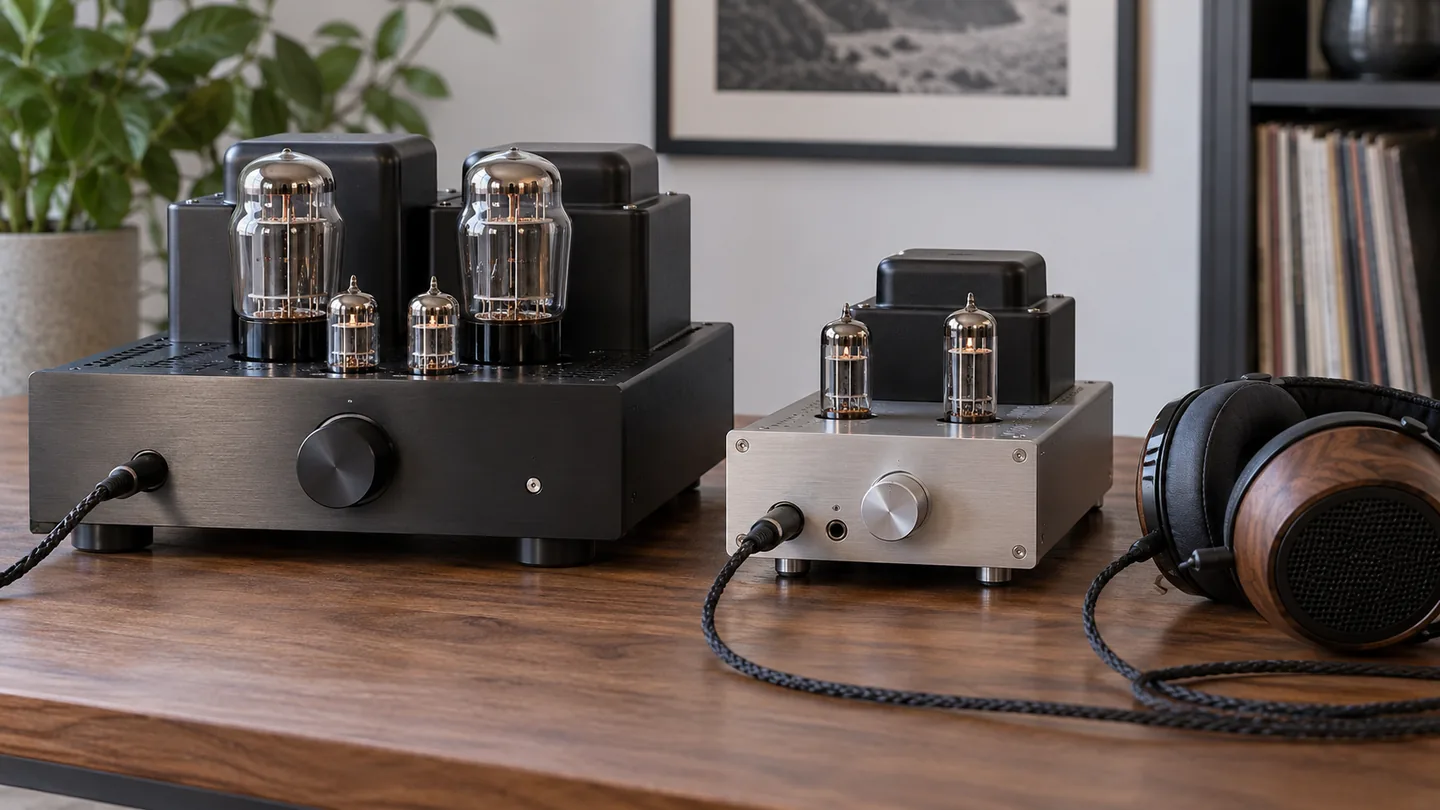
Illustrative image; not a photograph of a specific product.
What the two labels actually describe
OTL means there is no output transformer between the tube stage and the headphones. Transformer-coupled designs use an output transformer in that path. Neither term, on its own, states a product’s output impedance or power into a particular headphone. Circuit implementation, feedback, protection, and operating settings all matter.
Schiit’s Valhalla 3 specification provides a useful caution against treating OTL as one fixed capability. The maker describes it as an OTL design, lists different output impedances by gain mode, and supplies an impedance multiplier intended to extend operation with lower-impedance headphones. Its maximum-power ratings use a 10% distortion threshold, and the maker says some very low-efficiency models remain outside its intended range. The multiplier is not a promise of low output impedance or a clean-power rating at every load. These are product-specific claims, not properties of every OTL amp.
Match the amplifier to the headphones
Start with your headphone model’s impedance and sensitivity, then read the amp’s published performance at the closest stated load. Check whether the specification changes by output jack, gain, or another switch. As Headphones.com’s worked explanation shows, output impedance interacting with a headphone’s frequency-dependent impedance can alter tonal balance. Insufficient current or power can lead to distortion on peaks. Sensitive headphones may expose hiss even when an amplifier has enough power.
Ask the maker whether the exact headphone is supported if the published load does not match. Listen at a safe level for noise at idle, bass control, and clean peaks. Do not assume that a headphone with the same nominal impedance as yours will behave identically: sensitivity and impedance variation can differ.
When each approach makes sense
Consider an OTL amp when its documented output conditions and noise suit your headphones and you specifically want that design. Do not choose a traditional OTL solely for a low-impedance load because someone recommended “tube sound” without checking compatibility.
Consider a transformer-coupled tube amp when the manufacturer documents a suitable output for your load and you prefer its implementation. Do not assume it is automatically quiet with sensitive in-ear monitors or that its price predicts a better match. A hybrid is another legitimate option when the desired tube gain stage is paired with an output stage that supports your headphones; Schiit’s Vali 3 is a documented example of a tube voltage stage with a bipolar output stage.
Let the specifications and an audition decide the match; the topology label is a starting point. Schiit notes that Valhalla 3’s tubes get extremely warm, while the Rogue Audio M-120 manual warns that dangerous internal voltage can remain after disconnection. Follow the safety directions for your own model and leave internal work to qualified service personnel.