
Try your amplifier’s master volume at the listening level you actually need before buying an attenuator. A master volume and a speaker-output attenuator change different parts of the signal path, but the exact circuit varies by model. The right choice depends on whether your preferred sound comes mainly from the preamp, the power section, the speaker, or a combination.
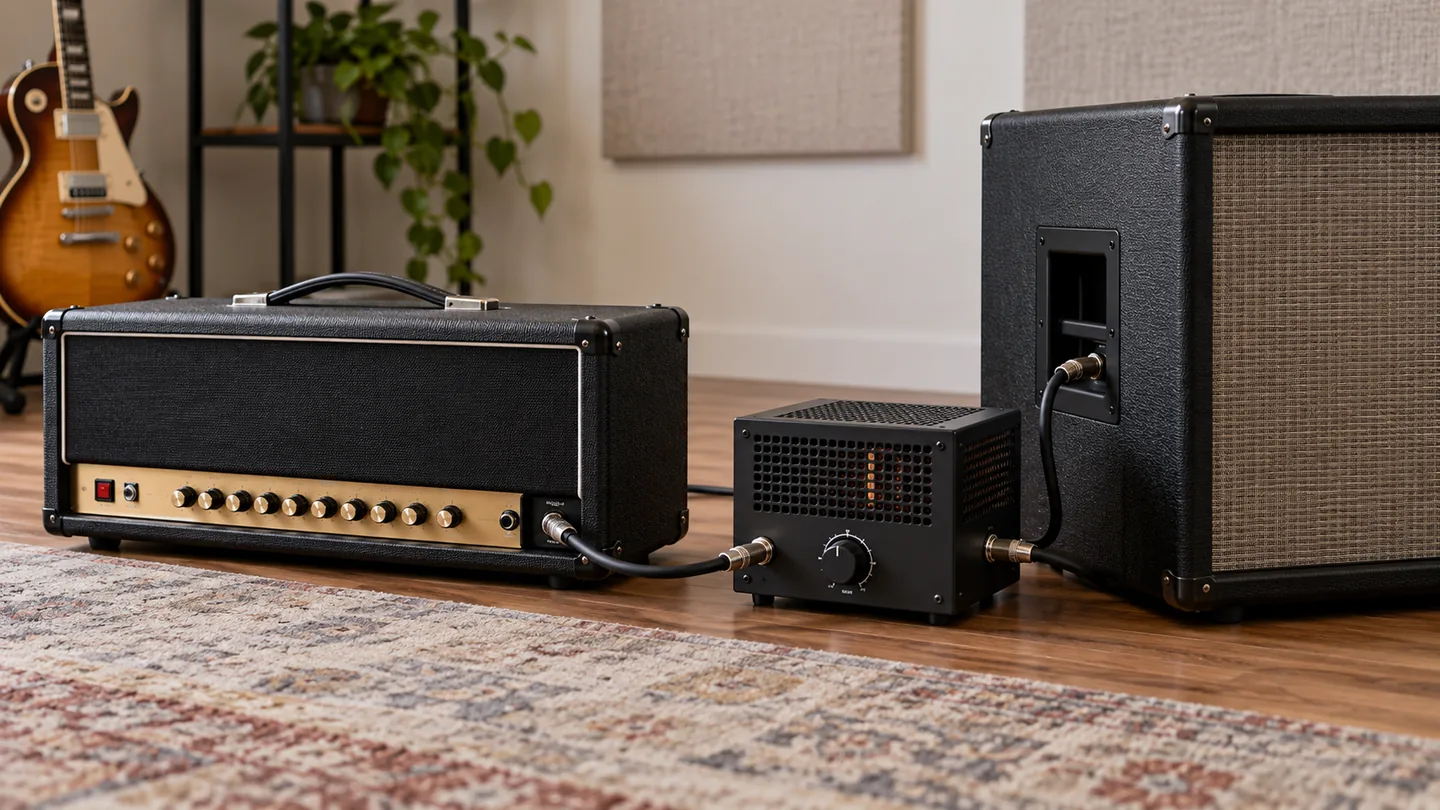
Illustrative image; not a photograph of a specific product.
Why the answers on Reddit conflict
One owner moving to an apartment described a “Princeton 65” that was too loud and asked whether to buy another amp with a master volume or an attenuator. The exact model is ambiguous: Fender has a solid-state Princeton 65 and a tube ’65 Princeton Reverb. The thread establishes the apartment-volume decision, but its model-specific load advice should not be transferred to an unidentified amp. In a separate thread whose original post is now deleted, visible comments describe different preferences for gain-channel and power-stage sounds. Those are user reports, not a universal tonal ranking.
Where each option sits
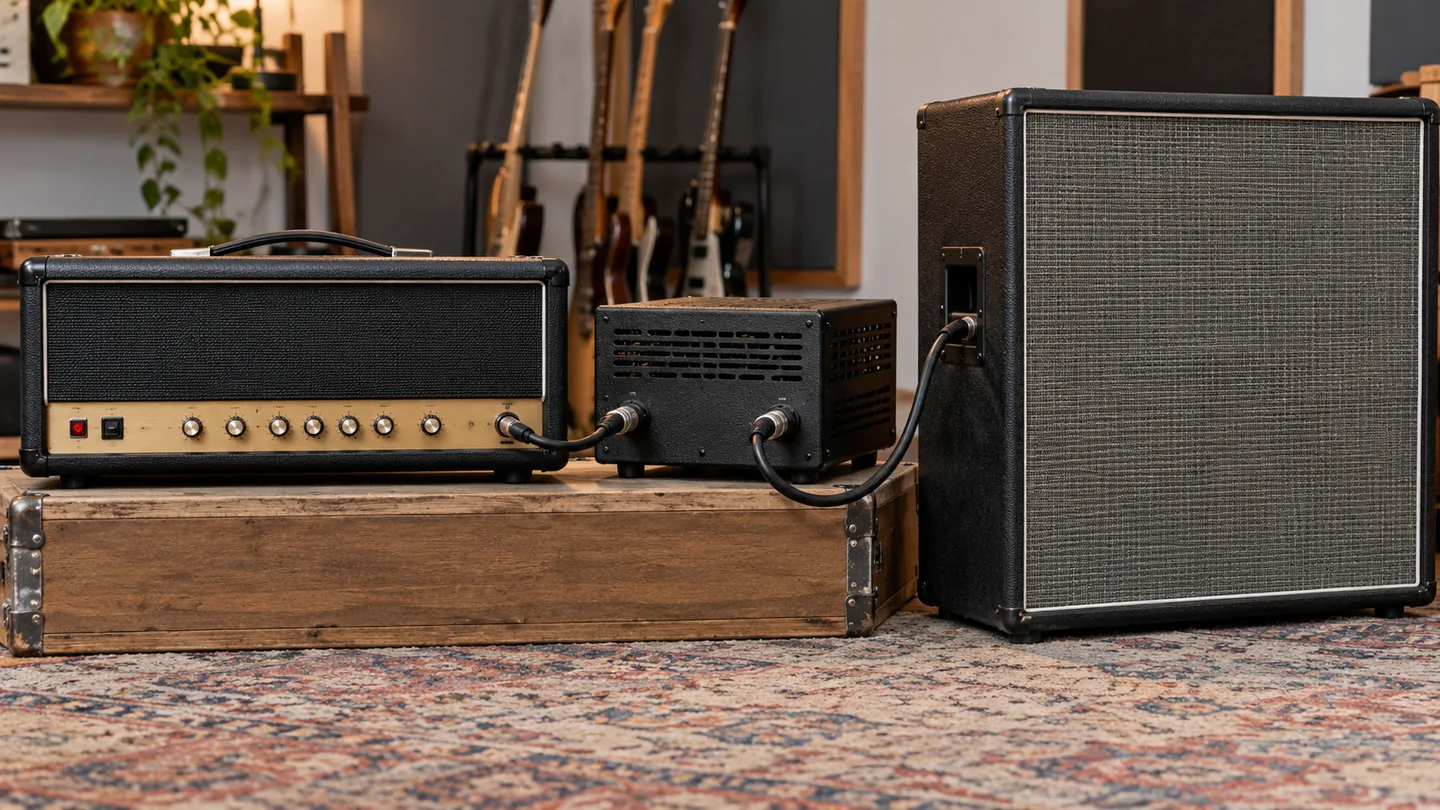
A conventional master volume is an amplifier control before the speaker output. An external speaker attenuator connects between the amplifier’s speaker output and a compatible cabinet; a load box may also permit operation without a cabinet if its manual explicitly says so. These devices are not interchangeable simply because both make a rig quieter. The exact topology varies: Orange’s Thunderverb 200 specification places its built-in attenuator after the master volume controls and before the output transformer. That internal circuit is not the signal path of an external speaker-output box. An attenuator may let the amplifier run at a setting the player prefers while the room is quieter, but the speaker is still moving less air.
| Situation | Start here | Reason |
|---|---|---|
| You like preamp drive at a quiet setting | Existing master volume | No extra box or cabling may be needed. |
| You want the sound of a specific louder amp setting | Compatible attenuator audition | It changes the speaker level after the amp output. |
| You need silent recording | Rated load box with line/cab output | An ordinary volume pedal is not a safe substitute for a speaker load. |
| You dislike low-volume speaker response | Headphones or monitors with cab simulation | Attenuation cannot make a quiet physical speaker behave exactly like a loud one. |
Compatibility is a purchase condition
Two Notes’ load-box guidance says a tube amplifier should be connected to a suitable load and that impedance and heat handling matter. Its Captor X manual specifies speaker cables for the amp-to-box and box-to-cabinet connections. Before buying, compare the amplifier manual’s speaker output, the device’s input impedance and power rating, and its exact speaker or silent-use connection. Keep the amp off while changing speaker connections. Do not treat a box in an effects loop as a speaker-output attenuator, and do not use an instrument cable for a speaker-output connection.
When not to choose an attenuator: your amplifier already sounds right at the required level, or the device cannot meet the amp’s load and power requirements. When not to rely on the master alone: the particular sound you want depends on a power-stage setting the master cannot reproduce at home volume. Audition both at the same perceived loudness, then decide whether the extra cost and setup deliver enough benefit.