
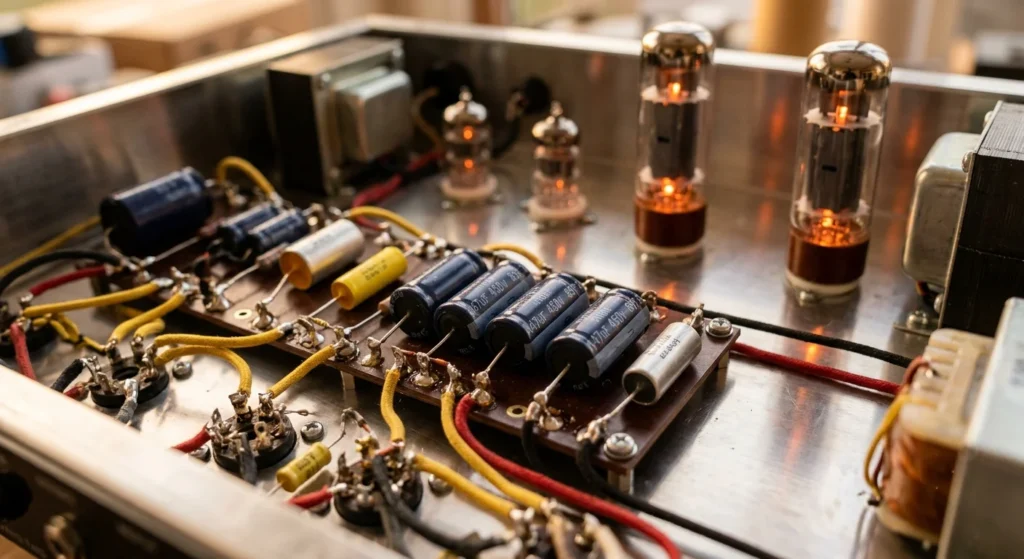
Selecting the right axial electrolytic capacitors directly impacts your board layout and overall circuit reliability. Axial lead components lay flat against the PCB, which suits low-profile enclosures, point-to-point wiring, and vintage audio amplifiers. As a result, you must balance physical case dimensions against your required capacitance and voltage rating.
Industrial aluminum electrolytic capacitors from Vishay and CDE deliver tight tolerances and low ESR for demanding power supplies. Meanwhile, alternative manufacturers like jb Capacitors and Tayda Electronics provide cost-effective options for high-volume prototyping. You also need high temperature ratings, such as 105°C, when placing components near hot power resistors or transformers.
Before routing your PCB, download verified CAD footprints for layout tools like Fritzing and Altium. This technical review compares key specifications, ripple current limits, and active stock across global component distributors. You will find the exact part number for your design needs right here.
Technical Specifications of Axial Aluminum Electrolytic Capacitors
To select the right part, you must compare key performance metrics like operating voltage rating, equivalent series resistance (ESR), and rated useful life under load. Standard axial lead aluminum electrolytic capacitors cover working voltages from 6.3V DC up to 500V DC. High-voltage power supplies require robust dielectric construction, whereas low-voltage digital rails demand minimal ESR to prevent unwanted voltage ripple. When you evaluate manufacturer datasheets, verify the rated capacitance at your specific operating frequency.
Thermal stress directly dictates overall operational longevity. A standard 85°C unit works reliably in ambient enclosures. However, you must specify a high temperature 105°C or 125°C rating when mounting components near heat sinks or power transformers. High ripple current ratings prevent internal self-heating under continuous load. Selecting a capacitor rated for 2,000 to 10,000 hours of useful life at peak operating temperature keeps your design reliable over years of service.
Industrial applications demand strict tolerance tracking and certified test data from established suppliers like Vishay or Cornell Dubilier. These premium components supply tight capacitance tolerances down to ±10% and stable performance across temperature shifts. Meanwhile, alternative brands like jb Capacitors and Tayda Electronics offer economical choices for early prototype builds. Always verify distributor inventory and physical case sizes before approving your final bill of materials.
Voltage Rating, Capacitance, and Operating Ranges
When you select physical case dimensions, you must evaluate how voltage ratings limit your total working capacitance. Commercial axial lead aluminum electrolytic capacitors cover capacitance values from 0.1 µF to over 10,000 µF. However, higher working voltages demand thicker dielectric layers inside the aluminum can. Consequently, a 450V axial unit provides far less capacitance than a 16V unit of the same physical size. You should choose a continuous working voltage (WVDC) rating with at least a 20% safety margin above your peak DC voltage.
To protect your circuit against stress, apply these operating parameters during component selection:
-
Voltage Derating: Derate your working voltage as operating temperatures approach maximum ratings. Running components at 80% of their rated voltage prevents dielectric breakdown during unexpected voltage spikes.
-
Capacitance Limits: Standard manufacturing tolerances fall between ±10% and ±20%. Power supply filter stages easily tolerate wider spreads, but precision timing networks require tight tolerance bounds.
-
Temperature Ranges: Standard axial parts operate from -40°C to +85°C, whereas industrial lines reach +105°C or +125°C. Sub-zero temperatures reduce effective capacitance and increase internal resistance.
Always verify these boundaries across your full expected environment before locking down your schematic parameters.
High Temperature Performance, Low ESR, and Useful Life Characteristics
Beyond verifying basic temperature boundaries, evaluate how high temperature performance, low ESR, and useful life characteristics dictate your board’s operational lifespan. Severe thermal stress dries out liquid electrolyte inside an axial lead package, accelerating capacitance loss and spiking internal resistance.
Calculate these critical parameters when evaluating aluminum electrolytic capacitors-for-amplifier-case-study/”>capacitors for high-demand designs:
-
High Temperature Margins: Select 105°C or 125°C rated components for high-density layouts, power supplies, or tube chassis. Operating an 85°C rated part near its upper limit rapidly degrades performance. Consequently, every 10°C reduction below the maximum rated temperature doubles component useful life.
-
Low ESR and Ripple Current Handling: Choose low ESR series to minimize internal self-heating caused by high ripple current. Internal resistance converts continuous ripple current into thermal energy, which breaks down the dielectric layer over time. Therefore, low ESR axial lead components maintain stable output voltage and run significantly cooler under dynamic loads.
-
Useful Life Endurance: Evaluate baseline useful life ratings, which range from 2,000 hours in standard commercial lines to over 10,000 hours in long-life industrial series at maximum rated temperature. Derating your operating voltage rating below the component maximum and maintaining air circulation stretches this operational life far beyond nominal datasheet values.
Leading Manufacturers and Series Comparison
Apply these technical benchmarks when selecting axial lead aluminum electrolytic capacitors across major commercial product lines.
-
Vishay Sprague Series (TVA ATOM™, 021 ASM, 030/031 AS, 30D/39D): Specify Vishay TVA ATOM™ series for high-voltage tube circuits requiring voltage rating specs up to 500V DC. As a result, these heavy-duty axial lead components withstand severe electrical stress while maintaining low leakage current. In addition, select the Vishay 021 ASM series when building compact power supplies that require extended useful life at 85°C. For industrial hardware exposed to elevated ambient heat, choose the 030/031 AS or 138 AVL lines to achieve up to 10,000 hours of endurance at high temperature ratings up to 105°C.
-
Cornell Dubilier / CDE Offerings: Select CDE axial lead components when your circuit design demands high ripple current capacity and mechanical durability. For instance, CDE lines feature thick outer sleeves and heavy-gauge lead wires that resist mechanical shearing under physical shock. Consequently, you can install these components in rugged automotive or industrial environments without risking physical fatigue at the solder joints.
-
jb Capacitors and Tayda Industrial Alternatives: Deploy jb Capacitors or Tayda general-purpose aluminum electrolytic capacitors for cost-sensitive production runs and bench prototypes. Specifically, these commercial series deliver stable nominal capacitance across standard -40°C to +85°C operating windows. However, you must verify ripple current limits carefully when integrating these lower-cost options into dynamic power supply outputs.
Vishay Portfolio: TVA ATOM™, 021 ASM, 030/031 AS, and 30D/39D
Beyond these budget and industrial alternatives, evaluate Vishay’s specialized axial aluminum electrolytic capacitors against your precise operating parameters. Compare these four core series to optimize your circuit performance and system longevity:
-
Vishay TVA ATOM™ Series: Specify TVA ATOM™ capacitors when engineering high-voltage tube circuits or servicing legacy audio hardware. These units handle voltage ratings up to 500V DC while maintaining low DC leakage current. Their larger case dimensions accommodate severe dielectric stress, making them ideal for point-to-point wiring layouts.
-
Vishay 021 ASM Series: Select the 021 ASM line for compact power supply decoupling networks operating under standard thermal conditions. This miniature series provides a strong ratio between physical volume and electrical endurance. You achieve up to 8,000 hours of useful life at 85°C.
-
Vishay 030/031 AS Series: Deploy the 030/031 AS series in severe ambient environments that demand high temperature resilience. These axial lead components sustain operational stability up to 105°C. As a result, they handle heavy continuous ripple current without causing premature capacitance drop.
-
Vishay 30D / 39D Powerlytic™ Series: Integrate 30D and 39D capacitors into industrial filter stages requiring maximum capacitance-voltage density. The 39D series delivers exceptionally low equivalent series resistance. Consequently, it withstands aggressive dynamic loads in heavy-duty linear power supplies.
Industrial Alternatives: jb Capacitors, CDE, and Tayda Offerings
Beyond Vishay’s portfolio, you must evaluate CDE, jb Capacitors, and Tayda offerings against your specific thermal and mechanical demands. Each manufacturer targets distinct operating profiles across the cost-performance spectrum.
-
Cornell Dubilier (CDE): Specify CDE axial lead components for high-vibration environments and severe mechanical stress. CDE utilizes heavy-gauge lead wires and thick outer sleeves. Consequently, these units absorb physical shock without cracking internal seals. Their elevated ripple current handling and high temperature tolerance suit demanding industrial power supplies.
-
jb Capacitors: Select jb Capacitors JAE or JAF series to balance unit cost with stable electrical parameters. These axial lead aluminum electrolytic capacitors offer broad capacitance selections and voltage ratings reaching 450V DC. Furthermore, their 105°C rating extends overall useful life in mid-tier power conversion stages.
-
Tayda Offerings: Deploy Tayda budget aluminum electrolytic capacitors strictly in non-critical prototyping or low-stress commercial designs, While cost-effective, these components feature tighter thermal limits and lower rated ripple current. Therefore, you must verify dynamic loads and operating margins before deploying them in production hardware.
Design Comparison: Axial Lead vs. Radial Electrolytic Capacitors
Evaluate these trade-offs against your layout requirements to determine whether an axial lead or radial aluminum electrolytic capacitor best serves your circuit topology, While radial capacitors dominate modern dense layouts, axial configurations provide distinct mechanical advantages for specialized power conversion and audio equipment.
-
Mechanical Stability and Vibration Resistance: Lay axial lead components flat against the PCB substrate to lower the center of gravity. As a result, these units absorb severe mechanical shock without snapping solder joints or cracking case seals.
-
Thermal Dissipation and Useful Life: Account for ambient operating conditions when calculating total useful life under high temperature stress. The longer cylindrical body of an axial lead capacitor spreads internal heat across a wider surface area. Consequently, this geometry maintains stable performance when subjected to continuous ripple current loads.
-
Electrical Density and Circuit Integration: Match your required voltage rating and total capacitance to the available board footprint. Radial components yield higher volumetric efficiency for tight modern assemblies. In contrast, axial units provide robust insulation margins and simplified routing for high-voltage power supplies and point-to-point power stages.
Form Factor, Mechanical Stability, and Vibration Resistance
Evaluate physical dimensions and terminal strain before selecting an axial lead aluminum electrolytic capacitor for high-vibration power conversion units. In heavy industrial machinery, standard radial packages often suffer lead fatigue from cantilever forces. Consequently, axial aluminum electrolytic capacitors secure both ends directly to the PCB substrate, which redistributes mechanical stress along the full body length.
Deploy heavy-gauge axial lead series when mechanical vibration threatens solder joint integrity. For example, specify thick-lead axial components when board flexure exceeds standard vibration thresholds. This horizontal mounting arrangement drops the center of gravity flat against the board. As a result, the component withstands continuous multi-axis shock without extra mounting clips or silicone adhesives.
Specify axial configurations to maximize the outer surface area for heat dissipation, Because the elongated body exposes more aluminum casing to ambient airflow, these capacitors run cooler under continuous ripple current loads. Therefore, adopting an axial form factor extends operational useful life in high temperature enclosures.
Point-to-Point Wiring and Vintage Audio/Tube Amplifier Restoration
Point-to-point chassis wiring relies on these mechanical and thermal characteristics when modernizing high-voltage vacuum tube amplifiers. Modern axial lead aluminum electrolytic capacitors bridge directly across tube sockets, terminal strips, and turret boards.
Specify components with a voltage rating between 450V and 600V to handle high DC plate supply levels safely. In contrast, radial capacitors present physical routing challenges on point-to-point terminal tags. Radial leads force long, uninsulated wire runs across the chassis that elevate insulation breakdown risks. Therefore, specify axial lead series like Vishay TVA ATOM or CDE 500 to maintain exact physical clearances and historical aesthetic alignment.
[Turret/Terminal Strip] --- (Axial Capacitor Body) --- [Tube Socket Pin]
                             <--- Extended Case Surface --->
                               (Direct Airflow Cooling)
Evaluate high temperature ratings up to 105°C when placing filter components near power tubes. Vacuum tubes dissipate substantial radiant heat inside closed steel chassis. As a result, selecting low ESR axial units with high ripple current capability prevents internal thermal runaway and extends operational useful life.
Always match the original capacitance values closely during power supply overhaul. Oversizing the primary filter capacitance increases turn-on inrush current through vacuum tube rectifier plates. Consequently, choosing correctly rated axial aluminum electrolytic capacitors maintains original circuit dynamics while ensuring reliable performance for decades.
PCB Layout Integration and Global Sourcing Strategies
Proper selection of axial lead aluminum electrolytic capacitors for modern PCB integration requires balancing raw electrical performance against physical package dimensions. High voltage rating requirements dictate larger case lengths and diameters. Consequently, board designers must verify CAD footprint spacing before finalizing layout traces.
In contrast to radial packages, axial lead components spread heat over a larger board surface area. As a result, operating an axial capacitor near its maximum ripple current limit yields lower internal core heat. You must evaluate useful life ratings at maximum ambient operating temperatures when selecting parts for production. Premium industrial series provide up to 5000 hours of useful life under high temperature conditions. In contrast, standard commercial grades offer shorter lifespans under continuous thermal stress.
-
Capacitance and Voltage: High capacitance values in high-voltage designs demand larger physical volumes. Consequently, you must adjust board mounting pitch accordingly.
-
Thermal Endurance: High temperature ratings up to 105°C extend circuit longevity near hot power components. Therefore, select high-temperature series for enclosed power electronics.
-
Ripple Current and ESR: Lower equivalent series resistance directly reduces heat generation under heavy AC ripple loads. As a result, low ESR axial capacitors enhance overall system efficiency.
Verify lead spacing and pitch parameters in your EDA footprint library to prevent board assembly errors. Consequently, standardized layout guidelines ensure smooth purchasing and assembly across global supply chains.
CAD Footprints, EDA Libraries, and Fritzing Schematics
When you map axial lead aluminum electrolytic capacitors to EDA footprints, physical package dimensions directly dictate your board layout rules. Standard high temperature industrial series feature larger can dimensions than commercial grades of equivalent capacitance. As a result, you must adjust pad-to-pad pitch in software like KiCad, Altium, or Fritzing to prevent mechanical stress on the lead seals.
For example, high-voltage Vishay TVA ATOM components require wider hole spacing than compact axial alternatives from jb Capacitors or Tayda. Consequently, assigning a generic axial schematic footprint without referencing manufacturer mechanical drawings leads to assembly failure on manufactured PCBs. You must model both the physical body length and lead bend radius accurately within your EDA library. Therefore, verified 3D STEP models prevent physical collisions with adjacent transformers or chassis walls in tight layouts.
Evaluate these physical and electrical constraints when building custom footprint libraries:
-
Lead Spacing and Hole Diameter: Higher voltage rating and higher capacitance parts use thicker axial lead wires up to 1.0 mm. Consequently, you must increase pad drill diameters to ensure proper solder penetration during production.
-
Thermal Courtyards: Operating near maximum ripple current limits generates substantial internal heat. As a result, your CAD footprint must define larger clearance courtyards around high temperature parts to protect sensitive circuit traces.
-
Polarity Identification: Axial packages invite installation errors during manual assembly. Therefore, you must draw explicit polarity silk screen indicators and render distinct chamfered ends in your 3D and Fritzing part models.
Regional Distributor Selection and Purchasing Options
Beyond CAD footprint verification, you must evaluate supplier specifications to select the correct axial lead aluminum electrolytic capacitors for production. High-end industrial series from Vishay and Cornell Dubilier (CDE) offer high temperature endurance up to 105°C alongside extended useful life metrics exceeding 5,000 hours. Consequently, global distributors like Mouser and Digi-Key stock these premium brands for mission-critical assemblies requiring high ripple current tolerance.
In contrast, regional distributors supply budget lines from jb Capacitors and Tayda Electronics for general-purpose applications. These lower-cost components deliver standard capacitance values, but they typically exhibit higher equivalent series resistance (ESR). As a result, using budget components in high-stress filtering circuits accelerates thermal aging and degrades circuit stability.
Evaluate these procurement criteria when comparing manufacturer series across regional channels:
-
High-Voltage Reliability: Vishay TVA ATOM and CDE series maintain stable dielectric integrity at a high voltage rating above 450V. Therefore, stock these parts through tier-one distributors for tube power supply restorations.
-
Sourcing Flexibility: Offshore suppliers provide broad capacitance ranges at lower price points for prototyping. However, you must verify their maximum operating temperature limits to prevent early field failures under heavy thermal loads.
FAQ About axial electrolytic capacitors
What is the primary structural advantage of an axial electrolytic capacitor over a radial type?
In an axial electrolytic capacitor, wire leads extend from opposite ends of the metal cylinder rather than side-by-side from the base. This layout lets you solder the component flat against a circuit board instead of standing it upright. You gain a low vertical profile and improved physical stability because the capacitor body rests against the board surface.
This flat shape works best in tight enclosures and point-to-point wiring setups. When restoring vintage tube guitar amplifiers, you can stretch axial leads across terminal strips to bridge long gaps. Always place a small dab of silicone adhesive under the capacitor body during assembly to protect the wire leads from vibration damage.
How do operating temperature and ripple current affect axial capacitor service life?
When you run an axial capacitor at high temperatures, the liquid electrolyte inside evaporates. Raising the operating temperature by ten degrees Celsius slashes the capacitor’s working life in half. Excessive ripple current forces alternating current through internal resistance, generating extra heat inside the casing. This internal heating accelerates electrolyte loss.
You extend component life by selecting an axial capacitor rated for 105 degrees Celsius over an 85-degree model. During assembly, leave space between the capacitor body and the circuit board. Air moving through this gap cools the metal casing and preserves the electrolyte.
Can non-polar axial electrolytic capacitors be used in AC audio crossover networks?
You can use non-polar axial electrolytic capacitors in AC audio crossover networks. Amplifiers send alternating current to speakers, which causes voltage to switch directions hundreds of times each second. Standard polarized capacitors fail under these conditions, but non-polar versions handle the reversing current. Speaker designers put these compact parts in woofer circuits where you need high capacitance at low cost.
When you rebuild an old crossover, pick capacitors with a voltage rating higher than your system output. A 100-watt receiver needs capacitors rated for 50 or 100 volts to prevent breakdown during loud playback. Swap out original electrolytic parts after ten years, because the internal fluid dries up and changes your speaker crossover frequencies.