
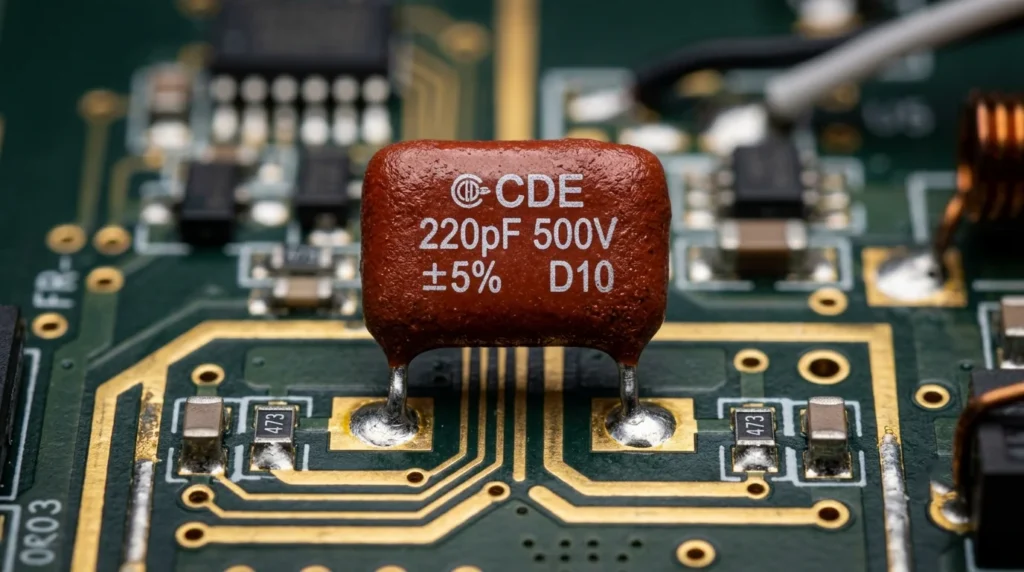
When stability and precision are non-negotiable, mica-capacitors”>silver mica capacitors remain the industry standard. As an RF engineer, I have spent decades testing these components in high-frequency filters and precision timing circuits.
Unlike standard ceramic capacitors, silver mica units use a highly stable natural silicate mineral as their dielectric. This unique physical construction delivers an exceptionally high Q factor, minimal temperature drift, and incredibly low electrical loss. Consequently, these components are indispensable in demanding RF applications and high-fidelity audio transmitters.
If you are currently designing a new circuit or sourcing legacy replacements, choosing the right manufacturer is critical. Leading brands like Cornell Dubilier set the industry benchmark for reliability, though this performance comes at a premium. This technical review evaluates their key electrical specifications, cost trade-offs, and leading market alternatives to help you make an informed purchase.
Understanding Silver Mica Capacitors: History, Materials, and Construction
To begin this evaluation, we must analyze how these parts behave under demanding bench conditions. For decades, silver mica capacitors have earned their place in high-stress RF applications due to their predictable performance. When you compare them to standard ceramic capacitors, the difference in capacitance stability is immediately apparent. Under fluctuating temperatures, a basic ceramic dielectric will shift wildly, whereas silver mica maintains its value. This stability is why brands like Cornell Dubilier remain the industry benchmark.
Also, these parts offer an exceptionally high Q factor that keeps energy loss to an absolute minimum, Because the dielectric consists of natural, cleaved mica sheets, it resists degradation even at elevated breakdown voltage limits. In practice, this means your tuned circuits stay precisely on frequency.
choosing these components is rarely about finding the cheapest option. Instead, it is a deliberate decision to prioritize long-term reliability over raw volumetric efficiency. If your project demands tight tolerances, investing in high-quality silver mica is your best choice.
The Evolution from Clamped Mica to Silver Deposition
This choice makes sense when you trace how these components evolved from early clamped designs to modern silver deposition. Historically, early RF circuits relied on clamped mica designs. These older parts used physical pressure to hold metal foils against raw mica sheets, Because of this mechanical interface, moisture intrusion and thermal expansion caused significant capacitance drift. Consequently, engineers struggled with frequency instability in high-power transmitters.
The industry solved this issue by transitioning to silver deposition. In this process, silver electrodes are screen-printed and fired directly onto the mica dielectric. This chemical bonding eliminates air gaps and mechanical shifting within the stack. By removing these physical gaps, manufacturers like Cornell Dubilier drastically improved capacitance stability.
Also, this direct deposition technique minimizes equivalent series resistance. This change directly elevates the high Q factor required for demanding RF applications. Compared to standard ceramic capacitors, which suffer from piezoelectric noise, silvered mica provides a highly linear response. Ultimately, this development transformed a sensitive mechanical assembly into a highly reliable, solid-state component.
Physical Structure and Epoxy Encapsulation Materials
This solid-state architecture relies on a precisely stacked physical structure of silvered mica sheets. Specifically, manufacturers assemble these individual layers to achieve the target capacitance value. Consequently, pure natural muscovite mica serves as the core dielectric material, Because of its atomic flatness, this cleaved mineral can be split into incredibly thin, highly uniform sheets. Silver electrodes are then screen-printed directly onto these sheets, and the alternating layers are stacked to form the capacitive element.
The terminal leads, typically composed of solderable copper-clad steel, are bonded directly to the edge of the silvered stack. This direct metal-to-metal interface ensures extremely low contact resistance. To protect this delicate internal assembly, the entire stack is dipped in a high-grade, vacuum-impregnated epoxy resin. Ultimately, this heavy-duty encapsulation acts as a robust barrier against moisture and atmospheric contaminants. Moisture ingress would otherwise degrade the high Q factor and lower the breakdown voltage of the unit.
Also, the cured epoxy provides superior mechanical rigidity. This rigidity prevents the microphonic noise that often plagues ceramic capacitors under physical vibration. Industry leaders, including Cornell Dubilier, utilize multiple dipping cycles to build a thick protective coating, Because of this rugged outer layer, the internal plates remain completely isolated from mechanical stress and thermal shock. Consequently, this construction maintains exceptional capacitance stability over decades. This makes these devices highly dependable for critical RF applications.
Key Technical Specifications and Performance Profiles
Achieving this level of reliability in RF applications requires a thorough understanding of the component’s underlying electrical limits. Consequently, designers must note that silver mica capacitors generally span a capacitance range from 1 pF up to 100,000 pF (0.1 µF). Within this range, they offer exceptionally tight tolerances, often reaching ±0.5% or ±1 pF for low-value units, Because of this precision, they are highly favored over standard ceramic capacitors in tuned circuits where even minor drift can detune the system. Furthermore, their breakdown voltage limits are remarkably high, typically ranging from 100 VDC to 1,000 VDC for standard radial parts, while heavy-duty transmitter variants can exceed 5,000 VDC. Ultimately, this high breakdown voltage rating allows the dielectric to withstand significant voltage spikes without physical puncture or electrical failure, Because the natural mica dielectric has an incredibly low loss tangent, these capacitors exhibit an exceptionally high Q factor that typically exceeds 1,000 at 1 MHz. Consequently, this minimized energy loss prevents self-heating and maintains signal integrity in high-power RF transmitters. Furthermore, their temperature coefficient is extremely stable and predictable, generally specified between 0 and +70 ppm/°C, Because of this linear temperature profile, engineers can easily implement temperature compensation in oscillator designs to prevent frequency drift. Ultimately, the combination of a robust physical structure and stable dielectric properties ensures that Cornell Dubilier and other premium silver mica components maintain their nominal capacitance stability over decades of continuous operation.
Capacitance Ranges, Tolerances, and Breakdown Voltage Limits
This long-term capacitance stability is directly tied to the precise physical parameters of the dielectric and the electrodes. Consequently, manufacturers like Cornell Dubilier can control the active area of the deposited silver to achieve nominal values spanning from 1 pF up to 100,000 pF (0.1 µF), Because of the physical volume constraints of stacking thin mica sheets, values above 0.1 µF become prohibitively large for standard printed circuit board layouts.
Within this range, engineers can obtain exceptionally tight manufacturing tolerances of ±0.5% or ±1 pF. As a result, these components are highly suited for critical tuning circuits in RF applications, Because of this structural precision, the actual capacitance deviates minimally from the nominal value during production runs. Consequently, hardware designers can eliminate adjustable trimmer capacitors from their designs, reducing overall system complexity and assembly costs.
Also, the dielectric breakdown voltage of these components is exceptionally high relative to their physical size. Standard radial-leaded parts easily handle operating voltages from 100 VDC to 1,000 VDC, while specialized transmitter variants can exceed 5,000 VDC, Because of this high breakdown limit, the internal dielectric layers resist puncture even when subjected to large voltage spikes. Ultimately, this voltage-handling capability ensures that silver mica remains far more reliable than standard ceramic capacitors under continuous high-voltage stress, preventing catastrophic circuit failures in high-power transmitters.
Exceptional High Q Factor, Low Dissipation, and Dielectric Absorption
To maintain transmitter stability under these high-power conditions, the capacitor must also exhibit minimal energy loss during high-frequency operation. Silver mica excels here by delivering an exceptionally high Q factor exceeding 1,000 at 1 MHz, Because of this high Q factor, the component exhibits an extremely low dissipation factor, often measuring below 0.1%. Consequently, very little RF energy is converted into waste heat within the dielectric material during operation.
This thermal efficiency is critical in high-power RF applications. In contrast, standard ceramic capacitors often suffer from dielectric losses that lead to localized self-heating under RF stress, Because of this thermal stability, silver mica prevents thermal runaway and maintains precise capacitance stability over long operating periods.
Also, the dielectric absorption of silver mica is virtually negligible. This physical property prevents the capacitor from retaining a residual charge after discharge. Consequently, signal phase errors are minimized in sensitive filtering and timing networks. Ultimately, the combination of a high Q factor and low dielectric absorption ensures clean, distortion-free signal processing in high-performance hardware.
Temperature Coefficient and Long-Term Value Stability
This clean signal performance must remain consistent across fluctuating thermal environments, Because of this requirement, the temperature coefficient of silver mica is engineered to be exceptionally low and highly predictable. Standard commercial components, such as those manufactured by Cornell Dubilier, typically exhibit a temperature coefficient ranging from 0 to +70 ppm/°C. Consequently, the actual capacitance stability of the device remains virtually unchanged even when subjected to extreme thermal cycling in high-power RF applications, Because of this stability, the component maintains its high Q performance across its entire temperature range without degrading the dielectric.
This thermal predictability is a direct consequence of the physical properties of the mica dielectric. Mica possesses a highly stable crystalline structure that does not undergo phase transitions within standard operating temperatures, Because of this structural integrity, the physical dimensions of the capacitive plates remain constant under thermal stress. In contrast, Class II and Class III ceramic capacitors experience significant capacitance shifts when temperatures fluctuate. Ultimately, using silver mica guarantees that tuned circuits do not drift off frequency during operation, regardless of the operating voltage or localized heat.
Beyond short-term thermal fluctuations, long-term capacitance stability is paramount for calibration-grade hardware. Silver mica capacitors exhibit an incredibly low aging rate, often showing less than a 0.1% change in value over decades of continuous service. This longevity occurs because the noble silver electrodes are chemically bonded to the inert mica sheet. Consequently, the component resists structural degradation and prevents changes to its breakdown voltage rating over time. Ultimately, this long-term stability reduces maintenance overhead and maintains system calibration over the equipment’s entire operational lifespan.
Strategic Applications of Silver Mica Capacitors
This long-term capacitance stability directly dictates how these components perform in demanding RF applications. In high-frequency oscillator circuits, any drift in capacitance shifts the operating frequency of the system, Because of this sensitivity to thermal and physical changes, design engineers specify silver mica to preserve precise transmitter alignment. These components also feature an exceptionally high Q factor that minimizes insertion loss. Consequently, they prevent signal degradation in narrow-band bandpass filters and impedance-matching networks.
Unlike typical Class II ceramic capacitors, silver mica does not exhibit a voltage-coefficient bias. As a result, the nominal capacitance value remains constant across the entire operating voltage swing. Leading manufacturers, such as Cornell Dubilier, design these parts with a robust physical dielectric capable of handling high voltage stresses. Ultimately, this high breakdown voltage rating protects transmitter tank circuits from catastrophic dielectric failures during high-power operations.
In vacuum tube audio amplifiers, the localized operating environment routinely experiences elevated temperatures, Because of this intense thermal environment, standard plastic film components can suffer from dielectric degradation. Silver mica capacitors maintain their physical integrity and electrical properties under these conditions. Ultimately, using these components in the signal path ensures low-noise performance and eliminates harmonic distortion caused by voltage modulation.
RF Transmitters, Oscillators, and High-Frequency Filter Networks
These same dielectric properties prove equally critical when transitioning from audio frequencies to demanding RF applications. In high-frequency transmitter circuits, temperature-induced frequency drift can compromise system compliance, Because silver mica maintains exceptional capacitance stability over time and temperature, it remains the standard choice for resonant tank circuits. Consequently, local oscillators using these components achieve highly predictable frequency control.
Unlike standard Class II ceramic capacitors, silver mica avoids the piezo-electric effects that introduce microphonic noise into sensitive RF systems. Furthermore, their extremely high Q factor minimizes insertion loss in multi-pole bandpass filters. As a direct result, receiver front-ends achieve sharper selectivity and transmitters emit fewer spurious harmonics.
In LC filter networks, impedance matching must remain stable across variable temperature profiles, Because silver mica has a low and highly repeatable temperature coefficient, it prevents filter detuning. As a result, the passband characteristics remain stable even during prolonged transmitter duty cycles.
Leading manufacturers like Cornell Dubilier design these components with a high dielectric breakdown voltage. This robust physical construction allows the capacitors to handle the high RF voltage swings present in impedance-matching networks. Therefore, the dielectric does not degrade under continuous-wave RF stress. Ultimately, choosing silver mica ensures long-term operational reliability in high-power RF systems.
Tube Amplifiers, Guitar Amps, and Premium Audio Equipment
Beyond RF applications, these same dielectric properties make silver mica highly effective inside vacuum tube amplifiers. Specifically, the high-voltage environment of vacuum tube grids and plates demands components with a high dielectric breakdown voltage. Standard ceramic capacitors often fail or exhibit voltage-coefficient bias under these intense electrical stresses. Consequently, using silver mica ensures unmatched capacitance stability even when subjected to DC bias levels exceeding 400 volts.
In the signal path of premium guitar amplifiers, the physical stability of the dielectric directly influences the audio output. Class II ceramic dielectrics exhibit piezoelectric characteristics, which convert chassis vibrations into audible microphonic noise, Because silver mica features a rigid, chemically bonded structure, it remains completely immune to these microphonic effects. Therefore, high-gain preamplifier stages maintain an exceptionally low noise floor during operation.
Also, the equalization networks and tone stacks of high-fidelity preamplifiers rely on precise, repeatable filter cutoffs, Because silver mica capacitors offer a high Q factor and extremely low dissipation factor, they prevent signal attenuation. As a result, the audio signal remains clean, avoiding the harmonic distortion typically introduced by non-linear dielectric materials.
Ultimately, hardware designers select components from reputable manufacturers like Cornell Dubilier to guarantee these tight tolerances. These premium capacitors maintain their nominal values despite the high operating temperatures found inside enclosed tube chassis. Consequently, the amplifier’s frequency response remains highly consistent from cold startup to prolonged thermal stabilization.
Comparative Evaluation: Silver Mica vs. Ceramic Capacitors and Porcelain
To maintain this thermal and frequency stability, engineers must compare silver mica, standard ceramic capacitors, and porcelain alternatives. Consequently, the choice of dielectric material directly dictates the component’s behavior under electrical and thermal stress. This choice is particularly critical in demanding RF applications and precision audio circuits.
Silver mica utilizes a natural mineral sheet as its dielectric, which inherently provides an exceptionally high breakdown voltage and superior capacitance stability. Therefore, it does not suffer from the voltage-coefficient degradation that routinely plagues Class II ceramic capacitors. Specifically, manufacturers like Cornell Dubilier engineer these components to deliver a high Q factor and negligible dielectric loss. As a result, silver mica consistently outperforms Class II ceramics in high-frequency RF applications.
Conversely, while porcelain capacitors also offer high Q values, they are typically limited to specialized microwave frequencies. Furthermore, the physical construction of silver mica ensures a near-zero temperature coefficient, typically rated around 0 to +70 ppm/°C. Consequently, the capacitance remains highly predictable, avoiding the thermal drift common in standard ceramic alternatives. Ultimately, a technical review of these materials highlights why silver mica remains preferred for high-voltage, high-Q environments. Its superior breakdown voltage rating, often exceeding 500V, ensures reliable operation where voltage spikes would rupture other components. Therefore, silver mica provides unmatched parametric stability in critical signal paths.
Dielectric Stability, Distortion, and Noise Performance
This parametric stability directly guarantees superior dielectric performance, minimal distortion, and low noise in high-fidelity circuits. Specifically, Class II ceramic capacitors rely on barium titanate formulations, which exhibit ferroelectric properties. Consequently, these ceramic dielectrics undergo capacitance shifts under varying DC biases and AC signal swings. This voltage-coefficient variation introduces significant odd-order harmonic distortion directly into the signal path.
Conversely, silver mica features a rigid, non-ferroelectric crystalline structure. As a result, its dielectric constant remains independent of applied voltage, preventing signal distortion. Furthermore, the physical properties of Class II ceramic materials make them inherently piezoelectric. Therefore, mechanical vibrations within an amplifier chassis generate electrical noise, which manifests as microphonics. Silver mica completely lacks these piezoelectric properties. Ultimately, it remains entirely immune to mechanical-to-electrical noise conversion.
For high-frequency RF applications, this dielectric stability also minimizes phase noise. Leading manufacturers, such as Cornell Dubilier, design these components to maintain a high Q factor across wide frequency bands. Consequently, silver mica prevents the dielectric absorption and signal loss that degrade sensitive filter networks.
Volumetric Efficiency, Mechanical Fragility, and Unit Cost
To maintain these high-performance RF characteristics, engineers must evaluate the physical and economic trade-offs of silver mica against modern ceramic capacitors, Because mica has a low dielectric constant (εr \approx 6) compared to Class II ceramic formulations, these components exhibit poor volumetric efficiency. Consequently, achieving even moderate capacitance values requires a physically large housing. Therefore, silver mica is generally restricted to values below 10,000 pF in standard through-hole configurations.
In terms of mechanical durability, the crystalline structure of raw mica is inherently brittle. Consequently, physical shock or excessive bending stress on the radial leads can cause internal delamination of the silvered layers. This damage ultimately compromises the protective epoxy encapsulation, allowing environmental moisture to penetrate. Subsequently, moisture ingress initiates silver migration across the dielectric, causing catastrophic breakdown voltage failures.
Also, the complex manufacturing process of sourcing, splitting, and stacking individual mica sheets increases production costs. Conversely, multilayer ceramic capacitors benefit from highly automated, co-fired mass production. Therefore, silver mica units carry a significant unit cost premium. Ultimately, engineers must justify this expense through the component’s superior capacitance stability and high Q factor in critical, low-tolerance RF applications.
Commercial Sourcing and Circuit Retrofitting
selecting the correct replacement requires a rigorous analysis of commercial technical specifications. Cornell Dubilier remains the primary manufacturer of high-quality silver mica components. Therefore, their CD15, CD19, and CDV19 series serve as the industry benchmarks for RF applications.
When sourcing these components, engineers must prioritize the dielectric breakdown voltage rating. Commercial silver mica parts typically offer voltage ratings from 100V to 2500V DC. Conversely, standard ceramic capacitors often exhibit reduced capacitance stability when subjected to high DC bias voltages. Silver mica maintains its rated capacitance regardless of the applied voltage. Ultimately, this voltage coefficient stability ensures highly predictable tuning in RF oscillators.
In addition to voltage stability, insulation resistance must remain high. These parts typically exhibit an insulation resistance exceeding 100,000 megohms at room temperature. Consequently, leakage current remains negligible even in high-impedance vacuum tube circuits. Therefore, they prevent DC bias drift in critical grid-coupling stages.
Capacitance tolerance is another critical factor during component selection. Standard tolerances range from ±5% down to ±0.5%. Consequently, these tight tolerances make them ideal for precise frequency-determining networks. Furthermore, the exceptionally high Q factor of the mica dielectric minimizes insertion loss in filter circuits. Substituting a lower-grade dielectric will inevitably degrade the overall selectivity of the system.
Finally, physical dimensions must match the circuit board footprint, Because silver mica units use a stacked-sheet design, higher capacitance values require larger package sizes. Ultimately, designers must verify lead spacing and housing dimensions before initiating a retrofit.
Sourcing from Cornell Dubilier and Other Leading Manufacturers
To address these physical footprint constraints, sourcing from dominant manufacturers like Cornell Dubilier Electronics (CDE) requires a strict examination of their standardized product series. Cornell Dubilier remains the industry benchmark for these components, particularly through their ubiquitous CD15, CD19, and CD30 dipped mica series. Consequently, specifying these exact part numbers ensures predictable lead spacing and casework clearance during retrofits.
From a technical evaluation perspective, these components leverage a highly stable raw muscovite mica dielectric. Therefore, they deliver exceptional capacitance stability across a wide thermal envelope, typically rated from -55°C to +125°C. Conversely, standard class 2 ceramic capacitors suffer from severe capacitance drift when subjected to temperature extremes. Furthermore, CDE’s standard dipped series achieves a high Q factor, often exceeding 1,000 at 1 MHz, which is critical for minimizing insertion loss in high-frequency RF applications.
When designing high-voltage transmitter stages, engineers must also verify the dielectric breakdown voltage of the selected package. For example, the CD15 series offers ratings up to 500 VDC, while the larger CD19 and CD30 packages safely scale to 1,000 VDC and 2,500 VDC, respectively. Ultimately, selecting the correct casing size prevents dielectric breakdown and guarantees long-term operational reliability under high RF power levels, While other legacy manufacturers like Sangamo or modern alternatives like Toshin Kogyo exist, Cornell Dubilier provides the most comprehensive datasheet documentation for modern engineering workflows. Thus, rigorous circuit design demands referencing these official datasheets to align electrical tolerances with physical constraints.
Step-by-Step Guidelines for Replacing Legacy Mica Components
a technical review of legacy silver mica specifications must precede any physical board modifications. When replacing aged components in critical RF applications, engineers must first calculate the exact circuit-operating parameters. Therefore, verifying the dielectric breakdown voltage prevents premature component failure under peak RF voltage swings. Replacing a high-voltage legacy unit with an underrated modern equivalent risks dielectric puncture.
Conversely, using standard ceramic capacitors as substitutes in tuned circuits compromises overall capacitance stability. Class 2 ceramics suffer from severe voltage coefficient degradation and temperature-induced drift. Furthermore, preserving a high Q factor is essential to maintain low insertion loss in transmitter filter networks.
Cornell Dubilier replacement parts provide highly documented performance curves to verify these parameters under active load conditions. Ultimately, physical dimensions must match the legacy circuit board layout. Modern dipped-mica packages often possess different lead-spacing profiles compared to vintage molded styles. As a result, precise lead forming or pad modification is frequently required during the retrofitting process.
FAQ About silver mica capacitors
Why are silver mica capacitors preferred over ceramic disk capacitors in RF applications?
Silver mica capacitors are the go-to choice for radio frequency (RF) applications because they offer outstanding stability and very low energy loss. Unlike common ceramic disk capacitors, which can drift wildly in value as temperatures change, silver mica capacitors keep their capacitance incredibly steady. They also have an exceptionally high quality factor, meaning they do not waste precious RF signal energy as heat. This makes them perfect for sensitive, high-frequency circuits where precision is key.
As a practical tip, if you are building or repairing a shortwave radio’s tuning circuit, always opt for silver mica over ceramic. Using a standard ceramic disk in these circuits will likely cause the radio’s frequency to drift as the equipment warms up, causing your signal to frustratingly wander off-station.
Do silver mica capacitors degrade or suffer from silver migration over time?
Yes, silver mica capacitors can definitely degrade over time due to a well-known phenomenon called silver migration, often nicknamed “silver mica disease.” This happens when moisture combined with continuous DC voltage causes silver ions to travel across the mica insulator. Over time, this creates unwanted conductive paths, leading to electrical leakage, crackling noises, or sudden component failure.
This issue is especially common in vintage audio gear and tube radios. As a practical tip, if you are restoring an old radio and hear a loud, random crackling static—often described as sounding like a thunderstorm—you should inspect and replace the silver mica capacitors inside the intermediate frequency (IF) transformers. Swapping them out for modern ceramic or film capacitors is a great way to bring your classic equipment back to life safely and reliably.
What are the best modern surface-mount (SMD) alternatives to silver mica?
If you want to replace bulky silver mica capacitors with modern, space-saving surface-mount technology, your best option is the C0G ceramic capacitor, which is also commonly called NP0. These components offer the same high stability, low loss, and resistance to temperature changes that made silver mica famous, but at a fraction of the size and cost. They are perfect for radio frequency circuits, precision timing, and audio equipment.
As a practical tip, when you are shopping for replacements in high-frequency radio filters, specifically look for “high-Q” rated C0G capacitors. These are specially designed to minimize signal loss, ensuring your modern circuit performs just as beautifully as the vintage original.