
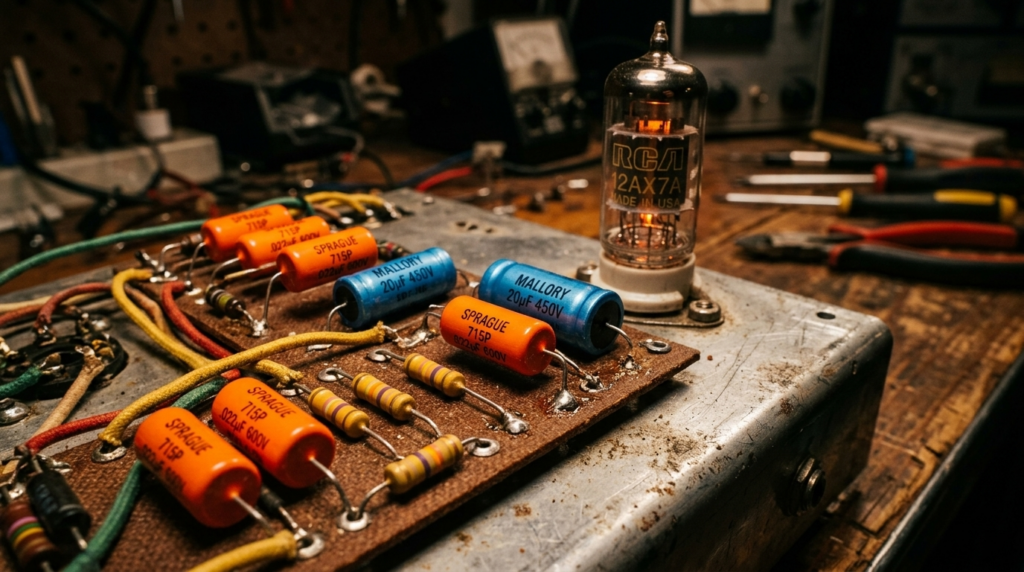
Upgrading your tube amp capacitors is the single most effective way to restore vintage tone and reduce hum. Over time, original components degrade, dragging down your guitar amplifier’s dynamic response and clarity.
Filtering sections demand robust, high-voltage electrolytic capacitors to keep the power supply quiet. For this critical job, German-made F&T caps and classic Sprague Atoms remain the industry standards. Meanwhile, swapping generic signal coupling caps for Orange Drop radials can reshape your mid-range bite and overall warmth.
Beyond choosing the right brands, successful capacitor matching requires strict attention to technical specifications and circuit safety. You must safely discharge the high-voltage power supply before touching any internal leads.
This technical review compares the best replacement kits and individual components currently available. We analyze ESR ratings, physical fit, and tonal characteristics to help you select the ideal upgrade for your rig.
Anatomy of Tube Amp Capacitors: Critical Functions and Types
To optimize your guitar amplifier, you must evaluate how different components handle high-voltage demands and audio signals. Selecting the wrong component can ruin your tone or cause premature circuit failure.
For example, high-voltage electrolytic capacitors maintain power supply stability by filtering out AC ripple. Consequently, choosing a brand with low Equivalent Series Resistance (ESR) directly translates to a tighter, punchier low-end response. In contrast, signal coupling capacitors block DC voltage while passing the audio signal to the next gain stage. For this specific job, the physical composition of the dielectric material shapes your overall EQ.
The following technical comparison highlights the leading individual components and kit upgrades preferred by bench technicians:
| Brand & Series | Capacitor Type | Max Voltage Range | ESR / Leakage Characteristics | Tonal Profile & Best Application |
|---|---|---|---|---|
| F&T LFA / Dual | Aluminum Electrolytic | 450V – 500V | Extremely low ESR, high ripple current | Tight, articulate bass response; ideal for power filtering. |
| Sprague Atom | Aluminum Electrolytic | 450V – 600V | Moderate ESR, low leakage | Classic vintage compression and “sag”; great for retro restorations. |
| Orange Drop 715P | Polypropylene Film | 400V – 600V | Negligible ESR, zero DC leakage | Bright mid-range bite, high clarity; perfect for coupling. |
| CDE Silver Mica | Silver Mica | 500V | Extremely low drift and loss | Crisp, detailed high-end; best for tone stacks and bright caps. |
Practically speaking, we recommend F&T electrolytic capacitors for power filtering because of their compact physical size. Consequently, they fit easily into vintage chassis where mounting space is limited. For classic American circuits, upgrading to Orange Drop coupling capacitors restores original clarity. Furthermore, silver mica caps offer unmatched reliability and high-frequency stability under high heat.
Power Supply Filter Capacitors
Building on these thermal considerations, optimizing power supply filter capacitors requires balancing filtration with vintage circuit dynamics. Specifically, these large electrolytic capacitors smooth rectified AC voltage into clean DC. This process directly impacts the noise floor and transient response of the power section.
When selecting replacements, matching the original operating voltage is your primary safety check. For instance, using a capacitor rated at 450V in a circuit that surges to 480V causes catastrophic breakdown. Consequently, techs often select premium F&T or Sprague electrolytic capacitors rated at 500V or higher. This design choice builds a reliable safety margin against modern wall voltage fluctuations.
Beyond safety, modifying capacitance values alters the feel and touch sensitivity of the guitar amplifier. For example, doubling the capacitance of the first filtering stage reduces hum and tightens low-end recovery. However, you must exercise caution when working with tube-rectified circuits. Specifically, rectifier tubes like the GZ34 have strict maximum capacitance limits. Exceeding these limits causes excessive current draw, which quickly ruins the tube. In contrast, solid-state rectified amps handle larger capacitance upgrades with ease. This modification allows you to achieve a punchier, modern dynamic response.
Signal Coupling Capacitors in the Signal Path
While electrolytic capacitors stabilize the power supply, coupling capacitors perform a completely different role within the signal path of a guitar amplifier. Specifically, these components block high-voltage DC plate voltage from the preceding tube stage while allowing the AC audio signal to pass safely to the grid of the next stage. Consequently, any DC leakage through a degraded coupling capacitor will bias the downstream tube into extreme distortion or thermal runaway.
To prevent this failure, technicians must select replacements with exceptionally high insulation resistance. For instance, the polyester-film Sprague Orange Drop series is a highly reliable choice for vintage Fender circuits because of its distinct mid-range bite and physical stability. Alternatively, polypropylene film capacitors offer a cleaner, more transparent high-end response. When dealing with high-frequency circuits like tone stacks or phase inverter inputs, technicians often use silver mica capacitors to maintain stability and prevent value drift under high heat.
The table below outlines the primary characteristics of common coupling capacitor materials used in professional tube amp service:
| Capacitor Type | Common Brands / Series | Typical Voltage Rating | Tonality and Behavior |
|---|---|---|---|
| Polyester Film | Sprague Orange Drop 225P / Mallory 150 | 400V – 630V | Warm, smooth highs; vintage-correct compression when pushed. |
| Polypropylene Film | Sprague Orange Drop 715P / Solen | 600V – 1000V | Fast transient response; bright, highly detailed high frequencies. |
| Silver Mica | Cornell Dubilier (CDE) | 500V | Extremely stable; tight tolerances for treble-peaking circuits. |
Also, you must physically orient these capacitors correctly during installation. Most film capacitors feature an outer foil layer that you should connect to the lower-impedance side of the circuit, which is typically the plate of the driving stage. Doing so shields the sensitive inner signal path from stray electromagnetic hum. Consequently, observing this physical detail ensures a much lower noise floor in high-gain guitar amplifiers.
Cathode Bypass and Tone Stack Capacitors
While shielding coupling capacitors reduces hum in the signal path, shaping the actual frequency response of the guitar amplifier requires precise selection of cathode bypass and tone stack capacitors. Specifically, cathode bypass capacitors work in parallel with the cathode resistor to control the AC gain of individual preamp stages. For this application, service technicians typically install low-voltage polar electrolytic capacitors, such as Sprague Atoms or F&T radial units. Consequently, altering these capacitance values directly dictates how much low-frequency gain passes through the tube stage. A higher value like 25 µF boosts full-range gain, whereas a lower value like 1 µF filters out muddy low-end frequencies to keep the overdrive tight.
Also, the tone stack network relies heavily on high-quality capacitors to shape the treble, middle, and bass frequencies. In these filtering positions, technicians often install Orange Drop film capacitors or silver mica discs depending on the desired transient response. Specifically, silver mica capacitors excel in the treble position due to their tight tolerances and high temperature stability. Conversely, failing or leaky bypass capacitors can introduce unwanted hum, bias drift, or harsh distortion into the circuit. Therefore, testing these components during routine maintenance preserves both the safety and the voicing of the amplifier.
Premium Tube Amp Capacitor Brands and Specifications
optimizing a guitar amplifier requires a precise understanding of how different premium capacitor brands and physical specifications affect the circuit’s electrical performance. Specifically, power supply filtering demands robust electrolytic capacitors that can handle high ripple currents and elevated operating temperatures. Conversely, coupling capacitors in the signal path must offer exceptionally high insulation resistance to prevent DC voltage leakage from biasing the subsequent tube grid. For these critical audio paths, technicians frequently choose between polyester and polypropylene film units like the Orange Drop series to tailor the high-frequency roll-off. Furthermore, replacing degraded vintage units with modern premium components drastically reduces background noise while restoring original dynamic response. Therefore, selecting the correct replacement part involves balancing physical layout constraints with specific electrical parameters.
The table below outlines the primary technical specifications and ideal circuit positions for industry-standard capacitor brands:
| Brand & Series | Capacitor Type | Primary Circuit Position | Key Technical Specification | Acoustic & Electrical Impact |
|---|---|---|---|---|
| Sprague Atom | Aluminum Electrolytic | Cathode Bypass / Power Supply | High temperature rating, axial leads | Solid low-frequency filtering, classic vintage response |
| F&T | Aluminum Electrolytic | Power Supply Filtering | Low ESR, compact physical sizing | Excellent ripple rejection, tight and fast bass response |
| Orange Drop (715P/716P) | Polypropylene Film | Signal Coupling / Tone Stack | High dV/dt, low dissipation factor | Bright, clean highs with immediate transient attack |
| Silver Mica | Mica / Metal Foil | Treble Bypass / Phase Inverter | ±5% tolerance, highly temperature stable | Smooth, noise-free high-frequency filtering |
When executing these upgrades, technicians must also verify that the voltage ratings meet or exceed the original factory specifications. Furthermore, selecting high-tolerance silver mica capacitors for the treble circuit stabilizes the high-frequency response under extreme thermal conditions. Specifically, using underrated components can lead to catastrophic dielectric breakdown and damage expensive output transformers. Consequently, analyzing these engineering specifications allows you to make informed component selections that maximize both the reliability and the tone of the amplifier.
Sprague Atoms and Orange Drops
Specifically, choosing Sprague Atoms or Orange Drop capacitors depends directly on how physical composition affects circuit performance. Each brand serves a distinct electrical role within a tube guitar amplifier.
Sprague Atoms (Electrolytic Capacitors)
Sprague Atoms are premium aluminum electrolytic capacitors designed primarily for power supply filtering and cathode bypass duties, Because these axial-lead components feature a large physical footprint, they dissipate heat highly efficiently. Consequently, they maintain low equivalent series resistance (ESR) and high stability over a long operating life.
Installing them in the power section stabilizes the B+ voltage rail. As a result, the amplifier delivers a punchier low-frequency response and a lower overall noise floor under heavy current demands.
Orange Drops (Film Coupling Capacitors)
Conversely, Orange Drop capacitors are film-dielectric components engineered specifically for signal coupling and tone control circuits. Technicians must select the appropriate dielectric material based on the desired sonic profile:
-
Polypropylene (715P/716P): These series utilize a low-loss film that delivers a clean, modern high-frequency response with rapid transient attack. Furthermore, their high voltage-rise time (dV/dt) ratings prevent signal degradation when dealing with the high-voltage swings of tube phase inverters.
-
Polyester (225P/PS Series): These components offer a slightly slower transient response. Specifically, the polyester dielectric softens harsh highs, making them the preferred choice for taming brightness in vintage-style overdrive channels.
Choosing between these options allows you to tailor both the transient speed and the high-frequency limits of the signal path.
F&T and JJ Electronic Electrolytics
While coupling capacitors shape the signal path, stabilizing the raw DC power supply requires robust high-voltage electrolytics. Consequently, selecting between premium brands like F&T and JJ Electronic is critical for maintaining low ripple voltage in a high-gain guitar amplifier.
F&T (Fischer & Tausche) electrolytic capacitors are manufactured in Germany to exceptionally tight tolerances. Specifically, they exhibit very low Equivalent Series Resistance (ESR) and minimal leakage current. As a result, these capacitors maintain excellent thermal stability under high ripple current conditions. Furthermore, their compact physical footprint allows technicians to mount them in tight chassis spaces where original, oversized Sprague Atoms will not fit.
Conversely, JJ Electronic electrolytics are widely preferred for their multi-section can designs. These configurations package multiple high-voltage capacitive elements into a single, vertically mounted aluminum housing, Because of this design, they save valuable chassis space and simplify the grounding scheme of the power supply. Therefore, they are highly effective for filtering B+ nodes in modern, high-power tube amplifiers.
The technical differences between these two premium brands dictate their placement in a restoration or build:
| Technical Specification | F&T Axial Electrolytics | JJ Electronic Can Electrolytics |
|---|---|---|
| Typical Form Factor | Axial leaded | Clamp-mount multi-section can |
| Operating Temperature | Up to 105°C (select models) | Up to 85°C |
| Tolerance Rating | ±20% (often measures tighter) | ±20% |
| Equivalent Series Resistance (ESR) | Exceptionally low | Moderate |
| Primary Application | Point-to-point vintage filtering | Modern PCB or chassis-mount B+ rail |
Choosing F&T axial capacitors yields excellent filtering performance in vintage point-to-point layouts due to their low ESR and high thermal rating. If the amplifier chassis utilizes a vertical mounting clamp, however, the JJ Electronic multi-section cans provide a more direct, space-efficient replacement.
Paper-in-Oil (PIO) and Audiophile Film Upgrades
While power supply filtering relies on large electrolytic capacitors, the signal path of a guitar amplifier requires distinct dielectric materials to manage coupling and tone-shaping functions. Specifically, upgrading standard coupling capacitors to paper-in-oil (PIO) or premium audiophile film designs alters the high-frequency roll-off and transient dynamics.
PIO capacitors utilize a paper dielectric saturated with oil, which provides high mechanical damping of internal vibrations. Consequently, they display a higher dissipation factor that naturally attenuates harsh upper-register harmonics. However, vintage PIO components are prone to moisture absorption and physical degradation over time. Therefore, they often exhibit measurable DC leakage current, which can shift the bias point of the subsequent tube stage.
To avoid this failure mode while retaining vintage tonal characteristics, engineers often select modern audiophile film upgrades, such as custom-molded polyester capacitors. These premium film capacitors mimic the physical construction of vintage “mustard” capacitors. As a result, they deliver a balanced transient response without the risk of high-voltage DC leakage. For critical high-frequency circuits like the tone stack or bright cap positions, replacing ceramic discs with silver mica capacitors reduces radio frequency interference and stabilizes capacitance. Accordingly, these component selections allow technicians to tune the frequency response and dynamics of the amplifier with precision.
| Capacitor Type | Dielectric Material | Key Electrical Attribute | Acoustic/Circuit Outcome |
|---|---|---|---|
| Paper-in-Oil (PIO) | Kraft paper & mineral/synthetic oil | High dissipation factor, variable insulation resistance | Softens high-frequency transients; risks DC bias drift if leakage occurs |
| Premium Film (e.g., Sozo) | Polyester film | Low dielectric absorption, highly stable insulation | Replicates vintage transient roll-off with modern reliability |
| Polypropylene Film | Polypropylene (e.g., Orange Drop) | Extremely low ESR, high dV/dt rate | Yields fast transient attack, high clarity, and minimal coloration |
Selecting and Installing Replacement Capacitor Kits
Therefore, optimizing a guitar amplifier requires analyzing how specific dielectrics alter the signal path and power rails. When installing a replacement kit, component selection directly dictates the noise floor and transient response.
For instance, power supply filtering relies heavily on high-quality electrolytic capacitors to minimize 120 Hz hum. Brands like F&T and Sprague offer low equivalent series resistance (ESR) and long thermal life. Consequently, installing premium F&T filter caps yields a stiffer power supply with tighter bass recovery under high current demands. As a result, the amplifier exhibits less sag during heavy power-chord transients.
Within the signal path, coupling capacitors block high-voltage DC while passing AC audio signals to subsequent stages. Substituting worn paper-in-oil units with polyester or polypropylene Orange Drop capacitors prevents control grid voltage drift. These film components feature exceptionally high insulation resistance. Accordingly, they eliminate the parasitic DC leakage that degrades bias stability and causes premature tube wear.
Finally, high-frequency tone networks demand extreme thermal stability to prevent frequency drift during operation. Replacing generic ceramic discs with silver mica capacitors reduces radio frequency interference and stabilizes the high-end response. Consequently, the tone stack operates with minimal thermal drift, preserving the detailed harmonic content of the guitar amplifier.
Matching Voltage Ratings and Capacitance Values
Preserving this harmonic integrity during component replacement requires a precise analysis of operating voltage ratings and nominal capacitance values. Selecting replacement components with insufficient voltage ratings leads to dielectric breakdown and catastrophic insulation failure. Consequently, the replacement capacitor must meet or exceed the working voltage rating of the original design.
In vintage power supplies, designers frequently utilized multi-section electrolytic capacitors rated for 450V DC. Accordingly, modern upgrades using premium F&T or Sprague Atom series electrolytics should select 500V or 600V ratings to accommodate modern, elevated AC mains voltages safely. Increasing this voltage rating provides a larger safety margin against transient voltage spikes. As a result, the dielectric material experiences less electrical stress over its operational lifespan, improving long-term reliability.
Modifying nominal capacitance values, however, requires careful circuit analysis. Raising the capacitance of power supply filter units reduces ripple voltage and tightens the low-frequency response of the guitar amplifier. Therefore, replacing a 16 µF reservoir capacitor with a 22 µF unit improves bass transient recovery under heavy loads. However, excessive reservoir capacitance increases the peak inrush current through vacuum-tube rectifiers. Consequently, exceeding the maximum reservoir capacitance rating of rectifier tubes (such as the 5AR4 or 5U4GB) causes arc-over damage and premature cathode depletion.
For coupling capacitors, maintaining the exact design capacitance is critical to preserving the phase response and frequency cutoff of the preamp stages. Accordingly, substituting a 0.022 µF Orange Drop capacitor with a larger value shifts the high-pass cutoff frequency downward. This shift introduces muddy low-end frequencies into subsequent gain stages and destabilizes the bias.
| Capacitor Application | Standard Parameter | Acceptable Modification Range | Technical Engineering Consequence |
|---|---|---|---|
| Power Supply (Filter) | 16 µF to 50 µF | Up to +50% capacitance; voltage rating +10% to +20% | Reduces 120 Hz ripple; elevates peak rectifier inrush current. |
| Signal Path (Coupling) | 0.001 µF to 0.1 µF | Keep exact nominal capacitance; voltage rating +20% minimum | Preserves high-pass cutoff frequency; prevents DC voltage leakage. |
| Tone Stack (EQ) | 250 pF to 0.047 µF | Keep exact nominal capacitance; silver mica with 500V+ rating | Stabilizes high-frequency response; eliminates thermal drift. |
Diagnostic Signs of Failing Capacitors
identifying the early warning signs of capacitor degradation is vital to prevent catastrophic failure in a guitar amplifier.
For electrolytic capacitors in the power supply (such as Sprague or F&T), the primary failure mode is electrolyte evaporation. As a result, the capacitor suffers a measurable loss of capacitance and a significant rise in Equivalent Series Resistance (ESR). This degradation manifests acoustically as an elevated 120 Hz hum and a loss of low-frequency transient definition. Physically, degraded filter capacitors often exhibit bulging end caps, crusty chemical residue, or localized bubbling of the outer sleeve.
In the signal path, failing coupling capacitors—such as Orange Drop film units—present a different failure mode. Over time, physical stress and high operating temperatures degrade the dielectric layer. Therefore, the capacitor begins to leak high-voltage DC onto the grid of the following tube stage. This leakage shifts the operating bias of the subsequent tube, forcing it into over-dissipation. Consequently, you will observe red-plating of the power tubes, harsh crossover distortion, and a severe drop in clean headroom.
Finally, silver mica capacitors in the tone stack can suffer from silver migration under high DC voltage stress. Consequently, this migration creates intermittent conductive paths, resulting in random static popping, crackling noises, or complete signal loss. Measuring these components out of circuit with a specialized tester at rated voltage is the only reliable verification method.
Safety Guide: How to Safely Discharge Tube Amp Capacitors
executing a structured technical review of capacitor specifications is vital before replacing components in a guitar amplifier. Therefore, technicians must evaluate dielectric materials against circuit demands rather than relying on subjective tone claims. For instance, replacing power supply electrolytic capacitors requires matching both the capacitance and the equivalent series resistance (ESR). Consequently, installing high-quality F&T or Sprague filter units restores the voltage stability of the power rail.
In the signal path, coupling capacitors like polypropylene Orange Drop units must exhibit exceptional insulation resistance. As a result, they prevent high DC voltage from leaking onto downstream grid resistors. Similarly, replacing drifted silver mica capacitors in the tone stack restores precise equalization frequencies.
| Capacitor Family | Recommended Brand / Type | Primary Application | Critical Technical Parameter |
|---|---|---|---|
| Electrolytic Capacitors | F&T, Sprague Atoms | Power supply filtering | Low ESR and high ripple current rating |
| Film Capacitors | Orange Drop (715P/716P) | Signal coupling | High insulation resistance (IR) |
| Silver Mica | Cornell Dubilier (CDE) | Tone stack, high-frequency bypass | Tight tolerance and high voltage breakdown |
To optimize circuit performance safely, engineers must verify that the physical dimensions of replacement components match the chassis layout. As a result, lead lengths are kept short, minimizing electromagnetic interference and parasitic oscillation. Furthermore, utilizing capacitors with higher voltage safety margins (such as 600V instead of 450V) reduces long-term dielectric stress. Consequently, this engineering headroom prevents premature component breakdown under modern elevated mains voltages. Before initiating any physical installation or measurement, however, technicians must fully discharge the stored electrical energy in these circuits.
Understanding High-Voltage Storage Risks
This discharge process is critical because high-voltage electrolytic capacitors in a guitar amplifier power supply retain lethal charges after shutdown. Specifically, the stored electrostatic energy is directly proportional to the capacitance value and the square of the operating voltage. For example, a 50-microfarad F&T filter node charged to 450 volts stores more than five Joules of energy. Consequently, this stored energy is more than sufficient to cause severe physical injury or destroy digital test equipment.
Smaller coupling capacitors, such as Orange Drop film units or silver mica tone caps, discharge relatively quickly. Conversely, large power-filtering electrolytic capacitors retain their electrical potential for hours or even days. Furthermore, a phenomenon known as dielectric absorption can cause a discharged capacitor to recover a portion of its voltage over time. As a result, a technician may mistakenly assume a circuit is safe after a single rapid discharge event. Therefore, understanding these physical storage mechanics is essential before executing any component replacement or optimization.
Step-by-Step Safe Discharge Procedure
To mitigate these hazards during a guitar amplifier optimization, a technician must employ a systematic, measurable discharge process rather than relying on crude shorting methods. Direct shorting with a screwdriver causes destructive arc-over events. Consequently, this practice damages printed circuit traces and degrades the physical contacts of the components. Therefore, a professional discharge tool utilizing a current-limiting power resistor must be employed.
| Parameter | Specification | Technical Purpose |
|---|---|---|
| Resistor Value | 10 to 20 Kilohms | Limits discharge current to safe, non-arcing levels |
| Power Rating | 5 to 10 Watts (Wirewound) | Safely dissipates the stored electrostatic thermal energy |
| Maximum Voltage | 1,000 VDC | Insulates the technician against high-voltage breakdown |
| Clip Lead | Insulated alligator clip | Establishes a secure connection to the chassis ground |
Executing this discharge procedure requires five logical steps to ensure absolute safety.
First, disconnect the AC power plug from the mains outlet. Consequently, you isolate the power supply transformer from live incoming current.
Second, attach the insulated clip of the discharge probe directly to the metal chassis. Accordingly, this connection establishes a low-impedance ground return path.
Third, contact the positive terminal of each high-voltage capacitor, including large F&T electrolytic capacitors, with the resistive probe tip. As a result of this resistive contact, the stored charge drains safely into the ground path over approximately 30 seconds.
Fourth, repeat this process on smaller coupling capacitors and any Orange Drop or Sprague film capacitors to ensure complete depletion.
Finally, measure the remaining DC potential at each filter node using a digital multimeter. If the reading is below one volt, the circuit is safely discharged. Therefore, you can proceed to physical component replacement without safety risks.
FAQ About tube amp capacitors
How often should tube amp filter capacitors be replaced?
Determining how often to replace the electrolytic capacitors in a guitar amplifier requires analyzing both operational hours and chronological age. Consequently, technicians must establish strict preventive maintenance schedules to prevent catastrophic power supply failures. High-voltage F&T and Sprague electrolytic capacitors degrade over time as their internal wet electrolyte gradually dries out. As a result of this dry-out process, the equivalent series resistance increases and capacitance values drop.
Therefore, you must plan a complete replacement of all power supply filter capacitors every 15 to 20 years. For amplifiers subjected to heavy operational thermal cycles, you must accelerate this maintenance timeline. Accordingly, performing annual ESR measurements on these filter nodes is necessary to catch early signs of venting or physical bulging.
Unlike power supply filters, signal coupling capacitors—such as polyester Orange Drop series or Sprague film units—do not contain liquid electrolyte. Consequently, these components often remain functional for several decades. However, vintage paper-in-oil units and certain silver mica capacitors in the tone stack remain highly susceptible to moisture ingress. As a result, they develop internal DC leakage that disrupts bias voltages on control grids. Therefore, technicians must inspect these components for voltage leakage during every major service interval.
| Capacitor Category & Role | Premium Brand Examples | Expected Operational Lifespan | Preventive Replacement Target |
|---|---|---|---|
| Main Filter (Electrolytic) | F&T, Sprague Atoms, JJ | 3,000 to 5,000 hours / 15–20 years | 15 Years (Mandatory replacement) |
| Signal Coupling (Film) | Orange Drop, Sprague | Indefinite (Moisture-dependent) | On-failure (Replace if DC leaks) |
| Tone Stack (Silver Mica) | Cornell Dubilier | Indefinite (Temperature-sensitive) | On-failure (Replace if noisy or drifted) |
How do different capacitor materials affect amplifier tone?
Because physical degradation compromises performance, technicians must evaluate how different capacitor materials alter the electrical signal path. Consequently, selecting the correct dielectric directly influences the frequency response and harmonic distortion of a guitar amplifier.
Specifically, coupling capacitors constructed from polyester film, such as certain Sprague Orange Drop series, exhibit high dielectric absorption. As a result, these components introduce a mild phase shift and subtle compression in the mid-range frequencies. Conversely, polypropylene film capacitors possess a significantly lower dissipation factor. Therefore, they pass high frequencies with minimal phase alteration, producing a clearer and faster transient response.
The following technical comparison outlines how these dielectric materials behave in critical circuit positions:
| Dielectric Material | Common Application | Electrical Characteristic | Tonal / Physical Consequence |
|---|---|---|---|
| Polyester (Film) | Coupling Capacitors | High dielectric absorption | Warm mid-range; subtle compression |
| Polypropylene (Film) | Coupling / Signal Path | Low dissipation factor | Clear, fast transients; bright highs |
| Silver Mica | Tone Stack | High thermal stability | Precise high-frequency control; low noise |
| Aluminum Electrolytic | Power Supply Filtering | High capacitance-to-volume ratio | Dictates voltage stability and bass response |
In the tone stack, silver mica capacitors provide exceptional thermal stability. Accordingly, they maintain precise high-frequency filtering without introducing parasitic noise.
For power supply filtering, high-quality aluminum electrolytic capacitors from premium brands like F&T are critical, Because these components filter the rectified DC voltage, their equivalent series resistance (ESR) impacts power supply sag. Accordingly, replacing worn filters with low-ESR units stabilizes the operating voltages of the output valves. Consequently, this modification tightens the bass response and increases headroom during high-output transients.
Technicians must remember that upgrading these components requires strict adherence to safe discharge protocols. Specifically, a digital multimeter must always confirm that the DC potential at each filter node is below 1 Volt before physical installation begins.
Can I upgrade capacitor values for tighter bass response?
Once safety protocols are completed and the power supply is fully discharged, you can analyze how modifying specific capacitor values optimizes the low-frequency performance of your guitar amplifier.
increasing the capacitance of the primary electrolytic capacitors directly minimizes power supply voltage sag. Consequently, the output valves receive stable high-voltage DC during heavy low-frequency transients. Therefore, the amplifier delivers a tighter, more authoritative bass response and avoids muddy power-amp distortion. For these power supply modifications, high-capacity F&T or Sprague filter nodes are highly effective choices.
Similarly, altering the value of interstage coupling capacitors shifts the low-frequency high-pass cutoff point. As a result, swapping stock film caps for higher-value Orange Drop units allows more low-end frequencies to transition to the next gain stage. However, excessive coupling capacitance can induce blocking distortion. Accordingly, technicians must balance these values to preserve clarity, as detailed in the technical summary below:
| Modification Target | Recommended Component | Electrical Consequence | Acoustic Outcome |
|---|---|---|---|
| Power Filter Stage | High-capacity electrolytic capacitors (F&T/Sprague) | Reduced ESR and voltage sag | Tighter, punchier bass; increased headroom |
| Signal Coupling Stage | Selected value Orange Drop film capacitors | Shifted low-frequency cutoff point | Extended low-end response; cleaner signal pass |