
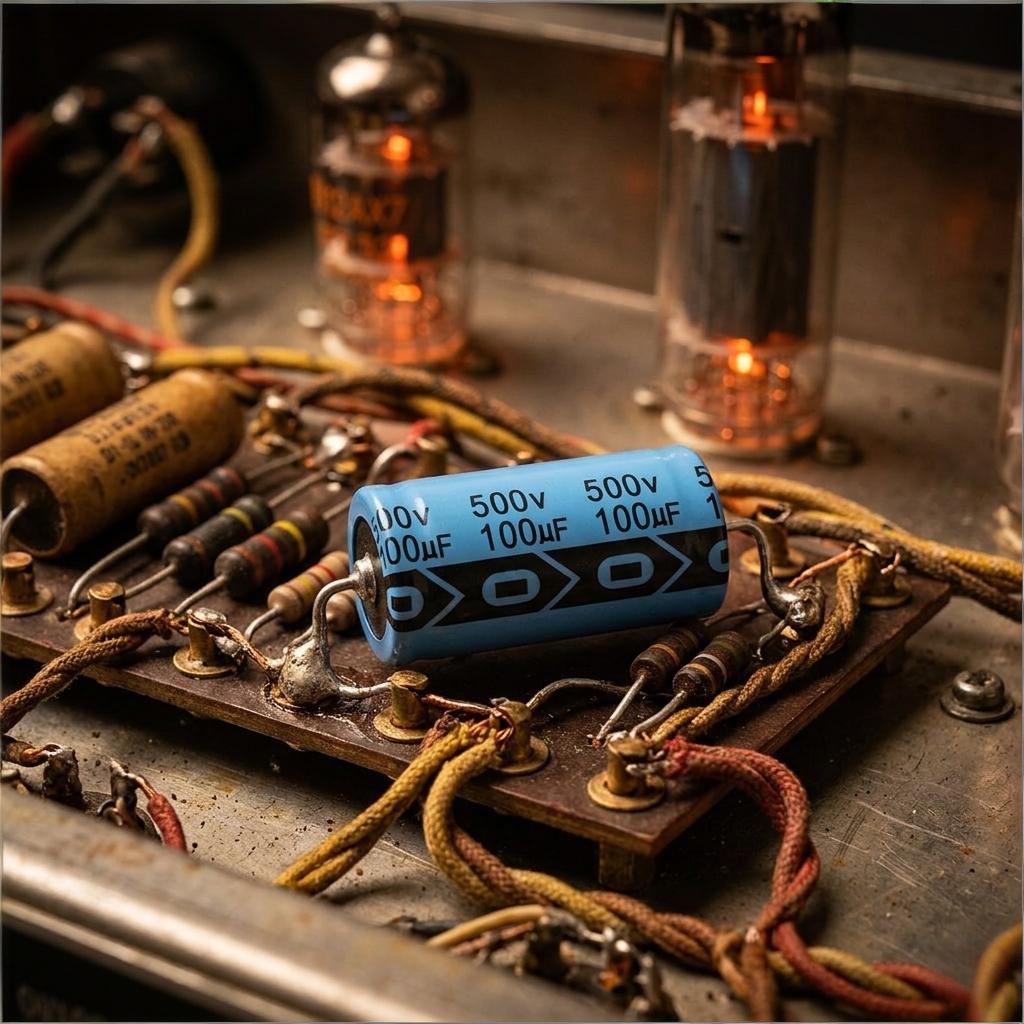
When it comes to high-voltage tube amplifier restoration and professional audio builds, the 100uF 500V capacitor is a critical cornerstone of your power supply’s filter stage. Whether you are smoothing out ripples in a vintage radio or upgrading a modern high-fidelity amp, selecting a component that balances ultra-low ESR with the thermal stability required for 500V rails is essential for achieving a hum-free, silent noise floor.
Because physical space is often the biggest hurdle in point-to-point wiring or turret board layouts, we offer a specialized range of form factors to fit every chassis. From precision axial leads for traditional under-chassis mounting to space-saving radial designs and multi-section can filters, our inventory prioritizes exact physical dimensions and brand-specific performance. Explore our selection of high-performance capacitors to find the reliable, high-voltage solutions you need to ensure your audio equipment performs with professional-grade precision and longevity.
Understanding the Technical Specifications of 100uF 500V Electrolytic Capacitors
When selecting a 100uF 500V capacitor for high-end audio or guitar amplifier repair, understanding the nuances of its technical specifications is critical for both performance and longevity. At this specification, these components primarily serve as reservoir capacitors in power supply filtering stages, smoothing rectified AC into clean DC for high-voltage (B+) rails.
The 500V rating provides a necessary safety margin for tube amplifiers where peak voltages often surge during startup. Unlike a standard 47uF 450V capacitor, the 100uF 500V variant offers significantly higher energy storage, which can tighten bass response and eliminate residual hum in demanding circuits. However, physical dimensions are a primary transactional concern; you must choose between an axial electrolytic capacitor, ideal for vintage turret board layouts and point-to-point wiring, or a radial lead design for modern PCB-based applications. For those restoring classic Marshall or Fender amps, multi-section “can” filters are often required to maintain original chassis grounding and aesthetics.
For audiophiles seeking the best electrolytic capacitors for audio, parameters like ESR (Equivalent Series Resistance) and ripple current ratings are paramount. Premium brands such as Mundorf, F&T, and TAD optimize these specs to ensure minimal heat generation and maximum signal purity. While polypropylene film capacitors or metallized polypropylene capacitors are preferred for the signal path, the electrolytic 100uF 500V remains the workhorse for high-voltage power filtering. Whether you are replacing a drying 500V electrolytic capacitor in a vintage radio or upgrading a boutique tube amp, ensuring the temperature rating (typically 85°C or 105°C) matches your enclosure’s thermal environment is essential for a reliable, professional-grade installation.
Axial vs. Radial vs. Multi-Section Can: Selecting the Correct Physical Form Factor
Choosing the right 100uF 500V capacitor involves more than just matching capacitance and voltage; the physical geometry—Axial, Radial, or Multi-Section Can—dictates its mechanical compatibility and heat dissipation capabilities in high-voltage audio circuits. For professionals performing tube amp repair or high-end restorations, selecting the incorrect form factor can lead to lead-stress failures or chassis fitment issues.
Axial electrolytic capacitors are the industry standard for point-to-point wiring and turret board layouts found in vintage Fender and Marshall circuits. With leads protruding from opposite ends, axial designs like those from TAD or F&T are ideal for spanning distances across a chassis. Their horizontal mounting offers superior mechanical stability and cooling surface area, which is essential for longevity in high-heat environments near vacuum tube sockets.
Radial capacitors, featuring both leads on the same side, are the preferred choice for modern PCB-based designs. These are optimized for a vertical footprint, saving valuable board “real estate.” When sourcing 100uF 500V radials, high-performance variants such as Mundorf M-Lytic or Nichicon provide the low ESR and high ripple current handling required for clean power filtration.
For authentic restorations, multi-section can filters are indispensable. These units often house multiple sections (e.g., dual 50uF or a single 100uF) within a single aluminum cylinder. These are typically chassis-mounted using a clamp or twist-lock tabs and connected via solder lugs. When selecting a replacement, precision is key: verify the diameter (often 1-3/8″ or 1″) to ensure it clears the octal tube sockets and fits existing mounting holes. Whether you are upgrading a 300B tube stage or a vintage radio, matching the form factor ensures that your high-voltage application maintains both electrical integrity and a professional, period-correct aesthetic.
The Critical Role of 500V Capacitors in Tube Amplifier Power Supply Filtering
In high-voltage vacuum tube circuitry, the power supply filter capacitor is the primary line of defense against AC ripple and 60Hz line hum. Utilizing a 100uF 500V capacitor in the first stage of a power supply provides the necessary energy reservoir to maintain a stable B+ rail, which is critical for the transient response and “weight” of the audio signal. While a standard 500V electrolytic capacitor is often the default choice for its high capacitance-to-volume ratio, the quality of this component directly impacts the amplifier’s noise floor and longevity.
For professional-grade restorations and high-fidelity builds, the selection process must prioritize low Equivalent Series Resistance (ESR) and high ripple current handling. Premium axial electrolytic capacitors from brands like Mundorf or TAD are engineered to withstand the intense thermal environments found near vacuum tube sockets and power transformers. Unlike lower-rated 47uF 450v capacitors—which may fail during the initial voltage surge of a cold start—a true 500V-rated component offers the essential headroom required for modern wall voltages that often exceed vintage specifications.
When sourcing tube amp parts for a project, consider the synergy between the filter stage and the rest of the signal chain. For instance, if you are populating a turret board or a vintage point-to-point chassis, the physical durability of the lead wires is paramount. High-performance filters ensure that your 8-pin octal sockets and 12AX7 tube shields are part of a stable electrical environment, preventing the parasitic oscillations that plague inferior builds. Whether you are replacing dried-out vintage radio capacitors or upgrading a modern guitar amp, choosing a high-temperature, low-ESR 100uF 500V unit is the most effective way to ensure “black” backgrounds and punchy, articulate low-end response.
High-Temperature Ratings: Why 105°C vs. 85°C Stability Matters for High-Voltage Audio
When selecting a 100uF 500V capacitor for high-voltage audio, the temperature rating is a primary indicator of long-term reliability. While 85°C was the vintage industry standard, modern 105°C-rated electrolytic capacitors offer a significant advantage in vacuum tube amplifiers, where internal chassis temperatures can soar. Because tube amp capacitors are often situated near heat-generating components like power transformers, 50CA10 tubes, or power resistors, they are subject to constant thermal stress.
The technical superiority of a 105°C rating lies in the “Arrhenius Law” of chemistry: for every 10°C decrease in operating temperature below the maximum rating, the component’s life expectancy approximately doubles. Therefore, a 105°C-rated 500V electrolytic capacitor operating at a typical internal temperature of 65°C will last significantly longer and maintain a lower ESR (Equivalent Series Resistance) than an 85°C-rated counterpart. This stability is crucial for power supply filtering; as a capacitor degrades due to heat, its ESR rises, leading to increased ripple voltage and the dreaded “60Hz hum” in the audio signal.
For technicians performing a high-end restoration or building a boutique 300B or EL84 amplifier, choosing 105°C axial electrolytic capacitors ensures that the power rail remains stiff and quiet for decades. This is especially vital in tight enclosures where airflow is restricted by vacuum tube sockets, 12AX7 tube shields, or turret boards. While signal-path components like polypropylene film capacitors or silver mica capacitors are less sensitive to these thermal fluctuations, the heavy-duty 100uF filter caps must be over-engineered. Investing in high-temperature stability is the best way to protect your output transformers and ensure your 100uF 500V capacitor provides consistent, ripple-free DC for the life of the amplifier.
Comparing Premium Brands: Mundorf MLytic, TAD Gold Cap, and JJ Electronic
When selecting the best capacitor for amplifier restoration or high-end builds, the choice between Mundorf, TAD, and JJ Electronic determines both the longevity of the circuit and the sonic “stiffness” of the power rail. These brands are the industry standards for 500v electrolytic capacitors, yet each serves a distinct niche in the high-voltage audio market.
Mundorf MLytic components are engineered for audiophiles who demand maximum transparency. Their HV (High Voltage) series 100uF 500V capacitors feature ultra-low ESR (Equivalent Series Resistance) and minimal internal inductance. This allows for incredibly fast current delivery, which is essential for maintaining dynamic transients in hi-fi tube power supplies. If you are upgrading a high-end preamp or power amp where “speed” and clarity are paramount, Mundorf is the premier choice.
TAD (Tube Amp Doctor) Gold Caps are specifically voiced for the guitar amplifier market. These tube amp capacitors are designed to handle the high ripple currents and thermal stress found in vintage Fender and Marshall circuits. They strike a balance between modern reliability and the classic ESR profiles that vintage-style guitar amplifier parts require to achieve a warm, compressed “sag.” Their axial configurations are ideal for traditional turret board layouts.
JJ Electronic is the industry workhorse, particularly favored for multi-section can filters. Known for their rugged construction and Slovakian manufacturing standards, JJ 100uF 500V capacitors are the go-to for professional repair shops. Whether you are replacing a filter cap next to a 12AX7 tube socket or a high-voltage rail near an octal tube socket, JJ provides a reliable, cost-effective solution with a high temperature rating. For builders sourcing audio capacitors for sale, JJ offers the most consistent performance-to-price ratio for heavy-duty filtering applications.
Multi-Section Can Filters: 100uF+100uF 500V Solutions for Marshall, Hiwatt, and Orange Amps
For restorers and builders of high-wattage British icons like the Marshall JCM800, Hiwatt DR103, or vintage Orange Overdrive heads, the 100uF+100uF 500V multi-section can filter is a non-negotiable component. Unlike standard axial electrolytic capacitors that reside on a turret board, these dual-section cans are designed for chassis mounting, typically secured by a 1-3/8″ (35mm) mounting clamp. This “two-in-one” design is critical for high-voltage power supply filtering, providing the massive reservoir of energy needed to maintain tight low-end response and minimize hum in 50W and 100W circuits.
When selecting these filters, the 500V DC rating is paramount. Vintage “Plexi” or Hiwatt circuits often see B+ voltages hovering near 460-485V; using a 450V rated part offers zero safety margin, leading to premature failure or catastrophic leakage. Premium dual-section cans from brands like JJ Electronic or F&T are the industry standard here, offering low ESR (Equivalent Series Resistance) and long service life.
Physical dimensions are the primary constraint for transactional buyers. A standard 100uF+100uF 500V can typically measures 35mm in diameter and 80mm in height. Before purchasing, verify your chassis clearance and the orientation of the solder lugs. These cans often feature common-negative terminals (the outer casing or specific lugs), which must be correctly grounded to the amplifier’s star-grounding system to prevent ground loops. Whether you are performing a full “cap job” on a classic stack or sourcing tube amp parts for a new high-gain build, these multi-section filters provide the authentic look and electrical “stiffness” essential for professional-grade high-voltage audio.
Performance Benefits of Low ESR and High Ripple Current in Audio Power Circuits
In high-voltage tube amplifier circuits, the technical superiority of a 100uF 500V capacitor is defined by two critical metrics: Equivalent Series Resistance (ESR) and Ripple Current handling. When restoring a vintage Marshall or Hiwatt, choosing a 500V electrolytic capacitor with low ESR is essential for maintaining a “stiff” power supply. Low ESR minimizes internal power dissipation, which reduces heat and prevents the dielectric from degrading over time. For the audiophile or technician, this translates to improved transient response and a tighter, more defined low-end, as the capacitor can discharge its stored energy into the circuit with minimal resistance during high-demand musical passages.
Ripple current—the AC component superimposed on the DC power line—is another vital consideration for 100uF 500V applications. In the rectification stage of a tube amp, the reservoir capacitors are subjected to significant stress as they smooth the rectified AC. A high ripple current rating ensures the capacitor can handle these rapid charge/discharge cycles without overheating. Premium components, such as Mundorf MLytic or TAD Gold Caps, are engineered specifically to provide high ripple stability, ensuring longevity even in the high-heat environment of a chassis filled with vacuum tubes.
Whether you are selecting an axial electrolytic capacitor for a point-to-point turret board build or a radial lead for a modern PCB, prioritizing these performance specs is the best way to ensure reliability. Low ESR and high ripple current ratings are not just numbers; they are the benchmarks for the best electrolytic capacitors for audio, directly impacting the signal-to-noise ratio and the overall “punch” of your amplifier. When shopping for 100uF 500V capacitors, always verify these data points to ensure your high-voltage audio project maintains peak performance for years to come.
Selecting the Best Electrolytic Capacitors for High-Fidelity Audio Restoration
When restoring vintage high-fidelity equipment, selecting a 100uF 500V capacitor is about more than just matching a value on a schematic; it’s about ensuring the long-term stability and sonic character of the power supply. For classic tube amplifiers—whether you’re working on a Marshall, Hiwatt, or a bespoke audiophile mono-block—the power supply filtering is the foundation of the audio signal. While a standard 500V electrolytic capacitor handles the bulk of the ripple current, hi-fi purists often choose premium axial electrolytic capacitors for their low Equivalent Series Resistance (ESR) and superior dielectric stability.
In high-end restorations, it is common practice to bypass large electrolytics with a high-quality polypropylene film capacitor or a metallized polypropylene capacitor to improve high-frequency performance and transient response. This hybrid approach compensates for the inductive properties inherent in large electrolytic cans. When auditing tube amp capacitors for replacement, ensure that the physical dimensions allow for proper clearance near vacuum tube sockets and high-heat components. For example, if you are rebuilding a point-to-point turret board, the lead length and diameter of an axial unit are critical for a secure mechanical connection. Conversely, multi-section can filters are often the only solution for maintaining the period-correct aesthetic of vintage radios or early guitar amplifiers.
Beyond the main filter caps, a complete restoration often necessitates auditing the signal path, where you might swap aging units for silver mica capacitors or polyester film capacitors (often called “yellow film capacitors“) to maintain tonal accuracy. Whether you are sourcing components for a 12AX7 preamp stage or a 300B power section, prioritizing high-voltage reliability ensures your audio capacitors deliver the “black” backgrounds and dynamic headroom essential for high-fidelity playback. Always verify that your chosen 100uF 500V unit can withstand the inrush current typical of vintage rectifier circuits to avoid premature failure.
Replacement Guide: Upgrading from 47uF 450V to 100uF 500V for Increased Headroom
Upgrading your power supply filtering from the standard 47uF 450V capacitor to a robust 100uF 500V variant is a common and highly effective modification for modernizing vintage tube amplifier performance. The primary advantage of moving to a 500V rating is the increased dielectric safety margin. Modern AC line voltages often run higher than the vintage 110V–117V standards, frequently pushing 450V-rated capacitors to their absolute limit. A 500V electrolytic capacitor provides a critical buffer against these voltage spikes, ensuring long-term reliability and preventing the catastrophic failures associated with over-voltage stress.
From a performance standpoint, increasing capacitance from 47uF to 100uF significantly enhances the reservoir of stored energy available to the output stage. This effectively “stiffens” the power rail, reducing 120Hz ripple hum and providing noticeably increased headroom. For audio applications, this translates to tighter, more articulate low-end response and improved transient clarity, as the power supply is less likely to “sag” during high-demand passages. However, when selecting your 100uF 500V capacitor—whether you choose a high-performance axial electrolytic capacitor or a multi-section can—you must verify the maximum input capacitance rating of your rectifier. While solid-state diodes handle the higher inrush current of a 100uF load with ease, vintage vacuum tube rectifiers like the 5Y3 or 5U4GB may require a smaller first-stage filter to prevent premature tube failure.
When sourcing these parts, prioritize low ESR (Equivalent Series Resistance) and high-ripple current ratings to maximize the filtering efficiency. Brands like TAD and Mundorf offer specialized 100uF 500V solutions that fit the physical constraints of vintage chassis while providing the high-temperature stability (105°C) necessary for the high-heat environments found near vacuum tube sockets and power transformers. Whether you are performing a total high-fidelity audio restoration or a simple guitar amp repair, this upgrade is a foundational step in achieving a quieter, more powerful circuit.
Installation Essentials: Mounting Clamps, Solder Terminals, and High-Voltage Safety
When integrating a 100uF 500V capacitor into your power supply, physical stability is as crucial as electrical performance. For multi-section can filters, heavy-duty mounting clamps (waist clamps) are essential for securing the chassis-mount housing. Proper clamping prevents vibration-induced lead fatigue and ensures a solid ground connection to the amplifier chassis. If you are utilizing an axial electrolytic capacitor for a point-to-point build or vintage radio restoration, ensure the leads are properly tensioned across a turret board or secured to high-quality solder terminals to prevent sagging in high-temperature environments.
Connectivity varies by form factor. Radial variants are typically destined for high-voltage PCBs, while axial types offer flexibility for spanning distances between a 9-pin tube socket and a ground bus. Unlike a non-polarized capacitor or a polypropylene film capacitor used in signal paths, these 500V electrolytic capacitors are polarized. Incorrect orientation at these voltage levels will result in immediate component failure and potential damage to other tube amp parts, such as the power transformer or rectifier.
Safety is paramount when handling high-voltage audio circuits. A 100uF capacitor charged to 500V stores significant energy that remains long after the amplifier is unplugged. Always use a discharge probe to bleed the charge before touching any internal components, including the 12AX7 or octal tube socket pins. When sourcing your 100uF 500V capacitor, also consider refreshing related hardware like tube retainers and gold-plated binding posts for speakers to ensure your high-fidelity restoration or boutique build meets professional standards for both safety and signal integrity.
Where to Buy Professional-Grade 500V Capacitors and Vintage Tube Amp Parts
When sourcing 100uF 500V capacitors for high-voltage audio applications or vintage tube amp restoration, selecting a specialized distributor is critical to ensuring component authenticity and performance longevity. Professional-grade results require more than generic parts; you need retailers that stock boutique brands known for tight tolerances and low ESR, such as Mundorf MLytic, TAD Gold Cap, and JJ Electronic. These suppliers cater to the transactional needs of technicians by offering comprehensive data sheets that detail exact physical dimensions—vital when choosing between a large-can multi-section filter for a Marshall or a long-lead axial electrolytic capacitor for a point-to-point Fender circuit.
A reputable vendor for tube amp parts should offer a “one-stop-shop” experience. Beyond the main filter caps, high-fidelity restorations often require 10uF 500V or 22uF 630V capacitors for preamp filtering, alongside silver mica capacitors and metallized polypropylene film capacitors for precision tone stacks. For those performing a total overhaul, look for suppliers who also stock essential hardware like 8-pin octal sockets for power tubes, 9-pin 12AX7 tube sockets with shields, and rugged turret boards.
Whether you are upgrading from a 47uF 450V unit to a 100uF 500V capacitor to increase power supply headroom or sourcing high-temperature 105°C rated radial units for a compact build, prioritize retailers that provide bulk pricing and verified ripple current ratings. Expert-level sourcing also extends to the chassis interface; premium shops will carry high-purity copper binding posts, locking RCA connectors, and heavy-duty tube retainers to ensure your high-voltage circuit remains stable and noise-free under heavy loads. Always verify the lead spacing and diameter before purchase to ensure a seamless drop-in replacement.
Have questions or your own tips to share? Drop a comment below!