
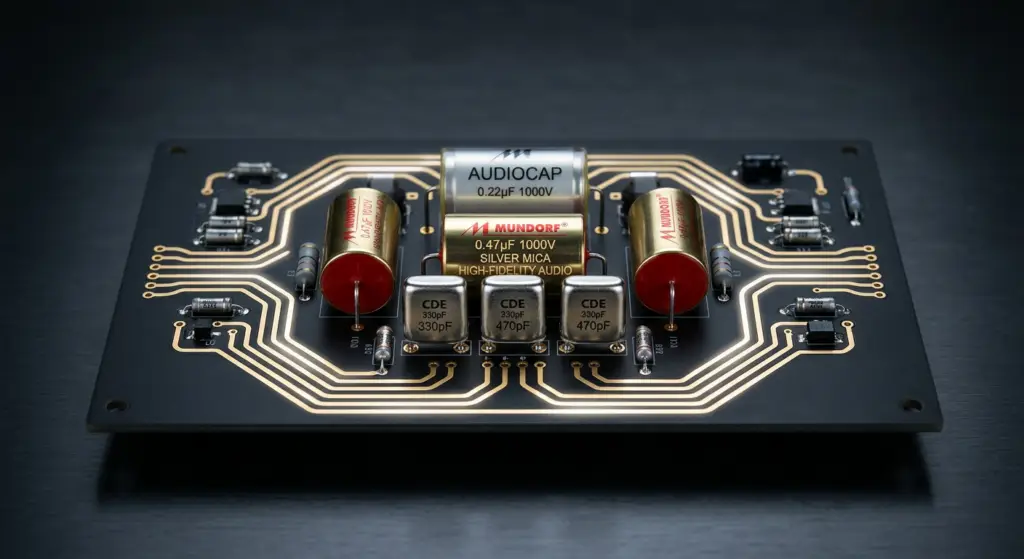
Finding the best capacitor for amplifier setups isn’t just about matching a capacitance value; it’s about mastering the synergy between electrical physics and sonic character. Whether you are hunting for high-current stiffening capacitors to stabilize a car audio system, seeking ultra-low ESR (Equivalent Series Resistance) industrial parts for a Hi-Fi power supply, or debating the tonal “mojo” of paper-in-oil versus polypropylene film in a vintage tube amp, the right choice defines your final output.
From high-voltage electrolytic capacitors to boutique signal-path components, the market is a complex intersection of objective measurements and subjective performance. This guide cuts through the marketing noise to help you navigate technical trade-offs like ripple current ratings and size constraints. We will analyze the commercial differences between boutique and industrial brands, ensuring your selection provides the clarity, punch, or warmth your specific audio project demands.
Understanding Capacitor Functions: Signal Path vs. Power Supply Filtering
To select the best capacitor for amplifier performance, you must first distinguish between two radically different roles: the power supply reservoir and the signal path coupling. In the power supply, capacitors act as energy storage tanks, smoothing rectified AC into clean DC. Here, axial electrolytic capacitors and high-capacitance radial units are the workhorses. For tube amplifiers, high-voltage ratings are critical; you’ll often see 47uF 450V or 100uF 500V capacitors utilized to handle the B+ rail. In this context, Low Equivalent Series Resistance (ESR) is the most vital metric. A low-ESR electrolytic ensures the power supply can respond instantaneously to transient peaks, which is crucial for maintaining “punch” and “headroom” in both car audio systems and high-wattage Hi-Fi stages.
Conversely, signal path capacitors—often called coupling capacitors—are where the “subjective sound vs. objective measurement” debate is loudest. These components sit directly in the audio stream, blocking DC while allowing the AC signal to pass between gain stages. For audiophiles and guitarists, the dielectric material is everything. Polypropylene film capacitors and metallized polypropylene variants are prized for their transparency and low dielectric absorption. In vintage tube circuits or guitar tone stacks, a 0.022uF capacitor or a silver mica capacitor can subtly shift the harmonic texture, providing that coveted “warmth.”
While industrial-grade capacitors offer tight tolerances and reliability, boutique “audio-grade” options focus on minimizing microphonics and internal resonance. Whether you are replacing a 22uF 630V capacitor in a high-end mono-block or selecting a polyester film capacitor for a guitar amp’s turret board, understanding this divide is essential. Power capacitors provide the foundation of stability, while signal capacitors act as the final “lens” through which your music is filtered.
Best Capacitors for Car Audio: Stiffening Caps vs. Super Capacitors for Voltage Stability
In the high-current environment of car audio, voltage sags are the primary enemy of peak performance. When a monoblock amplifier demands a sudden surge to reproduce a sub-bass transient, the vehicle’s alternator and battery often cannot react fast enough, leading to clipping and audible distortion. Selecting the right capacitor for voltage stability depends on your system’s total wattage and the speed of discharge required.
Traditional stiffening capacitors are essentially large-can electrolytic capacitors designed to bridge the gap between the battery and the amplifier. For systems under 1,000 watts, a standard 1-to-2 farad stiffening cap acts as a high-speed buffer. Their main advantage is an incredibly low ESR (Equivalent Series Resistance), allowing them to discharge energy nearly instantaneously. This makes them a “high frequency capacitor” of sorts for the power rail, smoothing out the rapid ripples created by the amplifier’s switching power supply.
However, for high-SPL (Sound Pressure Level) builds or systems exceeding 2,000 watts, super capacitors (or ultracapacitors) have become the industry standard. Unlike traditional electrolytic variants, super capacitors offer massive energy density—often rated in hundreds of farads. While they have slightly higher internal resistance than a small stiffening cap, their ability to hold a massive reserve of energy allows them to act as a secondary, ultra-fast-charging power source that stabilizes the entire 12V–14.4V rail.
When choosing between the two, consider your space constraints and electrical goals. If you need to stop your headlights from dimming during kick drums, a high-quality electrolytic stiffening cap is an affordable, compact solution. But for sustained, heavy low-end notes that would otherwise starve your amp of current, a supercap bank is the superior commercial investment for maintaining rail voltage and protecting your amplifier’s internal components from thermal stress.
The High-Fidelity Signal Path: Comparing Polypropylene, Metallized Film, and Polyester Capacitors
In the pursuit of sonic purity, the signal path acts as the nervous system of your amplifier. While power supply filtering demands high-capacitance axial electrolytic capacitors, the signal coupling and bypass stages require components that minimize phase distortion and dielectric absorption. The polypropylene film capacitor is widely considered the gold standard for high-fidelity audio. Whether you opt for a metallized polypropylene capacitor for its self-healing properties and compact footprint or a film-and-foil variant for ultimate peak current delivery, polypropylene offers the lowest ESR (Equivalent Series Resistance) and the most linear frequency response across the audible spectrum.
Conversely, the polyester film capacitor—often recognized in its “Mylar” or yellow film capacitor iterations—is frequently found in mid-tier gear and vintage restorations. While polyester is more space-efficient and cost-effective, it possesses higher dielectric absorption than polypropylene. In the “subjective sound vs. objective measurement” debate, many enthusiasts argue that polyester adds a “warm” coloration or a subtle “smearing” to high-frequency transients. In the context of tube amp capacitors and guitar amplifier parts, this coloration is often a deliberate design choice. For example, a 0.022 uf capacitor in a guitar’s tone circuit or a tube coupling stage can define the “vintage” character of the instrument’s bite.
When selecting the best capacitor for amplifier signal coupling, you must balance technical transparency with the desired tonal signature. While silver mica capacitors are unparalleled for high-frequency stability in delicate feedback loops, the bulk of your signal will pass through film. High-end Hi-Fi builds typically favor the surgical transparency of polypropylene to ensure the amplifier adds no “flavor” of its own, whereas tube aficionados may prefer the harmonic richness associated with polyester or paper-in-oil alternatives.
Why Silver Mica and Polystyrene Capacitors are Essential for High-Frequency Audio
While polypropylene and metallized film capacitors dominate the mid-range signal path, the “air” and “shimmer” of a high-end system often rely on the precision of silver mica and polystyrene capacitors. These components are indispensable for high-frequency audio applications where even the slightest phase shift or dielectric absorption can degrade the soundstage.
Silver mica capacitors are the gold standard for stability and low-loss performance in the picoFarad range. In tube amp circuits—particularly in the tone stacks and feedback loops of a 12AX7-driven preamp—silver micas are prized for their near-zero temperature coefficient and tight tolerances. Unlike standard ceramic or polyester film capacitors, silver mica does not suffer from piezoelectric effects, ensuring that high-frequency transients remain clean and linear. For guitar amplifier parts, they are the preferred choice for “bright caps,” providing that distinctive vintage sparkle without the grit. Their high voltage ratings, often exceeding 500V, make them a safe and sonically superior choice for high-voltage tube environments.
In the Hi-Fi realm, polystyrene capacitors (often referred to as Styroflex) are the ultimate choice for high-frequency filtering and RIAA equalization networks. They offer exceptionally low dielectric absorption and a very low dissipation factor, resulting in a level of transparency that is often described as “glass-like.” While they are heat-sensitive and require careful soldering, their performance in the signal path is unrivaled for maintaining phase integrity. For audiophiles choosing between guitar capacitor types or high-end Hi-Fi components, substituting a generic high-frequency capacitor with a precision polystyrene or silver mica unit is one of the most cost-effective ways to improve top-end clarity and reduce “veiling” in the audio image.
Best Electrolytic Capacitors for Audio: Choosing Between Boutique Brands and Industrial Reliability
Electrolytic capacitors are the heavy lifters of the amplifier world, primarily serving as power supply filters to smooth DC ripple and as cathode bypass components. When selecting the best electrolytic for your build, you must navigate the tension between industrial reliability and boutique sonic voicing.
For power supply filtering in high-performance solid-state and Hi-Fi gear, industrial-grade capacitors from manufacturers like Panasonic (FR/FM Series) and United Chemi-Con are often the objective winners. These components prioritize ultra-low ESR (Equivalent Series Resistance) and high ripple current ratings, which are critical for maintaining a stable, low-noise floor. However, in the signal path or cathode bypass positions, many audiophiles prefer “boutique” series such as the Nichicon Muse (KZ/FG) or Elna Silmic II. These use specialized separators—including silk fibers—to dampen mechanical vibrations and reduce harmonic distortion, often resulting in a “warmer” or more “musical” subjective response compared to the clinical precision of standard industrial parts.
In the realm of tube amplifiers and vintage radio restoration, physical form factor and voltage headroom are paramount. High-voltage axial electrolytic capacitors are standard here, as they fit the point-to-point layouts of turret boards. Whether you are looking for a 47uF 450V capacitor for a classic Marshall-style circuit or a 100uF 500V capacitor for a heavy-duty power rail, brands like F&T and JJ Electronic are the gold standard. They provide the necessary voltage tolerance to handle the plate voltages of a 300B or EL84 without the leakage current issues common in cheaper alternatives. Ultimately, while industrial caps offer the best measurable performance for power stabilization, boutique electrolytics allow for fine-tuning the “tonal weight” of your amplifier.
Specialized Capacitors for Tube Amplifiers: Paper-in-Oil (PIO), Orange Drops, and High-Voltage Needs
In the realm of tube amplifiers, capacitors are more than just energy storage devices; they are tonal sculptors operating under extreme electrical stress. Unlike solid-state gear, vacuum tube circuits demand high-voltage capacitors capable of handling 400V to 600V rails. For power supply filtering, high-voltage axial electrolytic capacitors are the gold standard, particularly in vintage restorations and point-to-point builds where values like 22uf 500v, 47uf 500v, and 100uf 500v are ubiquitous. These components must offer low ESR and high ripple current resistance to minimize hum in sensitive 12AX7 or 300B gain stages.
When it comes to signal coupling, the choice between Paper-in-Oil (PIO) and “Orange Drop” (polypropylene or polyester film) capacitors defines the amplifier’s character. PIO capacitors are prized by purists for their “liquid” mids and smooth high-end roll-off, making them a top choice for high-fidelity Hi-Fi tube systems. Conversely, the Orange Drop—specifically the 715P and 716P series—is the backbone of the “American” guitar amp sound, offering a punchy, aggressive transient response and exceptional stability.
For builders working with turret boards, the physical form factor is as critical as the capacitance value. Whether you are installing a new 8-pin octal socket for an EL34 or a 9-pin ceramic socket for an EL84, lead length and orientation matter. Specialized parts like the 22uf 630v capacitor with long leads allow for a clean, secure layout on a turret board, reducing parasitic oscillation. Ultimately, selecting the best capacitor for a tube amplifier requires balancing these subjective tonal preferences with objective safety margins, ensuring that every component—from the silver mica caps in the tone stack to the 500v electrolytic capacitor in the reservoir—works in harmony with your vacuum tube sockets to produce a reliable, world-class sound.
Understanding High-Voltage Requirements: Selecting 450V to 500V Electrolytic Capacitors for Valve Amps
When working with valve amps, the power supply section demands a specialized class of components: high-voltage electrolytic capacitors capable of handling the 400V to 500V+ B+ rails common in tube circuitry. Unlike car audio or low-voltage solid-state systems, a 500V electrolytic capacitor in a tube amp is a critical safety and performance component. For commercial investigation, the choice often boils down to a balance between historical accuracy (tonal “sag”) and modern reliability.
In vintage restorations or boutique builds utilizing a turret board or point-to-point wiring, axial electrolytic capacitors are preferred for their ease of mounting. Standard values like the 10uF 500V capacitor or 22uF 500V capacitor are frequently used for preamp filtering to decouple stages and minimize crosstalk. For the main reservoir, higher capacitance values like the 47uF 450V capacitor or 100uF 500V capacitor are essential to smooth rectified DC and minimize hum.
From a technical perspective, Equivalent Series Resistance (ESR) and ripple current ratings are the most vital metrics. Industrial-grade capacitors offer longevity, but boutique brands like F&T or Mundorf are favored in high-end tube amp parts catalogs for their lower ESR and superior dielectric stability under heat—a necessity when positioned near glowing 12AX7 tube sockets or power tubes. While some purists argue for the “musicality” of specific brands, the objective goal is maintaining a stable voltage floor. Whether you are sourcing a 16uF 450V capacitor for a vintage radio or a 32uF capacitor for a classic British stack, ensuring a voltage overhead (e.g., using a 22uF 630V capacitor long lead version for a 450V circuit) provides a necessary safety margin against mains fluctuations that could otherwise lead to catastrophic dielectric failure.
The Role of Axial Electrolytic and Non-Polarized Capacitors in Vintage Restorations
In vintage restorations, the choice between axial and radial form factors is more than just cosmetic; it is a matter of mechanical integrity and circuit fidelity. For tube amplifiers and classic radios, axial electrolytic capacitors are the gold standard because they align with the physical architecture of turret boards and point-to-point wiring. Replacing a dried-out 16uF 450V or 47uF 500V capacitor with a modern axial equivalent ensures the leads can span the distance between terminal strips without the need for unsightly jumpers that increase parasitic inductance.
When sourcing parts for high-voltage valve stages, such as those using 8-pin octal or 12AX7 tube sockets, voltage headroom is non-negotiable. Modern restorations frequently utilize 22uF 500V or 100uF 500V capacitors to handle the rigorous demands of rectified DC power supplies. For signal coupling in guitar amplifiers, the “best” capacitor often involves a debate between the smooth, rounded highs of polyester film capacitors and the clinical transparency of a metallized polypropylene capacitor.
Furthermore, non-polarized (bipolar) capacitors play a critical role in vintage crossover networks and specific feedback loops where a DC bias is absent. While some purists hunt for “New Old Stock” yellow film capacitors, modern high-frequency capacitors offer significantly lower ESR (Equivalent Series Resistance) and better thermal stability. Whether you are installing a 22uF 630V capacitor with long leads into a boutique hand-wired amp or refreshing a vintage radio, selecting components that match the original’s ESR profile—while upgrading to 500V+ ratings—is the key to preserving that coveted “vintage” warmth while ensuring long-term reliability. For those managing complex rebuilds, incorporating high-quality audio capacitors alongside robust vacuum tube sockets and gold binding posts ensures the restoration is both sonically superior and technically sound.
Technical Criteria for the “Best” Sound: Low ESR, Tolerance, and Thermal Stability
When selecting the “best” capacitor, technical specifications often collide with subjective listening preferences. At the heart of objective performance lies Equivalent Series Resistance (ESR). In high-power applications, such as power supply filtering with 500V electrolytic capacitors, low ESR is non-negotiable. It minimizes internal heating and ensures a low-impedance path to ground for ripple current. For those sourcing a 100uF 500V capacitor or a 47uF 450V capacitor for a high-voltage rail, low ESR translates to a “faster” bass response and a significantly lower noise floor.
In the signal path, tolerance is the primary concern for maintaining a precise soundstage. Using high-precision metallized polypropylene capacitors or polypropylene film capacitors ensures that filter slopes and RC constants remain identical across stereo channels. While a standard axial electrolytic capacitor may have a wide 20% tolerance, boutique audio-grade caps often narrow this to 5% or 1%, providing the consistency required for true high-fidelity performance.
Finally, thermal stability dictates how a component behaves under operational stress. In the sweltering environment of a tube amp chassis, where power tubes generate significant heat near vacuum tube sockets, a capacitor’s temperature coefficient is critical. Silver mica capacitors and high-quality polypropylene capacitors are prized for their extreme stability in high frequency circuits. Conversely, lower-grade polyester film or yellow film capacitors may experience capacitance drift as the amplifier warms up, leading to tonal “smearing” or shifting crossover points. Balancing these objective metrics—ESR, tolerance, and thermal drift—against the perceived “musicality” of the component is the hallmark of a professional-grade build, whether you are populating a custom turret board or restoring a vintage guitar amplifier.
Boutique vs. Industrial: Evaluating Mundorf, Nichicon, Audio Note, and Vishay Performance
When selecting the best capacitor for amplifier design, the choice between boutique and industrial brands often defines the sonic signature and reliability of the build. Boutique manufacturers like Mundorf and Audio Note cater to the high-fidelity and tube amp markets, prioritizing subjective musicality. Mundorf is renowned for its metallized polypropylene capacitors, often incorporating silver and gold to enhance micro-dynamics. Similarly, Audio Note’s legendary paper-in-oil (PIO) components are prized in tube circuits for their “organic” texture, particularly when used as coupling capacitors in the signal path of a 300B or EL84 vacuum tube stage.
In contrast, industrial giants like Nichicon and Vishay dominate the landscape of power supply filtration and high-performance stability. For those seeking the best electrolytic capacitors for audio on a budget, Nichicon’s “Fine Gold” or “Muse” series offer exceptional low ESR (Equivalent Series Resistance) and consistency. In high-voltage tube amplifier power supplies, industrial reliability is non-negotiable; here, Vishay’s axial electrolytic capacitors—specifically their 47uF 450V and 100uF 500V capacitor variants—provide the rigorous ripple current handling and thermal stability required to ensure a hum-free floor.
The commercial trade-off is clear: boutique brands offer “tonal flavoring” through exotic materials like silver mica capacitors or specialized foil windings, making them ideal for signal-path upgrades where transparency is the goal. However, for power stabilization—especially in car audio or high-wattage solid-state builds—industrial brands offer superior objective measurements and longevity. Ultimately, the “best” choice involves a hybrid approach: utilizing the precision of a Vishay or Nichicon for the power rail’s high-voltage needs while placing a Mundorf polypropylene film capacitor in the signal path to unlock the amplifier’s full spatial potential.
Subjective Tone vs. Objective Measurement: The Debate Over Capacitor “Sonic Signatures”
The debate between objective measurement and subjective “sonic signatures” is the crossroads where engineering meets artistry. From a purely technical standpoint, a capacitor’s performance is defined by ESR (Equivalent Series Resistance), leakage current, and dielectric absorption. Many engineers argue that a high-quality metallized polypropylene capacitor or a silver mica capacitor provides the most transparent signal path because they exhibit near-zero distortion and superior thermal stability. In high-frequency applications, these components are objectively superior, ensuring that the “best capacitor for amplifier” performance is simply the one that removes itself from the signal path entirely.
However, in the realms of tube amplifiers and vintage restorations, the “sound” of a capacitor is often a deliberate aesthetic choice. For instance, Paper-in-Oil (PIO) capacitors are frequently described by enthusiasts as “musical” or “lush,” despite measuring worse in terms of leakage than modern polypropylene film capacitors. Similarly, the ubiquitous “Orange Drop” (often polyester film capacitors) remains a staple in guitar amplifiers because its specific dielectric properties contribute to a “punchy” mid-range that musicians crave. While an oscilloscope might show a cleaner sine wave through an industrial-grade axial electrolytic capacitor, a listener may prefer the subtle harmonic texture provided by boutique audio-grade equivalents.
For the commercial investigator, the choice depends on the application. If you are aiming for clinical transparency in a Hi-Fi power supply, prioritize low-ESR polypropylene capacitors with high voltage ratings like 22uf 630v. If you are voicing a 12AX7 preamp stage or restoring a classic Marshall, the subjective “warmth” of specific guitar capacitor types or vintage-spec 500V electrolytic capacitors is often the priority. Ultimately, the “best” capacitor is the one that balances measurable precision with the desired tonal outcome of your specific audio environment.
Proper Sizing and Installation: How to Match Farads and Voltage to Your Amplifier’s Load
Selecting the right capacitor is an exercise in balancing electrical headroom with circuit-specific demands. In car audio, the traditional “1 Farad per 1,000 Watts” rule has evolved; for high-current systems, prioritizing low ESR (Equivalent Series Resistance) in stiffening capacitors or super capacitors is often more effective for voltage stability than sheer Farad count.
In the realm of tube amplifiers, sizing is dictated by high-voltage safety and ripple filtration. When recapping a power supply, it is vital to match or slightly exceed the original capacitance while ensuring the voltage rating provides a 20% safety margin. Utilizing a 500V electrolytic capacitor, such as a 47uf 500v or 100uf 500v capacitor, ensures the component can withstand the initial voltage surge before the vacuum tubes reach operating temperature. For signal coupling, precision replaces bulk; a 0.022 uf capacitor made of metallized polypropylene or a polypropylene film capacitor offers the phase stability and transparency required for Hi-Fi performance.
Installation technique is equally critical. In vintage restorations, axial electrolytic capacitors are preferred for their physical compatibility with a turret board or point-to-point wiring. When mounting high-frequency components like silver mica capacitors, lead length must be kept to a minimum to reduce parasitic inductance. Whether you are securing a 22uf 630v capacitor long lead version in a boutique guitar amp or upgrading speaker binding posts for better conductivity, matching the capacitor’s thermal rating and physical footprint to the amplifier’s load is the only way to ensure long-term reliability and sonic integrity. Proper sizing prevents the “choking” of the power supply, allowing your amplifier to deliver peak transients without distortion.
Safety and Maintenance: The Best Way to Discharge High-Voltage Capacitors During Repair
Safety is the non-negotiable prerequisite when upgrading or repairing high-performance audio systems. Whether you are handling a 1-Farad stiffening capacitor in a car audio setup or a high-voltage 500V electrolytic capacitor in a tube amplifier, these components can store a lethal charge long after the power is disconnected. The “best” way to discharge a capacitor is never to “short” it with a screwdriver—which can damage the internal foil of a metallized polypropylene capacitor or pit the traces on a turret board—but to use a dedicated discharge tool.
For tube gear utilizing common values like 47uF 450V or 100uF 500V capacitors, professional technicians use a high-wattage resistor (typically 10k to 50k ohms) housed in an insulated probe. By connecting this across the capacitor terminals or from the anode cap to the chassis ground, you bleed the energy slowly and safely. Always verify the voltage has dropped to near-zero using a digital multimeter before touching any axial electrolytic capacitor or sensitive vacuum tube sockets.
Maintenance also involves visual and thermal inspections. In vintage restorations, keep an eye out for leaking or bulging in axial electrolytic or old polyester film capacitors. High ESR (Equivalent Series Resistance) is a silent performance killer; even if a 22uF 500V capacitor looks intact, increased resistance can lead to hum or loss of transient punch. When replacing components, ensure your soldering technique on 8 pin octal sockets or binding posts is clean to avoid parasitic resistance. Proper maintenance ensures that your investment in boutique polypropylene capacitors continues to deliver the low-noise, high-fidelity experience you designed your system for.
Have questions or your own tips to share? Drop a comment below!