
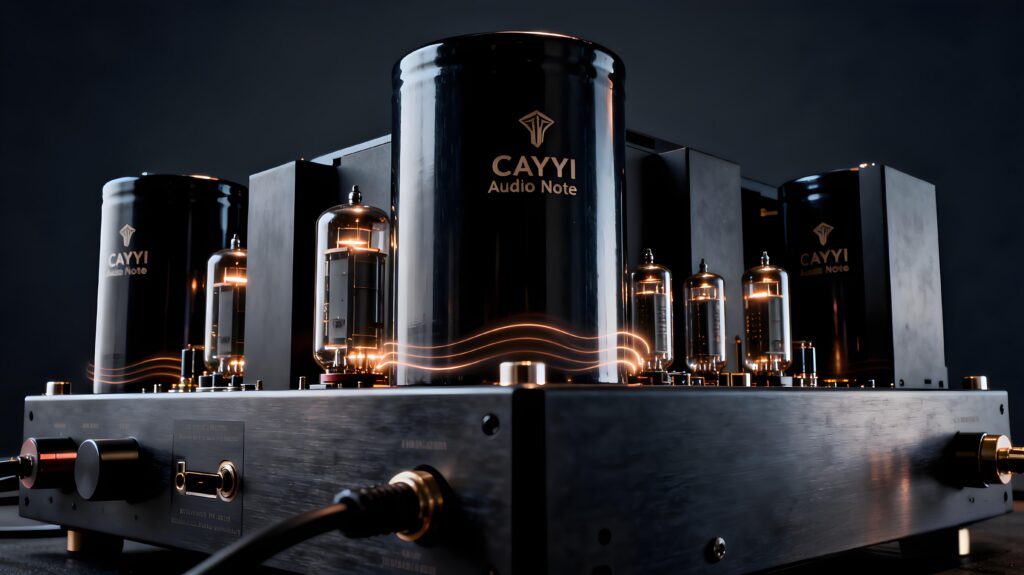
For audiophiles and DIY builders, the difference between a “good” amplifier and a transcendent listening experience often lies in the smallest components. If you are looking to breathe new life into your gear, selecting the best electrolytic capacitors for audio is the most impactful upgrade you can perform. This isn’t just a quest for reliability—it is an exploration of sonic signatures.
In this guide, we compare industry titans like the lush, “silk-fiber” warmth of the Elna Silmic II, the hyper-transparent Nichicon Muse, and the prestigious Audio Note Kaisei. Whether you are targeting a visceral low-end punch through power supply filtering or seeking unparalleled clarity in cathode bypassing, understanding how these components “color” your sound is essential. We have curated the top-tier options to help you strategically navigate the market and tailor your amplifier’s performance to your exact aesthetic preferences.
Understanding the Critical Role of Electrolytic Capacitors in High-Fidelity Audio
In the architecture of a high-fidelity amplifier, electrolytic capacitors are far more than simple energy reservoirs; they are the gatekeepers of the noise floor and the primary architects of transient response. While their primary function is to filter ripple voltage in power supplies or decouple DC in signal paths, their physical construction introduces non-linearities that directly color the “sonic signature” of your equipment. High-end audio grade electrolytics address these issues through specialized electrolytes, high-purity aluminum foils, and vibration-dampening materials that standard industrial-grade components ignore.
For enthusiasts conducting a commercial investigation into the best upgrades, understanding application is paramount. In power supply filtering, where high ripple current handling and low Equivalent Series Resistance (ESR) are vital, a capacitor like the Audio Note Kaisei—which inherits the legendary Black Gate pedigree—offers a massive improvement in “low-end punch” and background silence.
Conversely, when used in the signal path or for cathode bypassing, the dielectric’s influence on micro-dynamics becomes apparent. The Elna Silmic II (RFS) series utilizes silk fibers in the separator paper to dampen mechanical energy, yielding a liquid, organic warmth often described as “tube-like.” In contrast, the Nichicon Muse (KZ) series provides a more transparent, clinical precision with extended high-frequency “air,” making it ideal for brightening a sluggish vintage circuit. By matching these specific sonic profiles to their location in the circuit—placing “fast” caps in the power rail and “smooth” caps in the signal path—you can effectively voice your amplifier to match your specific acoustic preferences.
The Audiophile’s Elite: Top-Rated Electrolytic Capacitor Brands and Series
To navigate the world of high-end capacitors is to understand that these components are the “voicing” tools of an amplifier. For the discerning audiophile, three series stand above the rest, each offering a distinct sonic fingerprint and specific application utility.
The Elna Silmic II (RFS) is the gold standard for those seeking an “organic” or “tube-like” warmth. By incorporating silk fibers into the separator paper, Elna suppresses vibrational energy, resulting in a lush midrange and a noticeably smooth high-frequency response. These are best utilized in signal coupling or cathode bypass positions, where their ability to mitigate digital glare can transform a sterile solid-state circuit into a more musical, fluid experience.
In contrast, the Nichicon Muse KZ—the flagship of the Muse line—is celebrated for its transparency and “air.” If your goal is a wide soundstage and clinical precision, the KZ delivers. It provides a fast, punchy low-end and exceptional detail retrieval. These are ideal for local decoupling near op-amps or within preamplifier power rails, where a low noise floor is critical for preserving micro-dynamics.
For the ultimate upgrade, the Audio Note Kaisei series aims to reclaim the legendary status of the discontinued Black Gate capacitors. Developed with Rubycon, the Kaisei offers a level of clarity and structural authority that is rare in electrolytic designs. Their extremely low ESR and high-speed discharge make them the premier choice for main filter reservoirs in power supplies. Replacing standard industrial caps with Kaisei units typically results in a significant increase in “scale” and bass definition, providing the effortless current delivery required for complex orchestral passages. By strategically mixing these series—perhaps Silmics for the signal path and Kaisei for the power supply—you can precisely calibrate your amplifier’s sonic signature.
Nichicon Muse Series: Achieving Transparency and Detail in the Signal Path
The Nichicon Muse series stands as a cornerstone in the world of high-end audio modification, favored by DIY builders and boutique manufacturers alike for its ability to “unmask” a recording. These Japanese-engineered capacitors are specifically designed for acoustic applications, utilizing specialized materials and construction techniques—such as oxygen-free copper (OFC) leads—to minimize the nonlinearities that plague standard industrial components.
Within this series, the Muse KZ is the undisputed flagship. It is celebrated for its remarkable transparency and a “fast” transient response that brings life to percussion and string plucks. Sonically, the KZ offers a neutral, airy top end and a tight, articulate bass that avoids the “bloat” often associated with lesser electrolytics. If your objective is to move away from a dark or veiled sound toward one of crystalline clarity and spatial precision, the KZ is the surgical tool of choice.
For signal coupling duties where DC polarity might be a concern, the Muse ES (Bipolar) is the industry benchmark. By eliminating the inherent distortion of polarized electrolytic plates in the signal path, the ES series provides a cleaner, more linear transition of the audio signal, rivaling the performance of much larger film capacitors in space-constrained layouts.
Application Guidance:
To maximize the Muse series’ potential, use the KZ for local decoupling near op-amps or as cathode bypass capacitors in vacuum tube stages; its low-noise floor is ideal for these sensitive areas. The Fine Gold (FG) variant is a versatile all-rounder, excellent for general signal path duties where a touch of musicality is preferred over raw clinical detail. Reserve these for signal-critical stages and local power filtering; for the primary reservoir in a power supply, larger industrial-grade “Super-Through” or “Gold Tune” units are better suited to handle high-current demands.
Elna Silmic II: The Secret to a Smooth, Silk-Like Analog Character
If the Nichicon Muse series is the king of transparency, the Elna Silmic II (RFS Series) is the undisputed master of texture and musicality. Widely regarded by audiophiles as the closest an electrolytic capacitor can get to the “soul” of a fine film capacitor, the Silmic II is unique due to its construction. Elna utilizes high-purity silk fibers within the separator paper, a design choice intended to suppress vibration and mitigate the “harshness” often associated with standard aluminum electrolytics.
The resulting sonic signature is unmistakably analog. While some high-end capacitors can sound clinical or overly analytical, the Silmic II provides a lush, organic midrange and a sweet, rolled-off top end that eliminates listener fatigue. It excels at smoothing out the “digital glare” in DAC output stages or adding a sense of weight and bloom to solid-state amplifiers.
Optimal Application:
To leverage the Silmic II’s strengths, use them in the signal path as coupling capacitors or for cathode bypassing in tube amplifiers. Because of their ability to resolve micro-dynamics with a warm tilt, they are also highly effective in local decoupling for pre-amplifier stages. However, be mindful of their physical footprint; the silk-fiber design results in a larger case size than standard caps, which can be a constraint on crowded PCBs. Additionally, professional modders often note that Silmic IIs require a longer “burn-in” period—typically 50 to 100 hours—before their characteristic smoothness fully stabilizes. If your goal is to transform a thin-sounding system into one with a rich, “silk-like” presence, the Elna Silmic II is your primary candidate.
Audio Note Kaisei: The Ultimate Choice for High-End Power Supply Performance
When it comes to power supply optimization, the Audio Note Kaisei is widely regarded as the pinnacle of electrolytic design. Developed through a prestigious collaboration between Audio Note (UK) and Rubycon, the Kaisei series was specifically engineered to fill the void left by the legendary, discontinued Black Gate capacitors. Unlike standard industrial components, the Kaisei utilizes the same high-purity materials and structural techniques found in the world-renowned Black Gate VK and PK series, but without the graphite particles, resulting in a capacitor that excels in high-voltage applications.
The sonic signature of the Kaisei is characterized by an “ink-black” background and a staggering level of transparency. While the Elna Silmic II adds warmth, the Kaisei prioritizes absolute clarity and transient speed. It delivers a sense of tonal density and organic realism that is rarely achieved in the electrolytic world, making the amplifier feel more like a direct conduit to the original performance. Its ability to resolve micro-dynamics without adding “electronic” glare makes it a favorite for those seeking a natural, uncolored soundstage.
In terms of application, the Kaisei is the ultimate choice for power supply filtering and decoupling in high-end tube and solid-state amplifiers. Because they exhibit exceptionally low ESR (Equivalent Series Resistance) and high stability, they allow the power rail to respond instantaneously to demanding musical peaks. Replacing the main reservoir capacitors or the high-tension (HT) smoothing caps in a power supply with Kaisei units often results in a dramatic expansion of the soundstage and a significant improvement in rhythmic “grip” and low-end authority. For the audiophile performing a no-compromise restoration or build, the Kaisei represents the definitive high-performance power supply solution.
Decoding Sonic Signatures: Choosing Between Warmth, Neutrality, and Dynamic Punch
Selecting the right capacitor is less about finding a “perfect” component and more about “voicing” your circuit to achieve a specific tonal balance. If your system feels fatiguing or overly analytical, prioritizing warmth is essential. The Elna Silmic II, utilizing its unique silk-fiber dielectric, is the gold standard for this application. It imparts a lush, organic richness to the midrange and rounds off brittle high frequencies, making it the ideal candidate for cathode bypassing in tube stages or output coupling where a “liquid” analog character is desired.
Conversely, for systems that feel veiled or “slow,” neutrality and transparency are the objectives. The Nichicon Muse KZ series offers a surgical level of clarity and frequency extension without becoming clinical. These capacitors provide the wide soundstage and precise imaging required for signal-path duties in high-resolution DACs or pre-amplifier stages, where the goal is to hear the recording exactly as it was captured.
Finally, dynamic punch and low-end authority are dictated by the power supply’s ability to deliver instantaneous current. This is where the Audio Note Kaisei and Mundorf M-Lytic series excel. By minimizing Equivalent Series Resistance (ESR) and optimizing ripple current handling, these capacitors ensure the amplifier responds to transients with visceral impact. When applied to the primary filter bank, they provide the “black” background and rhythmic “slam” that defines high-end audio. The art of the upgrade lies in synergy: utilizing a Muse in the input stage for detail, paired with a Silmic in the feedback loop for smoothness, often yields a more balanced, sophisticated result than using a single series throughout the entire chassis.
Strategic Application: Power Supply Filtering vs. Cathode Bypassing
Selecting a world-class capacitor is only half the battle; the true alchemy of high-fidelity audio lies in strategic placement. To optimize your amplifier’s performance, you must distinguish between the heavy-lifting requirements of the power supply and the delicate, signal-sensitive role of cathode bypassing.
Power Supply Filtering: The Foundation of Scale and Silence
In the power supply, the capacitor’s primary job is to smooth rectified DC and provide a reservoir of energy for transient peaks. Here, Equivalent Series Resistance (ESR) and Ripple Current ratings are paramount. For this application, the Audio Note Kaisei or the Nichicon KG (Gold Tune/Super Through) series are peerless. Because these components are not directly in the signal path but dictate the “stiffness” of the voltage rail, they influence the “blackness” of the background and the authority of the low-end. A high-quality filter capacitor reduces intermodulation distortion, ensuring that when a sudden orchestral crescendo hits, the power rail doesn’t sag, preserving dynamic headroom and imaging stability.
Cathode Bypassing: Shaping the Sonic Texture
Conversely, a cathode bypass capacitor is effectively in the signal path, as it provides an AC ground for the tube’s cathode. This position is highly sensitive to the capacitor’s dielectric properties and microphonic tendencies. This is where you “tune” the amplifier’s character. If your system feels clinical, the Elna Silmic II, with its silk-fiber paper, introduces a lush, organic warmth and holographic midrange. If you require surgical precision and transient speed, the Nichicon Muse KZ is the superior choice. Because this capacitor determines the local feedback and gain of the stage, even minor deviations in its sonic signature are magnified, making it the most critical “flavoring” component in your circuit. Matching a robust, low-ESR power supply with a high-transparency bypass cap creates a balanced, high-resolution ecosystem.
The Speed Factor: Why Bypassing Electrolytics with Film Capacitors Enhances Soundstage
Even the finest electrolytic capacitors, such as the Nichicon KG or Audio Note Kaisei, possess inherent physical limitations due to their wound-foil construction and chemical electrolytes. These characteristics result in higher Equivalent Series Resistance (ESR) and Equivalent Series Inductance (ESL) as frequencies rise. In high-fidelity audio, this manifest as a “bottleneck” where fast, high-frequency transients are slowed down, leading to a collapsed soundstage and a loss of micro-detail.
To overcome this, experienced builders utilize “bypassing”—placing a high-quality film or foil capacitor in parallel with the larger electrolytic. This creates a low-impedance path for high-frequency signals. While the electrolytic handles the bulk energy storage (the “muscle”), the film bypass provides the “speed.” By allowing the circuit to react instantaneously to sharp musical peaks, the soundstage gains holographic depth and the “air” around instruments becomes palpable.
For a balanced sonic signature, the rule of thumb is to use a bypass capacitor approximately 0.1% to 1% of the total electrolytic value. If you are using Elna Silmic II capacitors in a cathode bypass position, pairing them with a 0.1µF WIMA MKP10 or a Vishay MKP1837 can sharpen the leading edges of notes without sacrificing the Elna’s signature silkiness. In high-end power supplies, bypassing a Nichicon Great Through with a Mundorf MCap EVO Oil or even a Duelund Silver Foil bypass can dramatically lower the noise floor. This hybrid approach ensures your amplifier delivers the massive current reserves necessary for deep bass while maintaining the transient agility required for pinpoint imaging and a sprawling, transparent soundstage.
Key Technical Metrics: ESR, Ripple Current, and Temperature Ratings for Audio
While the subjective “flavor” of a capacitor defines its character, technical metrics provide the structural foundation for high-fidelity performance. Equivalent Series Resistance (ESR) is arguably the most critical parameter for audio enthusiasts to monitor. In power supply applications, ultra-low ESR translates to a lowered noise floor and a “blacker” background. When ESR is high, the capacitor generates internal heat and resists fast current delivery, leading to compressed dynamics and a perceived “blurring” of micro-details. For those seeking maximum transparency, choosing caps with low ESR at higher frequencies ensures the amplifier can respond instantaneously to complex transient peaks.
Ripple Current rating is equally vital, especially within the reservoir banks of a power supply. This metric defines the maximum AC current a capacitor can handle without internal degradation. High-end capacitors, such as the Audio Note Kaisei, are engineered to withstand significant ripple current, maintaining structural integrity during heavy low-frequency demands. If the ripple rating is insufficient for the circuit’s demands, the capacitor may suffer from premature electrolyte evaporation, resulting in a loss of bass “slam” and overall sonic instability over time.
Lastly, temperature ratings—typically 85°C or 105°C—reveal a crucial trade-off between longevity and musicality. While 105°C industrial-grade capacitors offer superior endurance in high-heat environments like Class A or vacuum tube amplifiers, many legendary audio-grade series, such as the Elna Silmic II, are rated at 85°C. This is often an intentional design choice; using specific electrolytes and silk-fiber separators that favor analog warmth often limits the raw thermal ceiling. When selecting components, you must balance the thermal environment of your chassis with the desired sonic signature, ensuring your technical specifications support the musical output of the circuit.
Longevity and Reliability: When to Replace “Vintage” Electrolytic Capacitors
While vintage amplifiers often possess a desirable “mojo,” their electrolytic capacitors are chemical components with a finite lifespan. Unlike resistors or film capacitors, electrolytics rely on a moist electrolyte paste that inevitably dries out or chemically degrades over 20 to 30 years. As this electrolyte evaporates, the Equivalent Series Resistance (ESR) climbs and the component’s ability to store energy diminishes, leading to a “veiled” sound, flabby low-end response, and an increased noise floor.
For the serious listener, “original” does not mean “optimal” when the chemistry has failed. You’ll know it’s time for a professional “recap” when you notice a loss of micro-dynamics, a narrowed soundstage, or an audible 60Hz hum—a classic sign of power supply filter degradation. Technically, if a capacitor’s ESR has doubled or its capacitance has drifted more than 20% from its rated value, it has become a liability that could potentially leak DC voltage and damage sensitive downstream components like output transformers or rare transistors.
Upgrading these aging components with elite modern series like the Audio Note Kaisei or Nichicon Fine Gold doesn’t just restore the amplifier to its former glory; it frequently surpasses the original factory performance. Replacing dried-out power supply cans with high-ripple-current alternatives provides a stiffer, quieter voltage rail, while swapping tired signal-path caps for Elna Silmic II units can retain that sought-after vintage “silkiness” while injecting modern transparency. By strategically replacing “vintage” electrolytics before they fail, you ensure the longevity of your investment while sharpening the sonic signature of your high-fidelity system.
The Counterfeit Crisis: How to Source Genuine Boutique Audio Components
In the high-stakes world of boutique audio restoration, the surge in demand for “New Old Stock” (NOS) and premium series like the Elna Silmic II or Nichicon Muse has unfortunately birthed a sophisticated market for counterfeits. For the audiophile, a fake capacitor is more than a sonic disappointment; it is a technical liability. Counterfeiters often “re-sleeve” generic, low-grade industrial capacitors with high-quality PVC heat-shrink, mimicking the branding and gold-lettering of elite series. These fakes typically exhibit significantly higher Equivalent Series Resistance (ESR), lower ripple current handling, and a fraction of the intended lifespan, which can lead to catastrophic failure in high-voltage tube circuits.
To safeguard your signal path, sourcing must move beyond the “too-good-to-be-true” pricing found on unverified third-party marketplaces. Expert builders rely exclusively on the authorized distribution chain. For standard boutique lines, global distributors like Mouser, Digi-Key, and Arrow provide a verified paper trail directly from the manufacturer. For ultra-high-end or specialized components like the Audio Note Kaisei or Mundorf series, specialized hifi vendors such as Parts Connexion, Hifi Collective, or Sonic Frontiers are the industry gold standard.
When inspecting components, look for “tells”: authentic Nichicon Muse capacitors feature crisp, laser-etched lettering and consistent “bungs” (the rubber seal at the base) with specific safety vent patterns. Furthermore, physical dimensions are a giveaway; a fake capacitor often rattles inside its shell or weighs significantly less than the manufacturer’s datasheet specifies. By prioritizing provenance over price, you ensure that the “sonic signature” you are installing is the genuine engineering of the brand, not a hollow imitation that compromises your amplifier’s integrity.
Safety Protocols for Modifying Tube and Solid-State Amplifiers
Before you desolder a single Nichicon Muse or Audio Note Kaisei, you must respect the stored energy within the chassis. Modifying high-fidelity equipment is an exercise in precision that carries inherent risks, particularly with power supply reservoirs. In tube amplifiers, the B+ rail often maintains lethal DC potentials (300V to 500V+) long after the unit is unplugged. Even in solid-state designs, high-capacitance banks can deliver significant current, capable of vaporizing PCB traces or damaging sensitive semiconductors if accidentally shorted.
The gold standard for safety is the “discharge and verify” protocol. Never assume that internal bleeder resistors have drained the circuit. Use a high-wattage, high-ohm resistor (typically 2k to 20k ohms) as a discharge probe to bleed the capacitors to ground. Always confirm a reading of near-zero volts with a digital multimeter before touching any component.
Furthermore, electrolytic capacitors are polarized components. Installing a boutique capacitor in reverse—especially in high-voltage tube circuits—will lead to catastrophic dielectric failure, resulting in an explosion and potential internal damage to your transformer. Always document the orientation of the original “negative” stripe before removal.
For vintage restorations involving high-end replacements, consider the “soft-start” approach. Using a Variac to slowly increase the AC line voltage allows the new electrolytic foils to “form” their oxide layers under controlled conditions, preventing premature failure. Finally, maintain a “one hand in the pocket” rule when probing live circuits to prevent a current path through the heart—a fundamental discipline for any serious audio engineer or hobbyist. Respecting these boundaries ensures that your quest for the perfect sonic signature doesn’t result in equipment failure or personal injury.
Have questions or your own tips to share? Drop a comment below!