
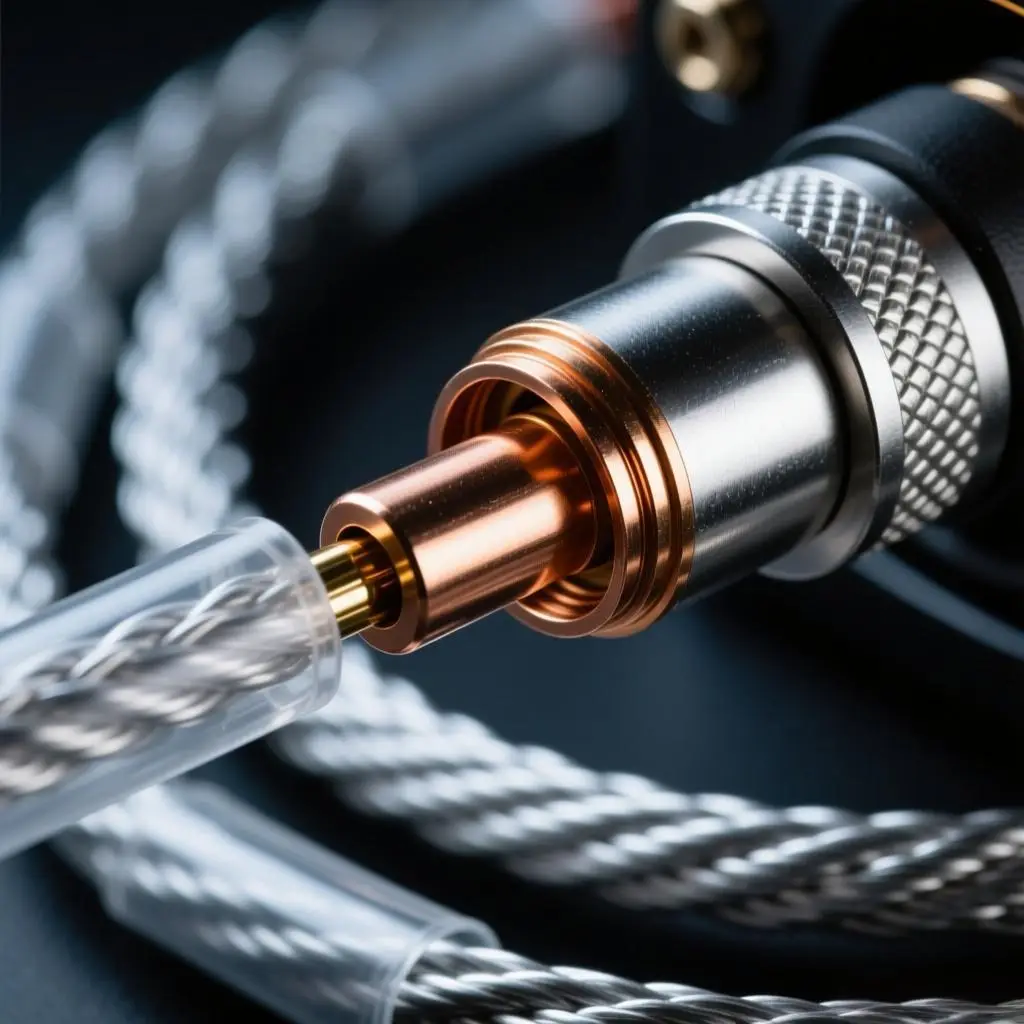
In the pursuit of sonic perfection, the smallest bottleneck can stifle the most sophisticated audio system. While many enthusiasts begin their journey with simple bare wire connections, a critical question eventually arises: is your stock hardware compromising your signal?
Upgrading to high-conductivity speaker binding posts is more than an aesthetic choice; it is a strategic investment in material science. While standard terminals often rely on gold-plated brass—a relatively poor conductor—premium alternatives utilize pure tellurium copper or silver to minimize resistive loss. Beyond metallurgy, these components provide the mechanical stability necessary to prevent oxidation and vibration-induced signal degradation over time. But does this transition offer a transformative performance boost, or does it hit a wall of diminishing returns in entry-level setups? This guide deconstructs the physics of electron flow and connection integrity to help you decide if high-end binding posts are the missing link in your signal chain.
Understanding the Critical Role of Speaker Binding Posts in the Signal Path
In the high-fidelity signal chain, every transition point represents a potential bottleneck. The speaker binding post is far more than a passive mechanical anchor; it is the final gateway the electrical signal must traverse before reaching the internal crossover. Standard terminals found on mass-market receivers are typically constructed from gold-plated brass. While durable, brass is an alloy with a conductivity rating of only about 28% IACS (International Annealed Copper Standard). In contrast, premium binding posts utilizing Oxygen-Free High-Conductivity (OFHC) copper or tellurium copper offer conductivity closer to 95–100% IACS, significantly reducing the DC resistance at the critical junction.
The “bare wire” method, while seemingly direct, is plagued by long-term instability. Copper oxidizes when exposed to air, creating a resistive layer of copper oxide that degrades signal purity over time. Furthermore, bare strands are prone to mechanical “creep,” where the wire flattens and loses clamping pressure, resulting in a loose, high-impedance connection. High-quality binding posts solve this through superior metallurgy and mechanical engineering, providing a gas-tight, high-torque interface that maximizes surface area contact.
From a commercial investment perspective, the value of upgrading is proportional to the system’s transparency. In high-resolution setups, switching to low-mass, high-conductivity terminals can yield measurable improvements in transient response and low-level detail by eliminating eddy currents and minimizing signal reflection. However, for entry-level systems, the bottleneck likely lies elsewhere—such as in the drivers or the room acoustics—meaning that while premium posts ensure longevity and reliable contact, the audible performance boost may face diminishing returns compared to other acoustic treatments.
The Metallurgy of Conductivity: Comparing Pure Copper, Brass, and Gold Plating
To understand why binding post upgrades matter, we must look at the International Annealed Copper Standard (IACS). Most “gold-plated” binding posts found on consumer-grade receivers are actually constructed from brass—an alloy of copper and zinc. While mechanically robust and inexpensive to machine, brass typically offers only 25% to 28% conductivity relative to pure copper. This creates a resistive bottleneck at the critical junction where the amplifier’s signal meets the speaker’s internal crossover.
In contrast, premium binding posts utilize Oxygen-Free Copper (OFC) or Tellurium Copper, which boast conductivity ratings of 95% to 100% IACS. By utilizing high-purity copper, manufacturers minimize the micro-level voltage drops and heat dissipation that occur at the connection point. However, pure copper is soft and highly prone to oxidation, which is why plating is a functional necessity rather than a cosmetic choice.
Gold plating is the industry favorite because it is chemically inert; it prevents the formation of copper oxide, which is semi-conductive and introduces non-linear distortion over time. While silver offers the highest theoretical conductivity (106% IACS), its tendency to tarnish necessitates frequent cleaning.
For the listener conducting a commercial evaluation of these components, the value proposition lies in “material synergy.” If you are investing in high-purity OCC (Ohno Continuous Cast) speaker cables, terminating them into high-resistance brass posts creates an electrical mismatch. While the audible gains may be subtle in entry-level systems, in high-resolution setups, upgrading to pure copper posts ensures the signal path remains as close to a continuous conductor as possible, effectively eliminating connector-induced signal degradation.
Mechanical Integrity: How High-Quality Binding Posts Prevent Signal Degradation
While metallurgy dictates the potential for conductivity, mechanical integrity dictates the longevity of signal purity. Standard binding posts—often mass-produced from thin, zinc-plated brass—frequently suffer from “stress relaxation,” a phenomenon where the clamping force diminishes over time due to thermal cycling and material fatigue. This leads to increased contact resistance and potential signal intermittentcy.
In contrast, high-quality binding posts are engineered for “gas-tight” connectivity. By utilizing precision-machined threads and high-torque caps, these components exert enough pressure to microscopically deform the contact surfaces, effectively sealing out oxygen. This prevents the formation of non-conductive oxides that inevitably plague bare-wire connections. Bare copper wire is particularly susceptible to “cold flow,” where the strands compress and shift under pressure, eventually loosening the connection and inviting signal-robbing micro-arcing. High-end posts mitigate this through high-tension spring mechanisms or oversized compression plates that maintain a constant PSI (pounds per square inch) regardless of cable thickness.
From a commercial investigation standpoint, the value of upgrading depends heavily on system resolution. In high-current, low-impedance environments, a stable mechanical interface is critical to maintaining a high damping factor and tight bass response. For entry-level systems, however, the performance gains may reach a point of diminishing returns, as the internal crossover components often represent a more significant bottleneck than the terminal interface. Ultimately, the primary value proposition of high-quality posts is the elimination of “slow” degradation; they ensure that the electrical path remains as robust in year ten as it was on the day of installation.
Terminating Your Cables: Bare Wire vs. Banana Plugs vs. Spade Connectors
Terminating your cables is the final bridge in the signal chain, and the choice between bare wire, spades, or banana plugs significantly impacts long-term electrical stability. While bare wire is often touted for having the “shortest” signal path, it is the most susceptible to atmospheric degradation. Over time, copper strands oxidize, creating a high-resistance layer of copper oxide that acts as a semi-conductor, effectively throttling the low-level detail your high-conductivity binding posts were designed to preserve. Furthermore, bare wire lacks the mechanical torque necessary to maintain a gas-tight seal, leading to signal “flicker” under high-current demands.
For the serious listener, the debate usually centers on spade connectors versus banana plugs. Spades are widely considered the audiophile gold standard for fixed installations. When paired with a high-torque binding post, a spade connector provides the maximum surface area contact and allows for immense clamping pressure. This pressure creates a “cold weld” effect, minimizing contact resistance to negligible levels. However, if your posts are made of soft, high-purity copper, care must be taken not to over-tighten and strip the threads.
Banana plugs, specifically BFA-style or “Z-plugs,” offer the best balance of convenience and performance. Unlike cheap leaf-spring varieties that lose tension over time, high-quality BFA plugs expand to create 360-degree contact within the post. While the sheer surface area is slightly less than a spade, the consistency of the connection is superior for those who move gear frequently. Ultimately, in entry-level systems, these differences may be masked by other distortions. However, in a high-resolution signal path, the transition from cable to post via a high-mass, oxygen-free copper connector is essential to prevent the “bottleneck effect” that occurs when premium signals meet inferior terminations.
Identifying the Bottleneck: Is Your Factory Hardware Throttling Your Speaker’s Potential?
Most enthusiasts invest heavily in high-purity speaker cables and sophisticated amplification, yet they frequently overlook the final two inches of the signal path: the factory binding post. In mass-produced loudspeakers, hardware is often a fiscal compromise rather than an engineering priority. Standard binding posts are typically machined from “free-machining” brass—a copper-zinc alloy favored for its durability and low cost. However, from a conductivity standpoint, brass is a significant bottleneck, offering only about 26–28% of the IACS (International Annealed Copper Standard) conductivity of pure copper. When your signal transitions from a 99.99% Oxygen-Free Copper (OFC) cable into a low-conductivity brass terminal, you are essentially forcing a high-speed signal through a resistive “choke point.”
Beyond metallurgy, factory hardware often suffers from poor mechanical tolerances. Thin, stamped-metal plates and plastic-capped nuts often fail to provide the clamping force necessary for a gas-tight seal. Over time, thermal expansion and ambient vibrations cause these connections to loosen, leading to micro-arcing, oxidation, and increased contact resistance. This degradation manifests as a loss of micro-dynamics and a “veiled” high-frequency response.
However, the value proposition follows the law of diminishing returns. If you are operating an entry-level system where the primary limitations are cabinet resonance or budget crossover components, the “brass bottleneck” may be the least of your concerns. Conversely, in high-resolution systems, these terminals are often the weakest link. Upgrading to high-conductivity tellurium copper or silver-plated posts is a high-ROI move for audiophiles seeking to eliminate the final barrier to transparency. In these environments, high-quality posts ensure that the signal delivered by your amplifier reaches the voice coil with its phase coherence and harmonic richness fully intact.
The Science of Signal Loss: Resistance, Impedance, and Interfacial Noise
To understand why high-conductivity binding posts are a vital upgrade, one must look at the physics of the connection interface. Every transition point in an audio circuit introduces a potential for signal degradation. This degradation primarily manifests through three phenomena: Ohmic resistance, frequency-dependent impedance shifts, and interfacial noise.
Standard binding posts are typically machined from brass, an alloy that is roughly 28% as conductive as pure copper. This creates a localized spike in resistance. While a few milliohms may seem negligible, the cumulative effect in a high-current environment—where the amplifier is struggling to control a reactive speaker load—can result in a perceptible loss of “grip” or damping factor. High-conductivity posts utilizing Tellurium Copper or pure Silver maintain a linear signal path, ensuring that the voltage drop across the terminal is virtually non-existent.
Beyond simple resistance, “interfacial noise” occurs at the microscopic level where two surfaces meet. In low-pressure connections, such as loose bare wire or cheap spring clips, the contact area is actually a series of microscopic peaks. This creates a “diode effect” due to oxidation layers, leading to non-linear distortion and micro-arcing that raises the noise floor. Audiophile-grade binding posts are engineered to provide massive, uniform clamping force, creating a “gas-tight” seal that eliminates the oxygen responsible for surface corrosion.
From a commercial standpoint, the value of this upgrade scales with the transparency of your system. In entry-level setups, the noise floor of the electronics may mask the benefits of high-end terminals. However, in high-resolution systems, replacing high-impedance brass with low-mass, high-conductivity hardware provides a measurable reduction in signal smear, manifesting as improved transient response and a more defined soundstage. For the serious listener, this is not about “tuning” the sound, but about removing a bottleneck that prevents the amplifier from seeing the speaker’s true load.
Performance vs. Placebo: Navigating the Law of Diminishing Returns in Audio Upgrades
In the audiophile world, the line between empirical engineering and psychoacoustic placebo is often blurred. Navigating the law of diminishing returns requires a cold look at the “signal chain bottleneck.” While a transition from standard nickel-plated brass terminals to high-purity tellurium copper offers a measurable increase in conductivity—often jumping from 28% IACS (International Annealed Copper Standard) to over 90%—the audible impact is dictated by the transparency of your existing system.
If you are operating an entry-level setup where the internal crossover utilizes budget electrolytic capacitors and thin-gauge internal wiring, ultra-high-end binding posts will likely result in a placebo effect. In this context, the hardware is not the primary bottleneck, and the investment would be better diverted toward better transducers or room acoustics. However, as system resolution increases, the binding post becomes the “final yard” of the signal path. In high-current applications or low-impedance scenarios (e.g., 4-ohm speakers), the reduction in interfacial noise and bulk resistance provided by premium posts prevents the subtle masking of micro-dynamics.
The true “performance” value of high-conductivity posts often lies in long-term reliability rather than an immediate “night and day” sonic shift. Premium connectors provide superior mechanical stability and gas-tight seals that resist the thermal cycling and oxidation that plague bare-wire or budget brass connections. While a $200 set of rhodium-plated posts on a $500 speaker is a textbook case of diminishing returns, upgrading a mid-to-high-tier system to high-purity copper terminals ensures that your hardware is no longer the weakest link in the chain. The goal is not to “improve” the sound, but to stop the connection from degrading it.
Installation Best Practices for Achieving a Gas-Tight Audio Connection
Achieving a gas-tight connection is the final, crucial step in ensuring your investment in high-conductivity metallurgy yields a measurable sonic return. A gas-tight seal occurs when the mechanical pressure at the contact point is sufficient to exclude atmospheric oxygen and moisture, preventing the inevitable oxidation that increases interfacial resistance over time. For the audiophile, this means maintaining the ultra-low impedance path your pure copper binding posts were designed to provide.
The process begins with meticulous surface preparation. Even brand-new connectors can harbor microscopic contaminants or residual oils from the manufacturing process. Applying a high-quality contact cleaner and enhancer ensures that the metal-to-metal interface is chemically pure before mechanical coupling.
When dealing with high-purity copper—which is significantly softer than common zinc-heavy brass—precision in torque is paramount. While hand-tightening is standard, the use of spade connectors offers a distinct advantage for achieving gas-tight seals. The broad, flat surface area of a spade allows for high-pressure compression against the binding post’s shoulder. At the right torque, the soft copper slightly deforms to fill microscopic voids in the connector, effectively “cold welding” the surfaces together. However, caution is required: because high-conductivity alloys are more malleable, over-torquing with tools can strip threads or stress the material.
If you prefer banana plugs, ensure the sleeves utilize high-tension springs (such as Beryllium copper) to maintain constant radial pressure against the internal wall of the post. By establishing this airtight barrier, you effectively “lock in” the signal integrity, ensuring that the system’s transparency and transient response do not degrade months after installation due to atmospheric exposure. This mechanical stability is what separates a professional-grade termination from a standard, high-maintenance bare-wire connection.
Have questions or your own tips to share? Drop a comment below!