
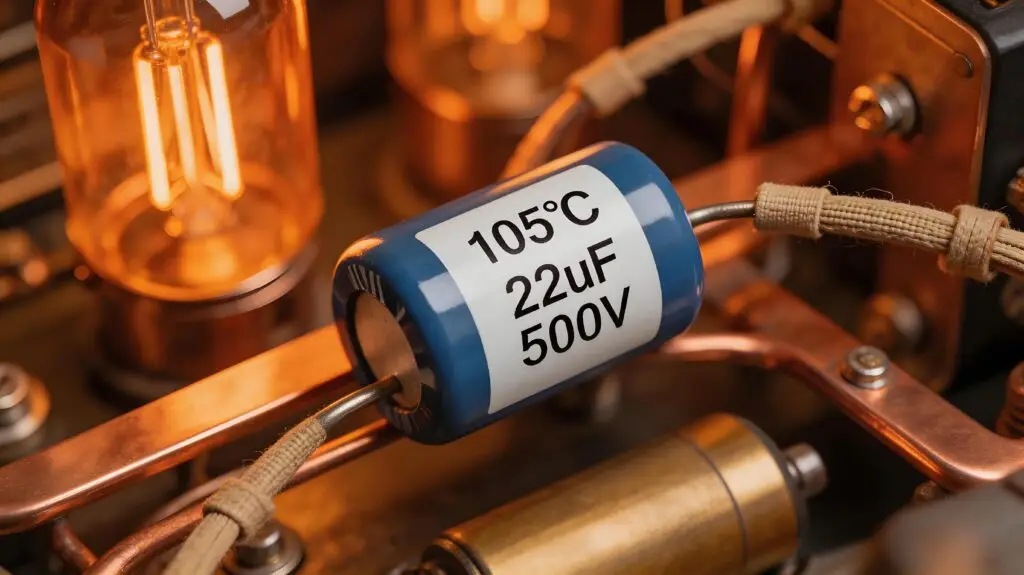
When you’re deep into a vintage tube amplifier restoration or a critical motor repair, a 500v 22uf capacitor is more than just a line item on a schematic—it is the lifeline of your circuit. At these high voltages, “good enough” is a recipe for catastrophic failure. While many components share the same printed specs, the reality is that a budget part can easily “pop” or drift when subjected to the heat and ripple current of a high-pressure environment.
To ensure long-term survivability, you must look beyond the label. This guide breaks down the essential factors that separate industrial-grade components from cheap imitations. We’ll explore why 105°C temperature ratings are non-negotiable over 85°C alternatives, how low ESR (Equivalent Series Resistance) impacts longevity, and which elite brands like Sprague, F&T, and Nichicon consistently deliver under stress. Don’t risk your hardware on a gamble; learn how to spec a capacitor that is truly built to last.
Understanding the Critical Role of a 500V 22uF Capacitor in High-Voltage Circuits
In high-voltage environments, a 500V 22uF capacitor serves as a primary reservoir for smoothing rectified AC into stable DC. This specific value is a staple in tube amplifier power supplies and industrial motor controls, where the component must withstand massive potential energy without dielectric breakdown. At 500V, the margin for error is razor-thin; the capacitor is not merely a passive component but the gatekeeper of your circuit’s stability.
The “survivability” of this component hinges on its ability to manage internal heat. If a capacitor’s Equivalent Series Resistance (ESR) is too high, the ripple current passing through it generates localized thermal stress, leading to electrolyte outgassing and the dreaded “pop” or catastrophic leakage. For commercial investigation, the distinction between an 85°C and a 105°C temperature rating is paramount. A 105°C rating signifies a more robust electrolyte chemistry designed to resist drying out over time, effectively doubling the component’s operational lifespan for every 10°C decrease in operating temperature.
For high-stress applications—such as the plate supply in a vintage Marshall or Fender amplifier—settling for generic brands is a liability. Premium manufacturers like F&T (favored for their tight tolerances and high-voltage stability), Nichicon (renowned for their high-reliability “PZ” or “BX” series), and Sprague “Atoms” provide the structural integrity required to handle high-surge voltages. When you select a 500V 22uF unit, you are not just buying a capacity rating; you are purchasing a safety margin. In these circuits, the capacitor is the last line of defense against power supply sagging and 60Hz hum, making its durability the cornerstone of the entire system’s performance and safety.
Why Voltage Headroom Matters: The Risks of Operating Near the 500V Limit
In the world of high-voltage electronics, particularly in vacuum tube amplifiers where “B+ rails” often hover around 450V, a 500V rating might seem like a comfortable margin. However, operating at 90% of a capacitor’s maximum Working Voltage (WVDC) is a gamble with the component’s lifespan. Capacitors are electrochemical devices; as they approach their dielectric breakdown point, internal stress increases exponentially.
When you push a 500V 22uF capacitor to its limit, you aren’t just risking a spectacular failure; you are dealing with increased leakage current and internal self-heating. This is where the distinction between an 85°C and a 105°C thermal rating becomes a “survivability” factor. A 105°C-rated component from a premium manufacturer like Nichicon or F&T uses more stable electrolyte formulations and superior sealing, which is essential when the capacitor is positioned near heat-radiating power tubes or within the enclosed housings of motor starters.
Furthermore, voltage headroom is critical for the “turn-on surge.” In many power supplies, the voltage can spike significantly before the tubes warm up and begin drawing current. High-tier brands like Sprague (specifically the “Atom” series) or German-engineered F&T are designed with a higher surge voltage tolerance compared to generic alternatives. By selecting a high-quality 500V unit with low Equivalent Series Resistance (ESR), you minimize internal power dissipation. Lower ESR ensures that even under heavy ripple current loads, the capacitor remains cool. In professional applications, providing at least 15-20% voltage headroom—or choosing a component specifically built for high-stress reliability—is the only way to prevent the electrolyte from outgassing, which leads to the “dried out” state that causes parasitic hum and eventual circuit collapse.
Temperature Ratings Explained: Why 105°C is the Gold Standard for Durability
In the high-stakes world of tube amplifiers and industrial power supplies, heat is the silent assassin of electrolytic capacitors. When sourcing a 500V 22µF unit, you will often face a choice between an 85°C and a 105°C rating. While 85°C might suffice for consumer-grade electronics, it is a liability in high-voltage environments where chassis temperatures and internal self-heating can soar.
The 105°C rating is the “Gold Standard” because of the Arrhenius Law of Chemical Reaction Rates. In practical engineering, this translates to a simple but brutal rule: for every 10°C decrease in operating temperature below the rated maximum, the component’s lifespan doubles. A 105°C-rated capacitor operated at a typical 65°C internal chassis temperature will theoretically last four times longer than an 85°C counterpart under the exact same conditions.
At 500V, the dielectric stress is already substantial. Heat compounds this stress by accelerating the evaporation of the liquid electrolyte. As the electrolyte dries out or “outgasses,” the Equivalent Series Resistance (ESR) begins to climb. This creates a lethal feedback loop: higher ESR generates more internal heat via ripple current, which further dries the electrolyte, eventually leading to the “bulge and pop” failure common in inferior builds.
By insisting on a 105°C 22µF capacitor from professional-grade manufacturers like Nichicon, Rubycon, or F&T, you are investing in a more robust physical seal and a more stable chemical composition. This thermal headroom is your primary insurance policy against premature failure and sonic degradation, ensuring your high-voltage equipment remains stable and filtered for decades rather than months.
The Impact of ESR and Ripple Current on Capacitor Stability and Heat Generation
While voltage and capacitance are the primary specs on the label, Equivalent Series Resistance (ESR) and Ripple Current are the hidden variables that dictate whether a 500V 22uF capacitor thrives or fails. In high-voltage power supplies—particularly in tube amplifiers or motor controllers—the capacitor must constantly “smooth” AC fluctuations. This process subjects the component to ripple current, which is the residual AC component riding on the DC voltage.
Think of ESR as an internal resistor within the capacitor. When ripple current passes through this resistance, it generates heat ($P = I^2R$). In a high-stress 500V environment, even a marginal increase in ESR can lead to significant internal temperature spikes. This heat is the primary enemy of electrolytic capacitors; it accelerates the evaporation of the liquid electrolyte, leading to a “dry out” failure or a catastrophic pressure vent.
When evaluating components for commercial or industrial reliability, you must prioritize a high ripple current rating and low ESR. Premium manufacturers like Nichicon (specifically their PT or CY series) and F&T utilize high-purity aluminum foils and sophisticated electrolyte formulas to keep ESR at a minimum. For heavy-duty tube applications, the Sprague Atom series remains a benchmark because its physical construction is designed to dissipate heat more effectively than generic, miniaturized alternatives.
A capacitor with a high ripple rating is inherently more robust, as it is built to survive the thermal stresses of continuous cycling. If your circuit demands high current delivery, choosing a 500V 22uF capacitor with an inferior ripple rating is a recipe for premature “popping.” Always cross-reference the manufacturer’s data sheet to ensure the component’s ripple handling exceeds your circuit’s peak requirements by at least 20-30% for maximum survivability.
Electrolytic vs. Polypropylene: Choosing the Right Dielectric for Your Application
At this specific 500V 22µF threshold, the choice between Aluminum Electrolytic and Polypropylene (Film) dielectrics is a pivotal decision that dictates both the longevity and the physical architecture of your build. For commercial applications and high-end audio restorations, this is often a battle between energy density and “bulletproof” reliability.
Aluminum Electrolytic capacitors are the traditional choice for 500V 22µF filtering, primarily due to their high energy-to-volume ratio. High-tier brands like F&T (Germany), Nichicon, and the iconic Sprague Atom series offer these ratings in relatively compact, polarized packages. However, electrolytics are electrochemical devices with a finite lifespan; the liquid electrolyte will eventually dry out, especially when subjected to the high internal heat of a tube chassis. If you opt for electrolytic, your “survivability” strategy must prioritize 105°C-rated components with high ripple current specifications to prevent the internal pressure build-up that leads to the dreaded “pop.”
Polypropylene Film capacitors, by contrast, are essentially “forever” components. Because they use a solid plastic dielectric, they do not dry out, are non-polarized, and boast significantly lower ESR than even the best electrolytics. In high-voltage power supplies, a 22µF polypropylene cap from a manufacturer like Solen or CDE provides exceptional stability and faster transient response.
The compromise is the “footprint tax.” A 500V 22µF film capacitor can be five to ten times larger than its electrolytic equivalent. If your enclosure has the real estate, polypropylene is the superior choice for high-stress environments where maintenance is not an option. If space is restricted, stick to premium, high-hour electrolytic brands to ensure your circuit doesn’t fail the moment the voltage swings toward that 500V limit.
Optimizing Audio Performance: The 500V 22uF Capacitor in Tube Amplifier Filter Stages
In the power supply of a tube amplifier, the 500V 22uF capacitor acts as a critical reservoir, smoothing rectified AC into clean DC. Because vacuum tube circuits often operate at B+ voltages dangerously close to the 450V–485V threshold, selecting a capacitor with a genuine 500V rating—and a robust surge voltage margin—is the difference between a reliable build and a catastrophic failure on stage or in the studio.
For the discerning technician, the choice goes beyond mere capacitance. In filter stages, Equivalent Series Resistance (ESR) is the silent performance killer. A high ESR in your 22uF cap increases the ripple voltage, which manifests as an audible 60Hz or 120Hz hum. Premium brands like F&T (Germany) or Nichicon (specifically the CY or VX series) are industry standards because they maintain low ESR and high ripple current handling even under the intense thermal stress typical of a tube chassis.
Physical construction also dictates longevity. While modern “miniature” electrolytics are convenient, larger-can capacitors like the Sprague Atom or F&T dual-section cans offer better heat dissipation. This is vital when the capacitor is mounted in an under-chassis “hot spot” near power tubes. If you are refurbishing a vintage Marshall or Fender, using a high-temp 105°C rated 22uF capacitor ensures that the power supply’s “sag” remains predictable and the low-end transient response stays tight. By prioritizing components with high-ripple current ratings, you effectively lower the noise floor and prevent the “ghost notes” and intermodulation distortion that occur when a filter stage begins to fail under pressure.
Industrial Applications: Power Filtration and Motor Starting Requirements
In industrial environments, the 500V 22uF capacitor moves beyond simple signal filtering and into the realm of heavy-duty power management. Whether it is acting as a DC link capacitor in a variable frequency drive (VFD) or providing the necessary phase shift for a small high-torque motor, the component faces aggressive thermal cycling and massive transient spikes. In these high-stakes settings, a “generic” capacitor is a liability; it is the primary point of failure that leads to costly machine downtime.
For industrial power filtration, the primary metric for survivability is the capacitor’s ability to handle sustained ripple current without localized internal heating. High-performance units from Nichicon (specifically the pencil-type or high-ripple series) or Rubycon are engineered with reinforced electrolyte formulas that maintain chemical stability even as the 500V threshold is approached. In motor-starting or run-assist applications, the dielectric must withstand instantaneous dV/dt (voltage change over time) stresses. A standard 85°C rated capacitor will often suffer from “dry out”—a phenomenon where the electrolyte evaporates due to internal heat—leading to a catastrophic loss of capacitance and eventual venting.
To ensure long-term reliability in industrial racks, prioritize components with high-grade hermetic seals and heavy-duty safety vents. Brands like F&T (Flick & Taller) are often preferred by technicians for their conservative ratings and robust mechanical construction, which helps the capacitor withstand the constant mechanical vibrations common in motor housings. By selecting a 500V 22uF capacitor with ultra-low Equivalent Series Resistance (ESR) and a verified 105°C rating, you effectively insulate your equipment against the thermal runaway and pressure build-up that causes lesser components to “pop” under the strain of industrial workloads.
Top-Tier Brand Reliability: Comparing F&T, Nichicon, Sprague, and JJ Electronic
When selecting a 500V 22µF capacitor, the manufacturer’s reputation is often the best proxy for actual field longevity. While data sheets provide baseline specs, real-world “survivability” in high-heat tube stages or industrial power supplies varies significantly across these four industry titans.
F&T (Fischer & Tausche) represents the pinnacle of German engineering for high-voltage electrolytics. Known for exceptionally tight tolerances and low ESR, F&T capacitors are the gold standard for premium audio restorations. Their 500V range is particularly prized for its low leakage current and mechanical stability, ensuring that the “hum” stays out of your signal path for decades rather than years.
Nichicon, the Japanese powerhouse, is the go-to for high-stress industrial reliability. If your application demands 105°C ratings with high ripple current endurance, Nichicon’s specialized series (like the CY or VX lines) are virtually unmatched. Their consistency in mass production means you get industrial-grade chemistry that resists drying out, even when tucked away in poorly ventilated chassis.
Sprague (Vishay), specifically the “Atom” line, carries a legacy of being “overbuilt.” These capacitors are often physically larger than their modern counterparts, which is a deliberate design choice that aids in thermal dissipation. For vintage guitar amplifier technicians, Sprague Atoms are the traditional choice because their massive thermal mass allows them to survive voltage spikes that might pop smaller, modern components.
JJ Electronic offers the most practical balance of performance and price. Based in Slovakia, JJ specializes in high-voltage “can” and radial capacitors specifically for the vacuum tube market. While they are often viewed as the “workhorse” option, their 500V 22µF units are specifically engineered to handle the idiosyncratic power-on surges of valve rectifiers, making them a reliable, cost-effective choice for modern builds where F&T or Sprague might exceed the budget.
Physical Form Factors: Radial, Axial, and ‘Can’ Style Mounting Considerations
When dealing with 500V 22uF capacitors, the mechanical layout is as vital to long-term reliability as the internal chemistry. Choosing the wrong form factor doesn’t just complicate installation; it creates thermal bottlenecks and mechanical stress points that lead to premature failure in high-stress environments like tube amplifiers or industrial power supplies.
Radial capacitors, where both leads exit the same end, are the industry standard for modern PCB-based power filtration. However, a 500V 22uF radial is often significantly taller than its lower-voltage counterparts. In high-vibration environments or compact enclosures, these “towers” can act as levers, eventually fracturing solder joints or snapping leads if not secured with RTV silicone. If your application involves significant movement, ensure the radial footprint allows for a secure, low-profile fit.
Axial capacitors (leads exiting opposite ends) remain the gold standard for point-to-point wiring and vintage restorations. Brands like F&T and Sprague produce high-quality axials that allow the component to lie flat against the chassis or terminal strip. This orientation provides superior mechanical stability and utilizes the chassis itself as a secondary heat sink. When installing these, avoid “tenting” the leads; keeping the body flush against the mounting surface minimizes the risk of lead fatigue from thermal expansion.
Finally, “Can” style or snap-in mountings are often required for high-current filtration where heat dissipation is critical. If you are replacing a vintage multi-section twist-lock can, you face a strategic choice: restuffing the original housing or mounting discrete radial/axial replacements. The latter requires careful management of lead length; long, unshielded leads can introduce parasitic inductance and ESR-related instability. Always prioritize a form factor that maximizes airflow around the component body, as 500V rails generate significant ambient heat that must be dissipated to prevent electrolyte “dry-out.”
Spotting the Red Flags: How to Identify Counterfeit or Low-Quality Components
In high-voltage environments, a counterfeit or “B-grade” capacitor is more than a technical failure—it is a safety hazard. When sourcing a 500V 22uF capacitor, the most common deception involves “re-sleeving,” where a lower-rated component (typically 400V or 450V) is wrapped in a new label claiming 500V or 525V tolerance. To spot these, start with a physical inspection. Authentic high-tier brands like F&T, Nichicon, and Sprague utilize high-resolution, heat-shrunk sleeves with crisp, legible text and consistent alignment. If the printing is blurry, the ink rubs off easily, or the sleeve appears loosely fitted with visible “ears” at the crimp, exercise extreme caution.
Physical dimensions are your next diagnostic tool. A genuine 500V 22uF electrolytic requires a specific volume of aluminum foil and electrolyte to handle the dielectric stress. If a component is significantly smaller or lighter than the manufacturer’s datasheet specifications, it likely lacks the necessary internal surface area, leading to premature dielectric breakdown. In the tube amplifier community, a notorious “red flag” is the “cap-in-a-cap” scam, where a tiny, inferior capacitor is hidden inside a larger, vintage-looking “can” shell.
Finally, utilize an LCR meter to verify the Equivalent Series Resistance (ESR) and leakage current. For a 22uF 500V part, an unusually high ESR out of the box suggests poor internal chemistry or aged stock. Furthermore, if you are sourcing for critical applications like motor starts or filter stages, avoid “no-name” components from unverified marketplaces. Authentic 500V capacitors from reputable manufacturers have a cost floor; if the price is 50% lower than the MSRP at authorized distributors like Mouser or Digi-Key, the component is likely a reject or a dangerous imitation.
Signs of Imminent Failure: When to Replace Your High-Voltage Capacitors
In the high-stakes environment of a 500V rail, capacitor failure is rarely a quiet affair. Because a 22µF capacitor at this voltage stores significant energy, identifying “pre-flight” warning signs is critical to preventing catastrophic damage to output transformers or vintage PCBs.
The most immediate physical indicator is venting or “doming.” High-quality radial capacitors are designed with a scored “K” or “X” on the top to allow for controlled outgassing. If the top of your capacitor isn’t perfectly flat, or if the rubber bung on an axial lead appears pushed out, internal pressure has already compromised the component. Similarly, look for “crusty” amber or white deposits at the base or around the leads; this is leaked electrolyte, which is both corrosive and conductive, posing a risk of short-circuiting adjacent traces.
From a performance standpoint, especially in tube amplifiers or motor controllers, the first symptom of a failing 500V 22µF cap is an audible increase in 60Hz/120Hz hum or the appearance of “ghost notes” (intermodulation distortion). This occurs as the Equivalent Series Resistance (ESR) climbs. High ESR prevents the capacitor from smoothing ripple current efficiently, leading to internal self-heating. If the capacitor casing feels hot to the touch—approaching its 85°C or 105°C limit—after short periods of operation, the dielectric is likely in a state of thermal runaway.
For technicians using an ESR meter, any reading significantly higher than the manufacturer’s datasheet—often above 2.0 ohms for this specific value/voltage combination—is a definitive red flag. While a failing cap might still measure 22µF on a standard multimeter, a high ESR proves the internal chemistry is spent. Replace these components immediately; the cost of a new Nichicon or Sprague is negligible compared to the collateral damage of a high-voltage rupture.
Safety First: Proper Protocols for Discharging and Installing 500V Components
When dealing with a 500V 22uF capacitor, safety is not merely a precaution; it is a critical technical protocol. A capacitor of this magnitude can store enough energy to be lethal long after the device is unplugged. Never rely on “natural” drainage through internal circuits. To safely discharge, avoid the amateur mistake of “shorting” the terminals with a screwdriver, which can cause arcing, pit the terminals, and create high-current stress that damages the internal foils. Instead, use a dedicated discharge tool—typically a high-wattage, 20kΩ to 50kΩ resistor—to bleed the charge slowly. Always verify the voltage has dropped below 10V with a calibrated digital multimeter before touching the component.
During installation, the highest risk to your high-performance Nichicon or F&T capacitor is thermal and mechanical stress. Electrolytic capacitors are polarized; reversing the orientation on a 500V rail will lead to a catastrophic rupture almost instantly. Double-check the cathode stripe against your PCB or chassis markings. Furthermore, high-voltage components are sensitive to “thermal shock” during soldering. Use a temperature-controlled iron to ensure a rapid, clean joint; excessive dwell time on the leads can heat the electrolyte to the point of internal pressure buildup, compromising the seal before the component is even energized.
Finally, consider the lead dress and physical placement. In tube amplifiers or industrial motor drives, 500V components should be positioned away from heat-generating resistors or power tubes. Maintaining a “cool zone” prevents the electrolyte from drying out prematurely, ensuring that your 105°C-rated part actually meets its promised lifespan. Secure “can-style” capacitors with proper clamps or high-temp adhesive to mitigate vibration, which can lead to lead fatigue and eventual arcing in high-voltage environments.
Have questions or your own tips to share? Drop a comment below!