
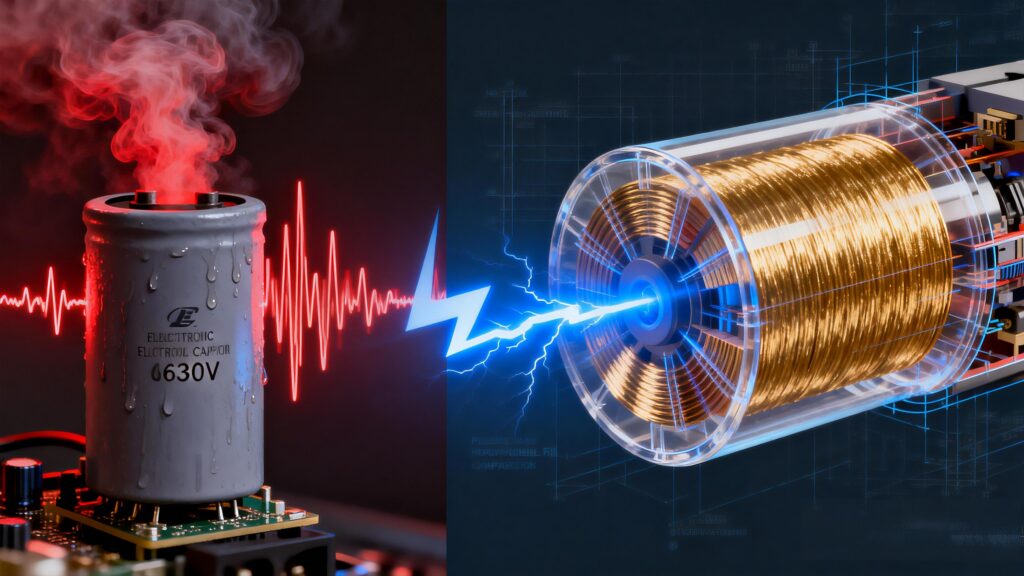
The pursuit of absolute high fidelity often stalls at a crucial, overlooked junction: the internal capacitance of the power supply or signal path. If your audio system suffers from veiled transients, a collapsed soundstage, or dynamic limitations during demanding musical passages, the subtle degradation caused by standard components is robbing your investment of its potential. This is where we introduce The Missing Link to Hi-Fi: High Voltage Film Capacitors. This detailed technical investigation is for the serious audiophile and designer. We move past simple definitions to analyze why these specialized components—built with high breakdown voltages and superior film dielectrics—fundamentally eliminate dynamic compression. You need a comparative guide, not a glossary. We will provide the deep dive you require, evaluating specific film types (from Polyester to high-grade Polypropylene) and construction methodologies to pinpoint the exact capacitor that unlocks the stunning neutrality, speed, and spatial accuracy your high-end system truly deserves.
The Capacitor Paradox: Why Standard Components Sacrifice Dynamic Range
The common assumption that any capacitor of the correct capacitance value will suffice in an audio circuit is the root of the “Capacitor Paradox.” Standard, non-specialized components—especially polarized electrolytics often utilized in power supply smoothing or budget coupling stages—inherently introduce mechanisms that sacrifice the micro-dynamics essential for true hi-fi reproduction.
The primary culprits are high Equivalent Series Resistance (ESR) and Equivalent Series Inductance (ESL). In power applications, high ESR acts as a parasitic resistor, impeding the capacitor’s ability to instantly deliver large bursts of current required during transient peaks. This restriction effectively softens sharp attack and decay envelopes, flattening the amplitude difference between loud and quiet sections, which is the definition of dynamic compression.
However, the more insidious flaw, particularly in signal path coupling and crossover applications, is high Dielectric Absorption (DA). Often referred to as the capacitor’s “memory effect,” DA describes the phenomenon where the dielectric material (like aluminum oxide in standard electrolytics) temporarily absorbs charge energy and then slowly releases it back into the circuit, lagging the signal. This delayed release smears the original waveform, superimposing residual energy from previous cycles onto subsequent, quieter signals. This masks low-level harmonic and spatial detail—the very elements that define neutrality and spaciousness.
By structurally compromising the capacitor’s ability to instantaneously track the audio signal’s rapid voltage swings, standard components blur the transient response and collapse the difference between a system’s noise floor and its maximum output. This dictates why discerning audio designers must transition to specialized high voltage film capacitor architectures to maintain the full, uncompressed dynamic window.
Defining the High Voltage Audio Capacitor: Requirements Beyond Standard Use
The definition of an audio-grade high voltage (HV) film capacitor diverges sharply from standard industrial requirements. While commercial filtering components prioritize bulk energy storage and ripple rejection, audio demands ultra-low distortion under conditions of high current transients and peak dynamic loading.
The “high voltage” specification (typically 630VDC or higher) in audio circuits is often utilized not strictly for the voltage margin, but rather to mandate a thicker, physically more robust dielectric layer. A substantial film gauge drastically improves the insulation resistance and prevents internal partial discharge (or corona effect). This effect, common in standard components subjected to rapid current peaks, introduces subtle intermodulation distortion that manifests as signal smearing, destroying spatiality and dynamic contrast.
Crucially, dynamic fidelity hinges on the capacitor’s ability to deliver and retrieve current instantaneously, requiring exceptionally low Equivalent Series Resistance (ESR) and Dissipation Factor (DF). Only low-loss dielectrics, predominantly high-purity Polypropylene (PP), maintain stability across the entire audible bandwidth without significant shifts in capacitance or phase angle—a necessity for achieving true neutrality.
Furthermore, construction type directly impacts performance in high-current applications like coupling stages. While compact metallized films are common, the highest fidelity requires heavy-gauge pure foil film designs. Foil construction exhibits vastly lower ESR and superior transient response, minimizing current handling limitations and thermal modulation effects. This results directly in tighter, more defined bass articulation and the complete elimination of the “sluggish” transient response associated with components that cannot keep pace with the musical signal’s dynamic envelope. These precise technical margins are what justify the selection of specialized HV components in high-fidelity circuits.
The Technical Rationale for High Voltage: Minimizing Parasitic Effects and Dielectric Absorption
The primary technical advantage of a high-voltage (HV) rated film capacitor operating within a standard audio circuit (e.g., 50V operational) lies in the extreme structural integrity required by the HV specification. This over-specification is the key to minimizing the two greatest spectral enemies of transient fidelity: parasitic resistance/inductance and Dielectric Absorption (DA).
A component rated for 400V or 630V mandates substantially thicker dielectric films, highly robust terminal attachment points, and meticulously controlled winding tensions. This design requirement inherently drives down the Equivalent Series Resistance (ESR) and Equivalent Series Inductance (ESL). Low ESR ensures rapid energy transfer without thermal loss or signal attenuation, preserving subtle micro-dynamics, while low ESL eliminates high-frequency ringing that distorts the leading edge of transients. Furthermore, the thicker insulation drastically reduces the risk of internal partial discharge or corona effects—micro-arcing noise that manifests as smearing in the upper octaves.
However, the most critical technical benefit addresses Dielectric Absorption (DA), often called the capacitor’s “memory effect.” DA is the delay in releasing stored energy, blurring the definition between signal peaks and the subsequent decay. A high voltage rating necessitates a film of superior purity and structure (e.g., high-grade Polypropylene). When operated at low audio voltages, the resultant electrical stress (E = V/d) is vastly reduced relative to the component’s rating. This minimal operating stress suppresses the polarization mechanisms responsible for DA, ensuring the capacitor acts as a near-perfect reservoir. The energy transfer is instantaneous, allowing the circuit to resolve incredibly fast, complex transients without hesitation, directly eliminating the dynamic compression and loss of spatial precision characteristic of lesser-specified components.
Microphony and Mechanical Resonance: How Physical Stress Causes Dynamic Compression
Microphony, often termed the “reverse speaker effect,” is a major contributor to dynamic compression in audio circuits. This phenomenon occurs when mechanical energy—whether structural borne noise from transformers or acoustic feedback from loudspeaker drivers—transfers to the capacitor’s body, causing physical deformation of the dielectric element.
The mechanism relies on the intrinsic electrostrictive and minor piezoelectric properties of the film dielectric (such as polypropylene). When physical stress is applied, the separation between the conductive foils and the dielectric constant itself momentarily changes. This movement translates directly into an unintentional, parasitic variation in capacitance ($\Delta C$), generating a micro-AC voltage superimposed onto the main audio signal path.
The resultant noise modulation is most damaging to the lowest amplitude portions of the signal. The induced parasitic voltage raises the effective noise floor and masks critical low-level transients and decay information—the very elements that define spatiality and micro-dynamics. While peak signal levels remain unaffected, the noise smothers the subtle cues, audibly shrinking the effective dynamic range and creating the sonic signature of compression.
Mitigating microphony requires construction tailored for mechanical stability. High-grade audio film capacitors utilize rigid, non-resonant housing and, crucially, full epoxy resin encapsulation or vacuum potting. This encapsulation eliminates internal air voids and mechanically locks the wound element, preventing the structural movement necessary for the electrostrictive effect to manifest. For critical filtering or coupling applications, choosing a fully immobilized, high voltage rated capacitor ensures the necessary mechanical silence required to preserve the system’s finest micro-dynamic resolution.
Equivalent Series Resistance (ESR) and Inductance (ESL): The Silent Killers of Transient Response
The true measure of a high-performance audio capacitor is its deviation from the ideal, purely capacitive component. This deviation is quantified by parasitic elements: Equivalent Series Resistance (ESR) and Equivalent Series Inductance (ESL). These factors are the primary technical barriers to achieving perfect transient response and maximum dynamic range.
ESR, the sum of resistance from leads, plate material, and terminal connections, acts as an unwelcome resistor in series with the signal path. In crossover networks, even marginal ESR variations significantly impact the filter’s calculated slope and damping factor, resulting in inconsistent driver control and spectral imbalance. For power supply filtering, high ESR increases ripple voltage and restricts the instantaneous current demanded by complex musical peaks. This parasitic resistance directly limits power delivery, manifesting audibly as dynamic compression and a loss of ‘punch’ during loud passages. The specialized construction of high voltage film capacitors—which utilize thick, low-resistance metallization or foil—is essential for keeping ESR negligible, preserving the amplifier’s control over the loudspeaker load.
Equally critical is ESL, the inherent inductance caused by the winding geometry and lead length. ESL creates an opposing impedance that rises with frequency, functioning as an unintentional low-pass filter at the highest end of the audio spectrum. More damagingly, high ESL restricts the component’s ability to react instantaneously to sharp input signals, causing subtle yet perceptible time smear. This delay destroys phase coherence and blurs the edges of fast transients, crippling spatial accuracy and the sense of ‘air’ around instruments. Minimizing ESL is achieved through sophisticated, non-inductive winding techniques, such as extended foil construction. For high-end audio, the goal is not just low capacitance, but ultra-low ESL to guarantee microsecond timing precision, thus maintaining the absolute integrity of the transient wavefront.
Comparative Dielectric Performance: Which Film Type Provides the Best Sonic Neutrality?
The choice of dielectric material is the most critical factor determining a capacitor’s inherent sonic neutrality and its ability to resist signal contamination across the audible bandwidth. Among the film types suitable for high-voltage audio circuits, Polypropylene (PP, or KP) provides the superior performance benchmark.
Polypropylene exhibits an exceptionally low Dissipation Factor (DF) and minimal Dielectric Absorption (DA)—often two orders of magnitude lower than other common materials like Polyester (PET or Mylar). This combination is crucial for achieving sonic transparency. Low DA ensures that the minute electrical charge temporarily retained by the dielectric is released almost instantaneously, preventing the subtle, time-delayed signal re-injection known as “memory effect.” Sonically, this minimal DA guarantees superior transient fidelity and phase accuracy, allowing complex spatial cues and micro-dynamics to remain unsmeared and fully intact.
Conversely, Polyester, frequently used in lower-cost circuits, suffers from higher intrinsic DA and DF. In a critical signal path, this results in a measurable non-linearity that subtly smears high-frequency information and compresses dynamic headroom, contributing to a less airy and less precise stereo image. While alternative dielectrics like PTFE (Teflon) offer marginal improvements in DA, their cost and manufacturing complexity often render them impractical for high-voltage ratings. For the necessary combination of voltage resilience, thermal stability, and uncompromising wide-band sonic neutrality required in high-fidelity audio, high-purity Polypropylene remains the indispensable dielectric choice.
Polypropylene (PP) vs. Polystyrene (PS): Achieving Ultra-Low Distortion in Coupling Stages
The coupling stage is arguably the most critical junction for maintaining signal integrity, and here, the choice narrows overwhelmingly to Polystyrene (PS) and Polypropylene (PP) due to their unparalleled performance in minimizing dielectric loss mechanisms. Polystyrene historically boasts the lowest measurable Dielectric Absorption (DA) of any widely available film, often registering near-zero. This near-perfect lack of energy storage and delayed release makes PS the theoretical ideal for preserving the leading edge of complex waveforms, delivering hyper-accurate transient response and the highest possible spatial resolution (soundstage depth).
However, practical application often favors Polypropylene. While PP’s DA is marginally higher than PS, its Dissipation Factor (DF or tan $\delta$) is typically lower and, critically, remains significantly more stable across both frequency and operational temperature shifts. This superior loss tangent ensures absolute signal neutrality and transparency, crucial for maintaining the intended tonal balance through the coupling point. Furthermore, PP is fundamentally more stable; PS exhibits poor tolerance to heat (maxing out around 85°C), making it unsuitable for components near heat sinks or in demanding power supply decoupling roles, and its large physical size complicates dense circuit layouts.
For the majority of high-voltage audio coupling requirements—especially where thermal stability and long-term reliability are factors—PP offers the optimal balance. Its extremely low ESR and DF, combined with superior volumetric efficiency and robustness compared to the thermal fragility and shrinking availability of PS, establish it as the definitive high-voltage film choice for achieving ultra-low distortion and maintaining dynamic compression immunity in modern hi-fi circuitry.
Application Deep Dive: Utilizing HV Film Capacitors in Crossovers vs. Power Supply Filters
The application dictates the primary performance vector. In passive or active crossovers, where the capacitor is directly in the audio signal path, the objective is absolute sonic neutrality. Here, high voltage (HV) film capacitors—typically non-metallized or heavy-foil Polypropylene (PP)—are chosen primarily for their vanishingly low Dielectric Absorption (DA) and superior mechanical rigidity, which combats microphony. The elevated voltage rating significantly reduces the field stress per unit thickness, ensuring the dielectric layer remains acoustically transparent and minimizes residual charge/discharge artifacts that smear transient leading edges. This selection directly preserves spatiality and transparency.
Conversely, the high voltage film capacitor’s role in power supply filtering (PSU) and decoupling is focused on instantaneous energy delivery and ripple suppression. For this application, while PP film is still preferred for its low inductance characteristics, the imperative shifts to extremely low Equivalent Series Resistance (ESR) and high ripple current handling. In the PSU, dynamic compression occurs when the voltage rail sags during sudden, massive current demands (e.g., handling a bass drum transient). Utilizing HV film construction ensures the large foil surface area and optimized lead structure provide the stiffness necessary to instantly charge the amplifier stage. The high voltage rating in this context guarantees stable insulation against high-frequency switching noise common in modern Class D or switching PSUs, thereby maintaining a profoundly quiet foundation essential for maximizing dynamic range. The HV capacitor acts as the immediate energy buffer, ensuring the amplifier never starves.
The Ultimate Selection Checklist: Choosing the Right Voltage Rating and Manufacturing Construction
The voltage rating of an audio film capacitor must be considered an active performance parameter, not merely a safety specification. While standard practice selects a rating 1.5 to 2 times the operating voltage, high-end audio necessitates a significant over-specification—often choosing 630V or 1000V components even for low-voltage signal paths. This approach is rooted in the physics of dielectric stress. A higher rated voltage implies a thicker dielectric film. By keeping the applied voltage constant while increasing the film thickness ($d$), the electric field strength ($E=V/d$) across the material is substantially reduced. Lower field strength drastically minimizes non-linear distortion mechanisms, especially those related to dielectric absorption and charge injection, which manifest as sonic smearing and dynamic clipping. This intentional over-rating directly correlates to enhanced soundstage focus and improved low-level resolution.
Equally critical is the manufacturing construction, specifically the choice between metallized film and discrete film-and-foil design. Metallized film capacitors are compact and feature “self-healing” properties, but their structure inherently includes a high-resistance conductive boundary layer (the vapor-deposited metal). For uncompromising audio reproduction, the superior choice is the film-and-foil configuration. This construction utilizes separate sheets of conductive metal foil (e.g., copper or tin) interwound with the dielectric film (e.g., Polypropylene). This dramatically reduces Equivalent Series Resistance (ESR) and Equivalent Series Inductance (ESL) by eliminating the resistive interface of the metallization process. The result is superior current transfer capabilities and unparalleled transient fidelity, ensuring that the critical high-frequency energy and complex dynamic swings required for accurate musical reproduction are preserved, effectively eliminating the dynamic compression associated with lesser designs. Though physically larger and more expensive, film-and-foil construction is the required component topology for achieving ultimate transparency in signal coupling.
Have questions or your own tips to share? Drop a comment below!