
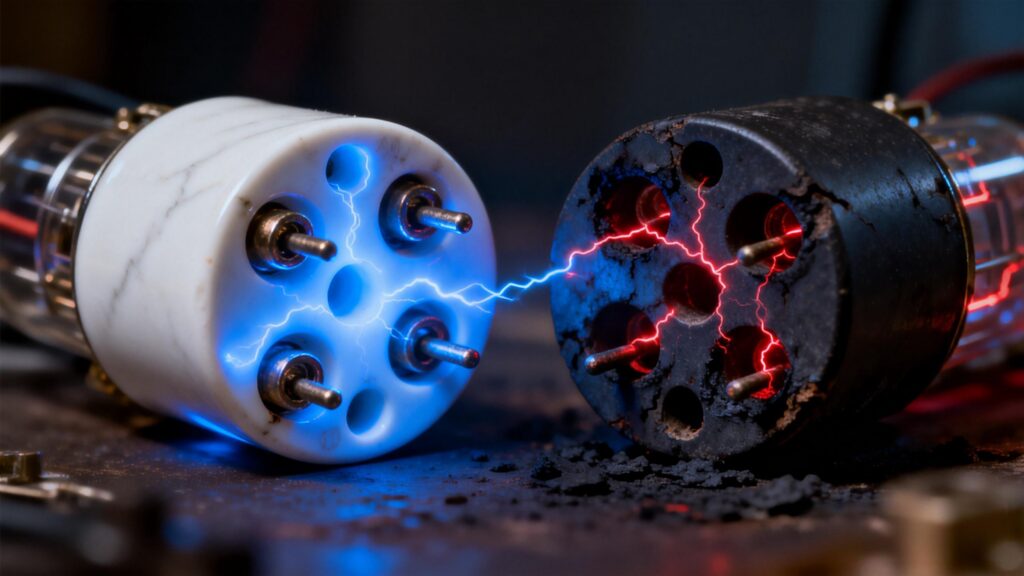
In the pursuit of sonic perfection, the choice of tube socket is never trivial—it’s a critical decision impacting everything from microphony to overall noise floor. You are investigating the core conflict: the ultra-low dielectric properties of Teflon (PTFE) versus the mechanical ruggedness and thermal resilience of the industry-standard Ceramic socket. This commercial investigation demands more than marketing hype. We move past anecdotal comparisons to analyze the physics, detailing why elite amplifier builders strategically employ Teflon for sensitive signal paths while relying on ceramic for high-power applications. This article breaks down dielectric constants, thermal stability, and, critically, reveals why the quality of the metallic contact often outweighs the insulator material itself. By the end, you will know exactly which material choice will truly Silence the Noise Floor in your next high-fidelity design, and whether the Teflon premium is justified for your needs.
Why the Tube Socket Material Matters: Dielectric Properties and the Noise Floor
A tube socket is more than a mechanical holder; its insulating body functions as a dielectric, separating critical high-potential and signal paths. The socket material’s Dielectric Constant (K) and Dissipation Factor (DF, or loss tangent) directly determine parasitic capacitance and energy storage—primary culprits in increasing the audible noise floor and signal degradation.
Polytetrafluoroethylene (PTFE, or Teflon) is the superior material from a pure electrical perspective. Teflon boasts an ultra-low Dielectric Constant (K ≈ 2.1) and a near-zero Dissipation Factor across the usable audio spectrum. This combination signifies that Teflon stores and dissipates minimal electrical energy. The practical result, especially in sensitive input stages, is minimized inter-pin capacitive coupling and negligible phase shift, leading to superior transient response and a demonstrably lower noise floor due to reduced stray capacitance loading.
Conversely, traditional ceramic sockets (steatite or alumina) have significantly higher K values (often 5.5 to 7.0). While ceramic offers exceptional heat resistance and mechanical stability, its greater dielectric value means increased parasitic capacitance, potentially leading to fractional high-frequency signal rolloff or “smearing” in ultra-critical applications.
However, the material science caveat is essential for commercial builders: while Teflon wins on dielectric parameters, the system noise floor is often governed by the quality of the metallic contacts. A socket with poor spring tension or oxidized conductors will introduce vastly more resistive noise, intermittent contact, and microphony than the dielectric losses inherent in a high-quality ceramic unit.
For designers, this dictates application: Teflon is the performance choice for critical, low-signal input tubes (e.g., 12AX7, 6SN7) where maximum fidelity and minimal capacitive loading are paramount. Ceramic, valued for its superior temperature tolerance and rigidity, remains the industry standard for high-current, high-heat output tubes (e.g., KT88, EL34), where mechanical longevity and thermal stability outweigh the fractional dielectric advantage of PTFE.
Teflon (PTFE) vs. Ceramic: A Head-to-Head Engineering Comparison
The primary technical disparity between these two materials lies in their electrical properties under load. Polytetrafluoroethylene (PTFE) boasts an extremely low dielectric constant (K ≈ 2.1) and a near-zero dissipation factor, making it the theoretical ideal insulator. This unparalleled low loss minimizes capacitive loading and energy storage within the socket, which directly correlates to maintaining signal purity and reducing the noise floor—a critical requirement for sensitive, low-level signal tubes. Conversely, high-grade Steatite or Alumina ceramic exhibits a dielectric constant ranging from 5.5 to 8.5. While ceramic’s thermal stability ensures its dielectric properties remain consistent even under extreme heat, its higher K value means slightly more energy is absorbed and released, potentially impacting the most subtle high-frequency transients.
In thermal and mechanical terms, ceramic sockets are the undisputed champion of brute strength and heat resistance. They routinely withstand localized temperatures exceeding 300°C without deformation or melting, making them the mandated choice for high-current power tubes (e.g., KT88s or large triodes) where heat dissipation is immense. However, ceramic’s inherent rigidity means it is brittle and provides minimal structural damping, potentially transmitting external vibrations that manifest as microphonic noise.
PTFE, while thermally excellent, cannot match ceramic’s upper temperature limits but offers a distinct mechanical advantage: superior vibration dampening. PTFE’s molecular elasticity absorbs mechanical energy, effectively dampening element-to-element microphony in sensitive preamp stages. Therefore, while ceramic excels under thermal stress, Teflon excels at reducing acoustic and vibrational noise transmission.
Crucially, commercial investigators must recognize that the insulator is only half the equation. The quality of the metallic contacts (pin retention, plating, spring tension) often dictates long-term performance and noise more than the insulator material itself. Application Verdict: Designers typically reserve Teflon for signal tubes (low-current, noise-sensitive) where dielectric purity and vibration control are paramount, deploying robust ceramic sockets solely for power tubes where thermal endurance is non-negotiable.
Critical Electrical Performance: Dielectric Constant and Low-Loss Characteristics
The core performance differential between PTFE and ceramic sockets resides in their fundamental dielectric characteristics. The Dielectric Constant (Dk)—the material’s ability to store energy when exposed to an electric field—is the key factor dictating the intrinsic parasitic capacitance of the socket. Teflon (PTFE) boasts an industry-leading Dk of approximately 2.1, making it one of the best solid insulators available for minimizing stray capacitance between adjacent pins. Lower Dk translates directly into less energy storage and reduced signal contamination, preserving the transient response of the tube stage.
This advantage is significantly compounded by the Dissipation Factor (Df), also known as the Loss Tangent (tan δ). The Df measures how efficiently the insulating material converts electrical energy into unusable heat or noise. PTFE exhibits an almost immeasurably low Df, often cited around 0.0002. This characteristic is paramount in sensitive pre-amp and driver sockets where micro-volt level signals must remain pristine, ensuring minimal signal attenuation and zero measurable phase shifts across the audio spectrum.
In sharp contrast, standard Steatite ceramic sockets typically possess a Dk ranging from 5.5 to 7.0 and a Df often exceeding 0.005. While ceramic’s higher temperature tolerance makes it superb for power tubes, its higher Dk introduces measurably greater parasitic capacitance, which can slightly roll off bandwidth in ultra-high fidelity, high-impedance applications. For elite builders optimizing the noise floor and demanding absolute signal transparency (e.g., input tube sockets), Teflon’s demonstrably superior Dk and Df firmly establish it as the acoustically quieter choice.
Mechanical Superiority: Analyzing Vibration Damping and Microphony Reduction
Mechanical performance is foundational for reducing microphony—the conversion of mechanical vibration into undesirable electrical noise—a critical concern in high-gain amplification stages. Teflon (PTFE) and high-density ceramics behave antithetically when analyzed for vibrational damping capabilities.
PTFE, characterized by its intrinsic viscoelastic properties and relatively low Shore hardness, functions as an effective acoustic absorber. This pliability allows the material to absorb and dissipate high-frequency mechanical energy originating from transformer hum, chassis resonance, or ambient acoustic feedback. By converting kinetic energy into negligible heat, Teflon sockets act as a superior mechanical buffer, making them the default choice for extremely sensitive input and small-signal tubes (e.g., 12AX7, 6922) where microphony is most acute.
Conversely, steatite and alumina ceramics offer exceptional structural rigidity and mechanical strength but are inherently poor vibration dampers. Their hardness means they effectively transmit mechanical energy rather than dissipating it. While this extreme rigidity is advantageous for maintaining precise pin alignment and structural integrity under the high thermal load of power tubes, it dictates that any microphonic noise reduction must be handled externally, often via high-mass chassis design or specialized tube damping rings.
Crucially, expert builders recognize that regardless of the insulator material’s mechanical damping capacity, the ultimate determinant of noise floor contribution is the quality and retention force of the conductive metallic contact (typically beryllium copper or phosphor bronze). A low-quality contact allows minute relative movement between the tube pin and socket wall, generating intermittent electrical noise far exceeding any noise related to the insulator’s damping deficiencies. Therefore, socket choice involves balancing Teflon’s superior damping for signal purity against ceramic’s superior thermal handling and rigidity for high-power applications.
Thermal Resilience: Comparing Heat Tolerance and Lifespan Suitability
Thermal Resilience: Comparing Heat Tolerance and Lifespan Suitability
When evaluating thermal performance, the ceramic socket (typically Steatite or Alumina) remains the standard bearer for raw, sustained heat tolerance. These materials are inorganic, non-flammable, and possess softening points exceeding 1000°C. This makes ceramic the required choice for high-dissipation applications, such as power tube sections utilizing KT88, KT150, or high-voltage rectifier tubes, where intense radiative heat and potential thermal runaway must be managed structurally. Ceramic withstands aggressive thermal cycling without material fatigue, cracking, or dimensional change, ensuring long-term pin alignment.
Teflon’s (PTFE) thermal profile, while excellent among polymers, sets a continuous operating limit around 260°C. Critically, this temperature is significantly higher than the typical operating temperatures found at the pin base of small-signal and driver tubes (e.g., 12AX7, 6SN7). Therefore, for low-power applications, PTFE’s thermal limit is entirely sufficient.
However, the lifespan argument shifts in favor of Teflon due to its chemical inertness. Unlike the micro-porous surface of ceramic, Teflon is non-porous and non-wetting. Over decades of service, ceramic surfaces can accumulate dust, oil vapor, and contaminants that bake onto the surface, leading to “carbon tracking”—the slow formation of conductive paths across the insulator surface under high voltage. This compromises dielectric integrity. PTFE’s superior resistance to surface degradation and its inherently low-friction, non-stick properties prevent this chemical breakdown and tracking, maintaining optimal low-loss characteristics throughout the component’s lifecycle.
The key engineering consideration ultimately rests on application: ceramic offers brute force heat resistance where wattage is high, while Teflon offers superior chemical stability and surface integrity longevity for sensitive, low-current signal paths. Elite builders often mix and match materials based on these specific thermal and electrical requirements.
The True Performance Bottleneck: Why Contact Quality Trumps Insulator Material
While previous discussions rightly highlight the electrical advantages of Teflon’s low dielectric constant, the professional consensus acknowledges that the single greatest contributor to noise, reliability, and signal loss in any tube circuit is the mechanical and metallurgical quality of the pin-to-socket interface. This contact region is the true performance bottleneck, dominating the signal chain impedance far more than the insulator material itself.
Superior sockets—regardless of whether they employ a PTFE or ceramic body—feature precision-machined, gold-plated, bifurcated contacts. This geometry provides multiple, high-pressure wipe points, ensuring a stable, gas-tight seal against the tube pin. This mechanical redundancy drastically minimizes contact resistance, the primary source of sporadic noise and intermodulation distortion. Conversely, sockets utilizing cheaper, stamped internal contacts rely on minimal surface friction, leading to mechanical fatigue, oxidation, and rapidly rising resistance after minimal insertion cycles.
The purity and choice of plating are paramount. Gold plating ensures long-term conductivity and resilience against corrosion, which is non-negotiable in high-end equipment designed for a lifespan exceeding decades. A premium ceramic socket utilizing these machined, low-resistance contacts will invariably outperform a low-cost Teflon socket relying on stamped, potentially nickel-plated (ferromagnetic) contacts, regardless of the latter’s theoretical dielectric superiority. When making a final purchasing or design decision, prioritize the integrity of the conductive metal contact mechanism—its tension, geometry, and plating—as this foundation dictates the true fidelity and reliability of the amplifier’s noise floor.
Evaluating Premium Contacts: Gold Plating, Pin Tension, and the Tube Grip Design
While the dielectric properties of Teflon or ceramic set the stage, the true gateway to signal integrity lies within the metallic contact system. For elite builders, the contacts must adhere to a strict set of metallurgical and mechanical criteria.
Premium contacts begin with the base metal, typically high-retention alloys such as Beryllium Copper (BeCu) or hardened Phosphor Bronze. BeCu is often preferred in critical signal path applications (where Teflon sockets typically reside) due to its superior tensile strength and fatigue resistance, ensuring consistent pin tension across thousands of insertion cycles.
This mechanical stability is paired with protective plating. In high-end audio, Gold plating is virtually mandatory. A deposit depth of at least three microns of hard gold over a nickel underlay prevents the formation of oxides and sulfides, which are primary sources of intermittent connectivity and increased noise floor resistance. Inferior sockets often use simple tin or nickel plating, which rapidly oxidizes, undermining the socket’s intended electrical performance within months.
Crucially, the Tube Grip Design dictates mechanical reliability. High-quality contacts are engineered with a ‘wiping’ action, ensuring the contact cleans the tube pin upon insertion, and often employ a split or multi-point design. This geometry maintains high, localized pressure—optimal pin tension—to minimize mechanical vibrations (reducing microphony) and maximize current distribution, keeping contact resistance extremely low. Thus, regardless of whether the housing is high-grade Teflon or low-loss steatite ceramic, the consistent performance of the amplifier ultimately hinges on the quality of this metallic triumvirate.
Architectural Decisions: Specifying Teflon for Low-Level Signal and Driver Tubes
For the discerning architect of high-fidelity tube gear, the specification of Teflon (PTFE) sockets is an architectural decision reserved for stages where signal purity is paramount: the input (V1) and driver tube positions. These stages handle the lowest signal voltages, making them exceptionally susceptible to noise introduction and parasitic capacitance loading—factors that directly determine the amplifier’s ultimate noise floor.
Teflon’s ultra-low dielectric constant (K ≈ 2.1) significantly reduces energy storage and reactive loading compared to traditional ceramic alternatives. This performance characteristic is essential for preserving the transient response and minimizing phase errors in low-level, high-impedance circuitry, effectively ensuring the fragile audio signal is transmitted to the next stage with maximal fidelity.
Furthermore, while ceramic is inherently rigid, its density allows it to transmit vibration efficiently. Teflon, due to its slight compliance, acts as a subtle damping layer, offering superior isolation against minute chassis and transformer vibrations that plague sensitive input tubes (the primary cause of microphony). This strategic placement isolates the most sensitive valves from mechanical artifacts, contributing to the “blacker” background noise floor desired by elite builders.
Architecturally, the specification rule is often strict: utilize Teflon for signal tubes (e.g., 12AX7, 6SN7) where electrical losses and vibrational integrity are the limiting factors, and reserve ceramic or other high-thermal composites for the output stages (e.g., KT88, 300B) where high plate dissipation and robust structural support are the overriding engineering concerns. However, the system’s success hinges entirely on the quality of the metallic contacts within the Teflon shell; a poorly tensioned, nickel-plated contact will negate all dielectric advantages. Premium Teflon sockets must therefore always incorporate gold-plated, beryllium copper contacts to realize the full performance potential of the material specification.
Architectural Decisions: Specifying Ceramic for High-Heat Power Tubes and Robustness
The decision to specify ceramic sockets is an architectural acknowledgment of sheer thermal load and mechanical necessity. In high-power amplification stages—where tubes like the KT88, 300B, or 6550 operate—localized temperatures can easily exceed the practical limits of PTFE. While Teflon offers superb dielectric characteristics, its structural integrity begins to degrade around 250°C, leading to softening, potential deformation, and poor pin retention over time.
Ceramic sockets, typically manufactured from Steatite or high-grade Alumina, possess exceptional thermal resilience, maintaining dimensional stability far beyond 500°C. This robustness is critical for longevity in a power tube socket, which is constantly subjected to massive thermal cycling. Furthermore, ceramic provides superior mechanical rigidity and resistance to insertion fatigue, ensuring that the critical pin tension necessary for low impedance contact is maintained for decades.
While ceramic’s dielectric constant is measurably higher than PTFE, making it slightly lossier, this trade-off is negligible in the high-current, high-voltage environment of the output stage. Here, signal fidelity is less dependent on ultra-low dielectric loss than in the micro-voltage input stage. The primary engineering goal shifts from absolute signal purity to reliable power delivery, heat mitigation, and unwavering mechanical integrity—attributes where ceramic remains the industry benchmark. Choosing ceramic for these high-dissipation applications is a practical choice for maximized reliability and safety.
Beyond the High-End: Recognizing and Avoiding Inferior Socket Materials (Bakelite vs. Phenolic)
While the focus remains on optimizing performance between Teflon (PTFE) and Ceramic, the elite builder must recognize and immediately dismiss the budget-grade options still prevalent in lower-end vintage restorations or poorly specified contemporary kits. The primary offenders are Bakelite and Phenolic compounds.
Bakelite, historically revolutionary, is fundamentally a poor choice for modern high-fidelity tube sockets due to its significant electrical shortcomings. Its primary failure point is a high dielectric loss factor and a susceptibility to moisture absorption—it is inherently hygroscopic. This absorption substantially degrades the insulation resistance over time, creating unwanted resistive leakage paths, increased crosstalk, and signal bleed between adjacent pins, directly compromising the noise floor that Teflon and Ceramic are designed to suppress.
Similarly, Phenolic resins, often confused with Bakelite, offer poor thermal resilience. Both materials possess a glass transition temperature (Tg) dramatically lower than that of Ceramic or Teflon. When subjected to the sustained heat of a typical power amplifier chassis, these materials soften, leading to socket deformation, inevitable loss of critical pin tension (reducing the efficacy of even premium contacts), and increased susceptibility to vibration and microphony.
In Commercial Investigation terms, specifying Bakelite or Phenolic is akin to deliberately introducing impedance instability and uncontrolled signal loss. For critical signal paths (preamp, driver stages) or high-heat environments (power tubes), these materials compromise the design integrity immediately. They represent a compromise on cost that directly sacrifices electrical performance and long-term mechanical reliability, serving only as a benchmark for what modern builders must actively avoid.
Have questions or your own tips to share? Drop a comment below!