
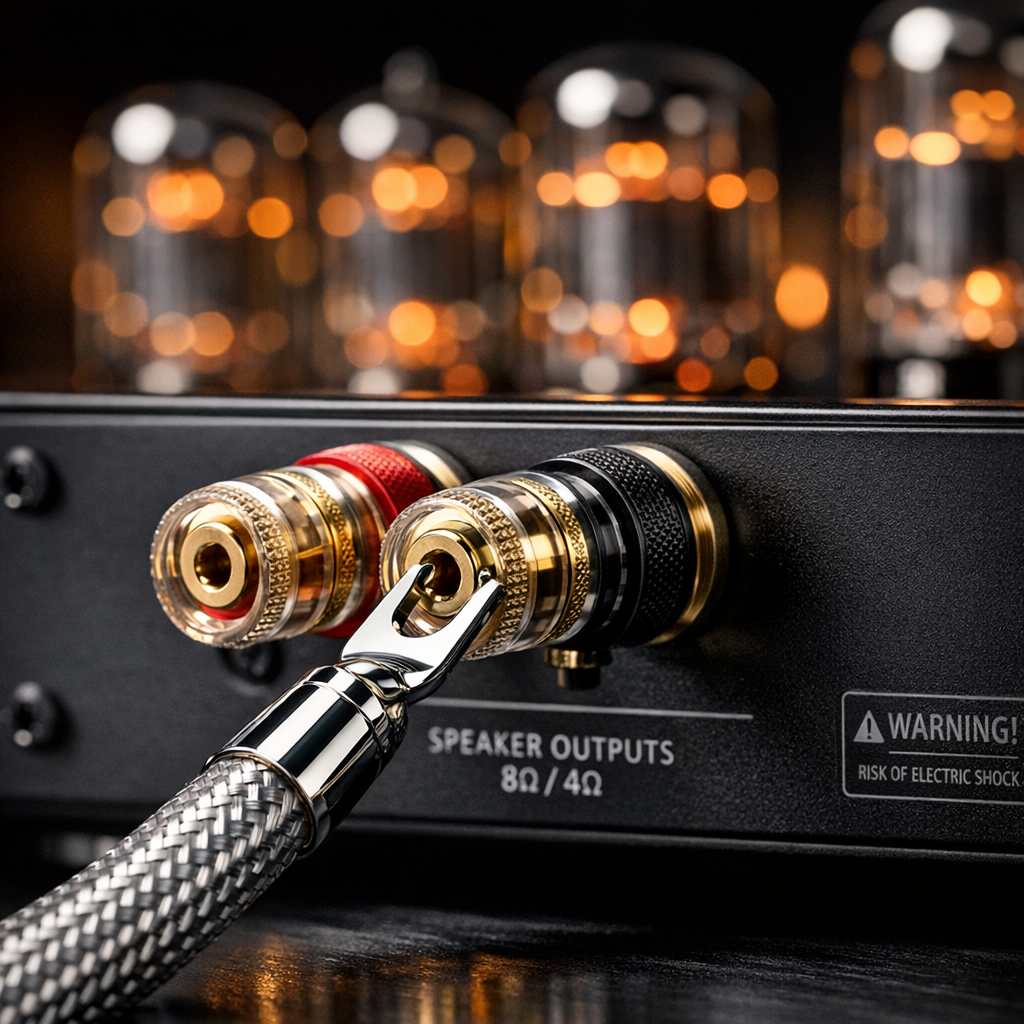
You’ve spent thousands of dollars perfecting your signal chain, but could the final inch of your signal path be sabotaging your sound? For many audiophiles, amplifier binding posts are an afterthought—a mere industrial utility. However, the metallurgical reality is that not all connections are created equal. If your setup relies on standard gold-plated brass posts, you may be unknowingly sacrificing the resolution, micro-dynamics, and tonal weight your system is truly capable of delivering.
In this deep dive, we strip away the marketing jargon to uncover the truth behind high-fidelity connectors. We will explore the critical science of metallurgy, explaining why high-purity copper outclasses common zinc alloys, and evaluate whether premium designs like the WBT Nextgen series are a legitimate sonic upgrade or mere audio alchemy. Is it time to stop treating your terminals like hardware and start treating them like high-end components? Let’s find out if your binding posts are the bottleneck killing your tone.
The “Last Inch” Bottleneck: Why Your Binding Posts Matter More Than You Think
In the signal path of a high-end audio system, enthusiasts often obsess over multi-thousand-dollar interconnects and speaker cables, only to overlook the final physical barrier: the binding post. This “last inch” represents a critical bottleneck. While your cable may boast 99.99% oxygen-free copper (OFC) purity, the standard industrial binding post it plugs into is frequently a compromise of structural convenience over sonic fidelity.
The primary culprit is metallurgy. Most stock binding posts are machined from brass—an alloy of copper and zinc. While durable and easy to plate, brass possesses only about 25–30% of the conductivity of pure copper (IACS). This drastic drop in conductivity at the exit point of the amplifier creates a localized impedance jump. High-fidelity posts, by contrast, utilize tellurium copper or high-purity silver, pushing conductivity back toward 90% or higher.
This disparity directly impacts “tonal weight” and micro-dynamics. When the signal hits a high-resistance junction, low-level resolution is the first casualty. Furthermore, traditional high-mass brass posts are prone to eddy current distortion—parasitic energy storage within the metal that introduces phase smearing. This is why premium “Nextgen” style designs prioritize low-mass, high-conductivity materials. By stripping away excess metal and focusing on metallurgical purity, these posts ensure that the amplifier’s damping factor remains high and the signal remains linear. If your connection is choked by industrial-grade brass, you aren’t hearing the true capability of your amplifier; you’re hearing the limitations of the bottleneck.
The Metallurgy of Tone: Why High-Purity Copper Destroys Standard Brass
To understand why premium binding posts are transformative, one must look past the shiny gold plating to the base metal underneath. Most standard industrial-grade binding posts are machined from brass—an alloy of copper and zinc. While brass is durable and inexpensive, its electrical conductivity is abysmal, typically hovering around 25% to 28% IACS (International Annealed Copper Standard). In the high-stakes environment of signal transfer, this creates a significant resistive bottleneck.
In contrast, high-fidelity posts utilize high-purity Oxygen-Free Copper (OFC) or Tellurium Copper, boasting conductivity ratings of 90% to 100% IACS. When your audio signal hits a high-impedance brass connector, the result is a measurable loss in “tonal weight” and a smearing of high-frequency transients. Because copper provides a nearly frictionless path for electrons, it preserves the micro-dynamics and harmonic textures that give music its “live” feel.
Furthermore, the metallurgy dictates the noise floor. Massive brass posts are susceptible to eddy currents—circulating loops of electrical current that create their own magnetic fields, interfering with the primary signal. This is why elite manufacturers, such as WBT with their Nextgen series, have moved toward low-mass, high-purity copper designs. By reducing the metal’s mass and increasing its purity, these connectors eliminate the capacitive and inductive storage effects that plague standard hardware. The result is a dramatic increase in resolution and a “blacker” background, allowing the subtle decays of a recording to emerge without the metallic glare often associated with inferior brass connections. If you want to hear the true capability of your amplifier, high-purity copper isn’t a luxury; it is the fundamental requirement for signal integrity.
Decoding Signal Integrity: How Connector Material Impacts Resolution and Dynamics
In the world of high-fidelity audio, signal integrity is defined by the preservation of delicate micro-harmonics that give a recording its sense of realism. When we transition from standard brass to high-purity oxygen-free copper (OFC) or silver, the impact on resolution is immediate. Brass, an alloy typically containing zinc and lead, exhibits significantly higher resistance and skin-effect distortions. This manifests as a “veiling” of the soundstage—where subtle spatial cues and the “air” around instruments are lost to a raised noise floor.
Dynamics and “tonal weight” are equally dependent on the connector’s mass and purity. Large, high-mass industrial posts act as reservoirs for eddy currents—parasitic magnetic fields that induce signal-blurring back-EMF. This is the engineering logic behind the “low-mass” revolution spearheaded by brands like WBT with their Nextgen series. By minimizing the conductive mass and utilizing high-purity materials, these connectors ensure that the “leading edge” of a transient—the sharp snap of a snare or the percussive attack of a piano—remains lightning-fast and undistorted.
Ultimately, high-fidelity binding posts act as the final gatekeeper of current delivery. When a connector allows the signal to pass unimpeded by metallic impurities or capacitive reactance, the result is a “blacker” background and improved “slam.” You aren’t just hearing more of the music; you are hearing the silence between the notes. For the serious listener, moving to low-mass copper connectors isn’t just an upgrade—it’s the removal of a systemic bottleneck that allows your amplifier’s true resolution to finally reach your speakers.
Beyond Technical Specs: Achieving “Wetness” and Realistic Tonal Weight
While technical metrics like low resistance and high conductivity are the baseline for any quality component, the true hallmark of a high-end amplifier binding post lies in its ability to preserve “wetness” and “tonal weight”—qualities that are often lost in the transition from the internal circuitry to the speaker cable. In audiophile terms, “wetness” refers to a liquid, grain-free presentation where notes flow naturally into one another, characterized by a sense of ease and organic decay. Conversely, standard industrial brass posts often introduce a “dryness” or “bleaching” of the sound, a result of skin effect distortions and eddy currents generated within high-mass metal structures.
Achieving realistic tonal weight—the physical “body” and authority of an instrument—requires more than just a thick piece of metal. It requires the preservation of the delicate harmonic envelope. High-mass, high-zinc brass connectors tend to truncate these harmonics, leading to a sound that feels thin or “reedy” despite having plenty of volume. By utilizing low-mass, high-purity copper designs—pioneered by brands like WBT with their Nextgen series—you minimize the energy storage effects that smear time-domain accuracy.
When you eliminate the “choke point” of a standard binding post, the mid-range gains a three-dimensional palpability. A cello retains its woody resonance; a vocal performance regains its breathy, human texture. For the serious listener, the upgrade to premium amplifier binding posts is not about changing the frequency response—it is about restoring the saturated, lifelike density that high-fidelity audio is supposed to deliver. This is where the “truth” of your connection becomes audible: in the difference between a clinical reproduction and a visceral musical experience.
High-Mass vs. Low-Mass Design: Lessons from WBT Nextgen Engineering
In the high-end audio world, a heavy, gold-plated chunk of brass has long been the visual shorthand for “quality.” However, modern engineering—pioneered most notably by WBT’s Nextgen series—has proven that this high-mass approach is often a detriment to pure signal transmission. To understand why, we must look at the physics of eddy currents and signal storage.
Traditional high-mass binding posts act as massive heat sinks for your signal. When an alternating current (your music) passes through a large conductor, it induces eddy currents. These internal circular flows create their own magnetic fields that oppose the primary signal, leading to measurable phase shifts and non-linear distortion. Furthermore, large metal masses exhibit a “memory effect,” storing energy and releasing it slightly out of time with the original pulse, which results in “smeared” transients and a loss of micro-detail.
WBT’s Nextgen engineering revolutionized this by utilizing a low-mass philosophy. By stripping away unnecessary metal and using a minimal amount of high-purity copper (or fine silver) supported by high-tech, resonance-damping polymers, Nextgen connectors eliminate the reservoir for eddy currents.
The result is a transformative leap in transparency. While high-mass brass posts might offer a perceived “warmth” (which is actually harmonic thickening caused by distortion), a low-mass high-purity connection offers superior speed and timing. You hear a “blacker” background, sharper leading edges on percussion, and a more three-dimensional soundstage. For the audiophile investigating whether an upgrade is worth the investment, the shift from industrial-grade mass to precision-engineered low-mass conductors is often the moment the “veil” is finally lifted from the system.
The Plating Controversy: Choosing Between Gold, Silver, and Rhodium Finishes
While the base metal dictates bulk conductivity, the plating is the actual interface where electron transfer occurs. This microscopic “skin” defines the contact resistance and, crucially, the final “flavor” of your sonic presentation. In high-end audio, the choice between gold, silver, and rhodium is rarely about cost; it is about achieving system synergy.
Silver is the undisputed heavyweight of conductivity. Audiophiles prize silver-plated binding posts for their unmatched transparency and “speed.” Because silver has the lowest electrical resistance of any metal, it excels at resolving micro-dynamics and high-frequency textures. While critics often label silver as “bright,” this is typically a misunderstanding of its transparency; it simply refuses to mask upstream flaws. Furthermore, unlike copper, silver oxide remains highly conductive, ensuring long-term signal integrity even as it develops a patina.
Gold remains the industry standard due to its total immunity to oxidation. Sonically, gold is often described as having a “warm” or “musical” character. This isn’t because gold adds harmonic distortion, but rather because its slightly higher resistance compared to silver can subtly round off the “etch” of harsh transients. If your system leans toward the analytical, gold-plated high-purity copper posts provide a lush, sophisticated top-end that many find more natural for long-term listening.
Rhodium, a member of the platinum group, is the choice for durability. It is incredibly hard and resistant to the mechanical wear of frequent cable swaps. Sonically, rhodium is the most “clinical” of the three—offering a tight, controlled bottom end and a highly focused soundstage. However, because rhodium is less conductive than silver or gold, it demands a world-class low-mass copper base to avoid sounding “lean.” Choosing between these finishes is the final step in “voicing” your amplifier to match your speakers’ unique impedance and tonal profile.
Industrial vs. Audiophile Grade: How to Identify Superior Machined Construction
To the untrained eye, a binding post is simply a mechanical terminal to secure a wire. However, the chasm between industrial-grade hardware and true audiophile-grade connectors lies in the precision of machined construction and the rejection of compromise. Standard industrial posts are typically mass-produced through casting or stamping processes using generic brass—an alloy often containing up to 40% zinc and lead. These casting methods result in microscopic voids and inconsistent grain structures that impede electron flow and degrade signal purity before it even leaves the chassis.
In contrast, superior audiophile-grade posts are CNC-machined from solid billets of high-purity oxygen-free copper or tellurium copper. This precision machining ensures a uniform grain structure and allows for tighter mechanical tolerances, which are critical for achieving a “gas-tight” connection. When you tighten a precision-machined post, the surface-to-surface contact is maximized at a molecular level, reducing contact resistance to near-zero and preventing the oxidation that plagues cast components.
Furthermore, industrial-grade posts frequently rely on ferrous under-platings, such as nickel, to provide structural rigidity and a base for gold flashing. These magnetic materials introduce hysteresis and smear low-level detail. A world-class machined post, such as those following the WBT or Furutech philosophy, will be entirely non-magnetic. To identify superior construction, look for the absence of casting seams, the presence of smooth, burr-free threading, and a low-mass architecture that prioritizes signal speed over decorative bulk. While industrial posts are designed for “adequate” electrical continuity, machined audiophile posts are engineered for transparency, ensuring the mechanical interface doesn’t become a bottleneck for your system’s dynamic range.
Optimizing the Interface: Maximizing Contact Pressure with Spades, Bananas, and Bare Wire
Even the most expensive high-purity copper binding post is only as effective as its physical interface. In high-fidelity audio, the objective is to minimize contact resistance, which is a direct function of surface area and contact pressure. When these two variables are optimized, you ensure a transparent path for the signal’s macro-dynamics and micro-detail, preventing the “bottleneck” effect that plagues standard connections.
For the serious listener, the spade lug is often considered the gold standard. A high-quality, cold-welded spade allows for massive clamping force via the binding post’s nut. This pressure physically deforms the metal at a microscopic level, excluding oxygen and creating a gas-tight, quasi-molecular bond. This maximizes the transfer of low-frequency authority and tonal weight, ensuring that the metallurgy of your posts and cables actually reaches the amplifier’s internal circuitry without loss.
Conversely, while banana plugs offer unparalleled convenience, standard “spring-leaf” designs often sacrifice contact pressure. To mitigate this, audiophiles should look toward BFA (British Federation of Audio) or locking banana styles. A locking banana expands within the cylinder of the post to create high radial pressure, mimicking the stability of a spade while maintaining a plug-and-play setup.
While bare wire is often touted for its “purity”—avoiding secondary connectors and solder—it is the most vulnerable to atmospheric oxidation and mechanical instability. Over time, frayed strands and surface tarnish increase resistance and “blur” the soundstage. To truly optimize the interface, a high-mass machined spade or a locking low-mass banana is essential to maintaining signal integrity through the final transition point of your system.
The Purist’s Philosophy: When to Consider Eliminating Binding Posts Entirely
To the ultra-high-end purist, every mechanical interface represents a potential compromise in signal purity. This philosophy argues that the “best” binding post is, in fact, no binding post at all. Even when utilizing world-class, high-purity OCC copper or silver-plated connectors, you are inherently introducing two additional transition points: the internal wire-to-post junction and the external cable-to-post interface. Each of these junctions involves dissimilar metals, solder alloys, or mechanical pressure points that can introduce microscopic levels of non-linear distortion, contact resistance, and signal reflection.
Eliminating binding posts entirely—often referred to as “hard-wiring”—involves running the speaker cable directly through the chassis and soldering it directly to the amplifier’s output stage or the speaker’s internal crossover. By bypassing the physical mass of a traditional binding post, you effectively eliminate the storage of eddy currents and the potential for mechanical resonances that can smear micro-detail and soften transient attacks. This “direct-path” approach is the ultimate realization of the low-mass engineering principles championed by industry leaders like WBT, reducing the signal path to its most elemental, transparent state.
However, this level of extremism is not for the faint of heart. It requires a permanent commitment to a specific cable and renders the system significantly less modular. You lose the ability to A/B test different geometries or conductor types. For the listener who has reached their “endgame” components and seeks to shave away the final layer of electronic haze, eliminating the binding post represents the final frontier of signal integrity. It ensures that the “wetness,” air, and holographic imaging you have meticulously cultivated are not subtly eroded by the very hardware meant to facilitate them. When transparency is the only metric that matters, the removal of the connector is the ultimate upgrade.
Selecting the Right Upgrade: A Comparative Guide to Premium Amplifier Connectors
Navigating the landscape of premium binding posts requires moving beyond aesthetic appeal to analyze the intersection of metallurgy and mechanical engineering. When selecting your upgrade, the primary fork in the road is the choice between high-mass solid copper and low-mass minimalist designs.
At the pinnacle of performance, brands like WBT with their Nextgen series have revolutionized the industry by championing low-mass architecture. By using the minimum amount of high-purity copper necessary to maintain signal integrity, these connectors virtually eliminate eddy currents and signal storage effects. The result is a noticeable increase in transient speed and a lower noise floor. If your goal is ultimate transparency and “air” around instruments, a low-mass, high-purity copper or silver post is the definitive choice.
Conversely, for those seeking “tonal weight” and a sense of structural permanence, high-mass connectors from manufacturers like Cardas or Furutech remain highly regarded. These solid-billet designs—often machined from oxygen-free copper rather than cast—offer immense contact pressure, which is vital for long-term gas-tight seals when using heavy spade terminals.
From a metallurgical standpoint, avoid any connector where the base metal is brass (a copper-zinc alloy), as its conductivity is roughly 28% that of pure copper. Instead, insist on tellurium copper or pure red copper. For the final finish, choose Rhodium if you desire a highly resolved, “fast” presentation with maximum durability, or Gold if you prefer a slightly warmer, more organic “wetness” to your mid-range. Selecting the right post is not just about the connection; it is about choosing the final filter through which your entire musical signal must pass.
Installation Essentials: Ensuring a Secure and Electrically Sound Connection
Even the most sophisticated high-purity copper binding post is rendered ineffective if the installation introduces mechanical instability or electrical resistance. Achieving a “sound” connection begins where the post meets the amplifier chassis. To maintain the signal integrity discussed in previous chapters, you must ensure total galvanic isolation from the chassis—unless the design specifically dictates otherwise—using high-quality non-conductive washers. This prevents parasitic capacitance and stray currents from polluting the noise floor.
On the internal side of the post, the method of termination is critical. While many DIYers opt for silver-bearing solder, expert-level installations often favor “cold-welding” or high-pressure crimping. Soldering adds a layer of dissimilar metal (the solder alloy) between the internal wiring and the post, potentially bottlenecking the low-resistance path you’ve invested in. If you must solder, use a high-wattage iron to complete the joint quickly; lingering heat can migrate through the high-conductivity copper, damaging the delicate dielectric housing or annealing the metal, which softens the threads and reduces long-term contact pressure.
Finally, consider the “torque factor.” Maximum signal transfer occurs when the contact pressure is high enough to deform the microscopic irregularities of the metal surfaces, creating a molecular bond. However, over-tightening can strip precision-machined threads, especially on low-mass designs like the WBT Nextgen series. Use specialized torque tools if available, or tighten until the lock-washer is fully compressed and the post is immobile. Periodically treating the interfaces with a high-end contact enhancer like DeoxIT Gold will prevent the microscopic oxidation that eventually dulls transients and robs your system of its hard-won “wetness” and air. Your goal is a permanent, gas-tight seal that treats the amplifier and cable as a single, uninterrupted conductor.
Have questions or your own tips to share? Drop a comment below!