
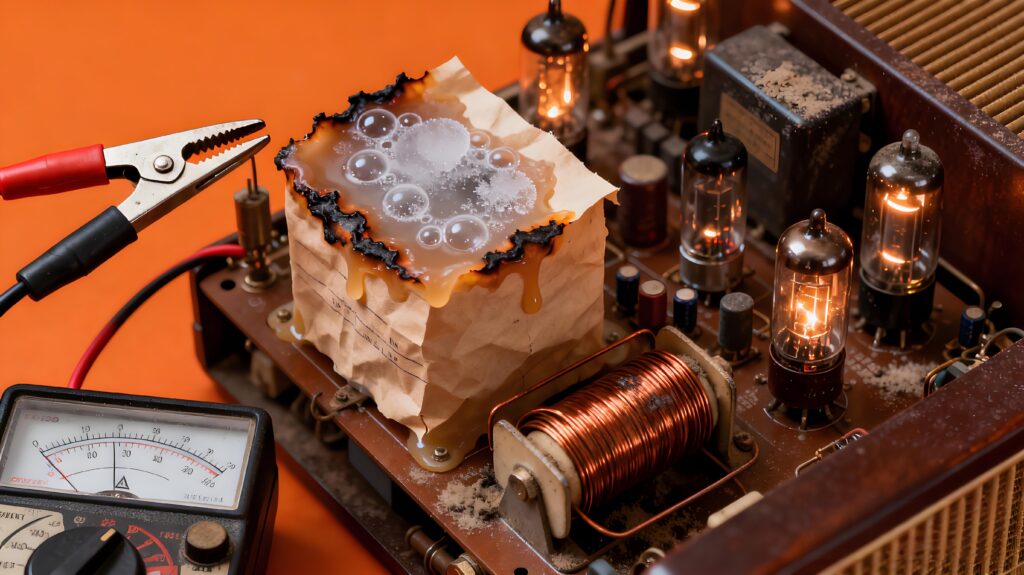
Restoring a classic tube set is a labor of love, but hunting for vintage radio capacitors for sale can be a minefield for the unwary. While the allure of New Old Stock (NOS) components is strong for purists, these aging parts are often ticking time bombs. One wrong choice doesn’t just result in poor audio—it can lead to a catastrophic failure that destroys your irreplaceable power transformer.
Before you click “buy,” you must transition from a collector to a savvy investigator. This guide breaks down the critical red flags every restorer needs to know, from physical signs of leaking electrolyte to the hidden dangers of high Equivalent Series Resistance (ESR). We’ll help you navigate the nuances of seller claims and technical specs, ensuring your “original” components don’t result in a puff of smoke. Protect your investment and your safety by learning how to vet vintage parts before they ever enter your chassis.
The Myth of “New Old Stock”: Why Age is Often the Enemy of Vintage Electronics
In the world of vintage restoration, “New Old Stock” (NOS) often carries a premium price tag, implying that because a component was never soldered into a circuit, it remains in mint condition. When hunting for vintage radio capacitors for sale, this is a dangerous fallacy. Capacitors are chemical devices, not just mechanical ones, and time is their primary antagonist regardless of usage.
For electrolytic capacitors, the internal electrolyte is a moist paste that inevitably dries out or chemically separates over decades. Even if the seal remains seemingly intact, the aluminum oxide layer—the dielectric that allows the capacitor to hold a charge—chemically degrades without the regular application of a polarizing voltage. Attempting to “reform” an NOS electrolytic that has sat on a shelf since the 1960s is a high-stakes gamble. Often, the internal Equivalent Series Resistance (ESR) has spiked so high that the component will overheat and vent (the “bang”) within minutes of power-up, potentially destroying an irreplaceable power transformer.
Paper-and-wax capacitors suffer a different but equally lethal fate. These components are hygroscopic, meaning they naturally absorb atmospheric moisture over time. Even in original packaging, microscopic fissures in the outer casing allow humidity to penetrate the paper dielectric. This leads to DC leakage, where the capacitor begins to act like a high-value resistor rather than an insulator. In a grid-coupling application, this leakage shifts the bias of your vacuum tubes, leading to “red-plating” and total circuit failure. When browsing listings, treat the “NOS” label not as a badge of quality, but as a red flag that necessitates rigorous leakage testing at full rated operating voltage before installation.
Visual Red Flags: Identifying Physical Deterioration in Online Listing Photos
When browsing online listings for vintage radio capacitors, your eyes are your first line of defense against components that are “dead on arrival.” Because you cannot physically put a multimeter or ESR (Equivalent Series Resistance) tester on the component through a screen, you must look for macroscopic indicators of microscopic failure.
First, scrutinize the seals of electrolytic capacitors. Look for “doming” or bulging at the top of aluminum cans or around the rubber bungs. This convex distortion is a clear sign of internal gas pressure caused by the chemical breakdown of the electrolyte. Similarly, any white, crusty, or oily residue around the base—often mistaken for simple dust—is leaked electrolyte. This substance is corrosive and indicates the component has lost its dielectric integrity; using it risks a literal “bang” or a short circuit that could take out your power transformer.
For wax-paper capacitors, examine the consistency of the coating. If the wax appears charred, darkened, or has “frozen bubbles” within it, the capacitor has likely been subjected to extreme heat or internal arcing. Deep cracks or “crazing” in the wax are equally problematic, as they allow atmospheric moisture to enter the foil windings, drastically increasing leakage current.
Finally, examine the leads. Heavy oxidation or “green fuzz” (verdigris) on the wire leads suggests the component was stored in a high-humidity environment. This moisture doesn’t just stay on the surface; it migrates into the core, compromising the insulation resistance. If a seller’s photos are blurry or strategically angled to hide the ends of the components, treat it as an immediate red flag. In the world of vintage electronics, a “clean” appearance is rarely just aesthetic—it is often the only visual proxy we have for internal stability.
Paper, Wax, and Trouble: High-Risk Capacitor Types to Avoid for Daily Drivers
If your goal is a “daily driver”—a vintage radio you can switch on and enjoy without a fire extinguisher on standby—certain capacitor types should be considered “replace on sight.” The primary offenders are paper-dielectric capacitors, specifically those encased in wax or molded plastic. While they look charmingly period-correct, paper is inherently hygroscopic. Over several decades, even the best wax seal fails, allowing atmospheric moisture to permeate the paper. This turns a component designed to block DC current into a high-value resistor, leading to “leaky” behavior that can destroy irreplaceable power transformers or output tubes.
When browsing listings for vintage parts, be especially wary of the infamous Sprague “Bumblebee” and “Black Beauty” molded paper capacitors. Despite their iconic striped appearance, the plastic casings frequently develop microscopic crazing and cracks. This makes them notorious for DC leakage. If you see a seller marketing “New Old Stock” (NOS) Bumblebees as “tested for value,” proceed with extreme caution. A standard digital multimeter only tests capacitance at a few volts; it cannot detect the dielectric breakdown that occurs under the 200V–400V stress found in a tube circuit.
For a reliable daily listener, these components are “Red Flags” regardless of their cosmetic condition. While purists may seek them for museum-grade restorations, they are time bombs in an active circuit. If you are inspecting a “refurbished” radio for sale and see original wax-dipped or molded paper caps still under the chassis, the seller has prioritized aesthetics over electrical safety. In the world of vintage electronics, “original” is often synonymous with “unreliable.” For a daily driver, you want modern polypropylene or polyester film replacements hidden inside the chassis—not 70-year-old paper.
Beyond the Multimeter: Why You Must Demand High-Voltage Leakage Test Results
A common trap for novice collectors is trusting a seller who claims a capacitor is “tested” simply because it shows the correct microfarad (µF) reading on a standard digital multimeter (DMM). In the world of high-voltage vintage electronics, a DMM is virtually useless for verifying component integrity. These handheld devices typically test components using a mere 9-volt battery. However, a vintage radio’s power supply will subject that same capacitor to 250V, 350V, or more. A capacitor that appears “perfect” at 9V can suffer from catastrophic dielectric breakdown the moment it hits triple digits, leading to a runaway thermal event.
When browsing listings for vintage capacitors, you must demand results from a high-voltage leakage test. This requires specialized equipment—such as a Sprague TO-series Tel-Ohmike, a Heathkit IT-28, or a modern insulation resistance tester (Megger)—that applies the component’s full rated working voltage. “Leakage” refers to DC current seeping through the dielectric layer. Even a few microamps of leakage in a coupling capacitor can shift the grid bias of a vacuum tube, causing it to “red-plate” and potentially destroying an irreplaceable output transformer.
If a seller cannot provide a specific leakage measurement (expressed in microamps or megohms of resistance at rated voltage), you are buying a ticking time bomb. While high ESR (Equivalent Series Resistance) is a concern for ripple filtering, high-voltage leakage is the primary culprit behind the “bang” mentioned in our title. Authentic New Old Stock (NOS) components are notorious for this; age-related chemical degradation of the dielectric is invisible to a low-voltage meter but manifests as a dead short under actual operating conditions. Never settle for “tested for capacitance”; insist on “tested for leakage at rated voltage.”
Decoding Seller Jargon: Translating “Untested,” “Pulled,” and “Original” Claims
In the world of vintage electronics, seller descriptions are often a linguistic minefield where “authentic” can mean “unusable” and “untested” is frequently a euphemism for “failed.” To protect your restoration project, you must look past the marketing adjectives and understand the technical reality behind common listing terms.
When a seller labels a capacitor as “Untested,” you should proceed with extreme caution. In a niche market populated by specialists, a seller who has the means to list a component usually has the means to test it. “Untested” often implies that the component was put on a bridge, showed significant leakage or high Equivalent Series Resistance (ESR), and is now being sold to a buyer willing to take a gamble. If they truly lack the equipment to test a capacitor at its rated working voltage, the part is a Schrodinger’s component—except in this case, it is more likely to be “dead” than “alive.”
“Pulled” components—those salvaged from donor chassis—carry their own set of risks. While a “pulled” transformer might be a viable find, a “pulled” capacitor has already endured decades of thermal stress and ripple current. Electrolytic capacitors, in particular, dry out over time; once removed from a circuit, their chemistry can degrade even faster. Unless the seller provides modern leakage data at the full rated DC voltage, a “pulled” cap is simply someone else’s electronic scrap.
Finally, beware the lure of “Original” or “Period Correct.” While these terms are prized in the museum-grade restoration community for aesthetic accuracy, they are red flags for functional reliability. An “original” 1940s wax-paper capacitor is a ticking time bomb of moisture-saturated paper and degraded foil. When a seller prioritizes the “original” look over modern electrical specifications, they are selling a display piece, not a functional component for a daily driver. Always prioritize a seller who provides specific microfarad (µF) and leakage measurements over one who relies on vintage charm.
The “Restuffed” Gamble: Spotting Poorly Rebuilt Capacitors in the Marketplace
For the purist seeking “vintage radio capacitors for sale” that maintain a chassis’s period-correct aesthetic, the “restuffed” capacitor seems like the holy grail. This process involves gutting an original electrolytic can or paper-wax shell and concealing a modern, high-quality component inside. However, in the secondary marketplace, a restuffed unit is a high-stakes gamble that requires rigorous scrutiny of the seller’s craftsmanship.
The first red flag is amateurish sealing. A professionally restuffed capacitor should show minimal evidence of tampering. Look closely at the base of electrolytic cans or the ends of axial leads in listing photos. If you see messy globs of hot glue, household silicone, or uneven epoxy, the mechanical and thermal integrity is compromised. These materials can soften or off-gas under the high operating temperatures of a tube radio, potentially leading to internal shifting or a short circuit against the original metal shell.
Secondly, demand transparency regarding the internal “donor” component. A reputable rebuilder will explicitly state the brand and series of the modern capacitor used—typically high-temp (105°C) components from Nichicon, Panasonic, or Vishay. If a listing is vague about the internal hardware, you may be buying a unit stuffed with “no-name” capacitors that lack the necessary ripple current rating for power supply filtering.
Finally, inspect the lead-out workmanship. Modern capacitor leads are significantly thinner than their vintage counterparts. If they aren’t properly reinforced or sleeved where they exit the old shell, they are prone to metal fatigue and snapping during installation. In the world of vintage electronics, a poorly restuffed capacitor is more dangerous than an honest modern replacement because it hides potential failure points behind a facade of authenticity. If the seller cannot provide photos of the internal assembly process, treat the component as a liability, not an asset.
Modern Alternatives vs. Period-Correct Parts: Balancing Safety with Historical Accuracy
For the serious restorer, the tension between preserving a radio’s internal aesthetic and ensuring its operational safety is constant. When searching for “period-correct” capacitors, you are often choosing between a museum-grade display piece and a functional daily driver. The hard truth is that while a 1940s wax-dipped paper capacitor looks “right” under the chassis, its dielectric chemistry has been degrading for eighty years.
Modern metallized polypropylene (MKP) or polyester (Mylar) film capacitors are technically superior in every measurable metric: they offer tighter tolerances, lower equivalent series resistance (ESR), and virtually non-existent DC leakage. Most importantly, modern film capacitors are “self-healing,” meaning they can survive minor internal spikes that would cause an original paper component to short-circuit and take out your power transformer.
If your goal is a functional restoration, prioritize modern components hidden under the chassis. However, if historical accuracy is non-negotiable, look for sellers offering professionally “restuffed” units. This involves gutting an original high-voltage electrolytic canister or wax paper shell and concealing a modern, high-quality component inside.
When evaluating “vintage” listings, be wary of sellers marketing NOS (New Old Stock) parts as “ready for service.” While these may be period-correct, they are rarely safe for high-voltage circuits. For a balanced approach, use modern axial-lead film capacitors for the circuitry and reserve original components solely for non-functional “dummy” placement if the radio is intended for display. When buying, always ask the seller: “Is this part intended for live circuit operation or historical reference?” If they cannot guarantee the dielectric integrity under full rated load, choose a modern alternative to ensure your vintage treasure doesn’t end in a cloud of acrid smoke.
Have questions or your own tips to share? Drop a comment below!