
If your priority is a predictable, low-maintenance hi-fi system, start with a solid-state amplifier that is rated for your speakers. Choose a tube amplifier when you have heard a specific pairing you prefer, can meet its load and ventilation requirements, and accept tube replacement as part of ownership. Neither label guarantees a particular sound or level of accuracy.
The question is real: in a Reddit discussion about tube versus solid-state amps, the original poster asks whether tubes offer an objective accuracy advantage or whether listeners mainly choose their particular presentation. The comments disagree, which is a useful reminder to compare actual designs rather than slogans.
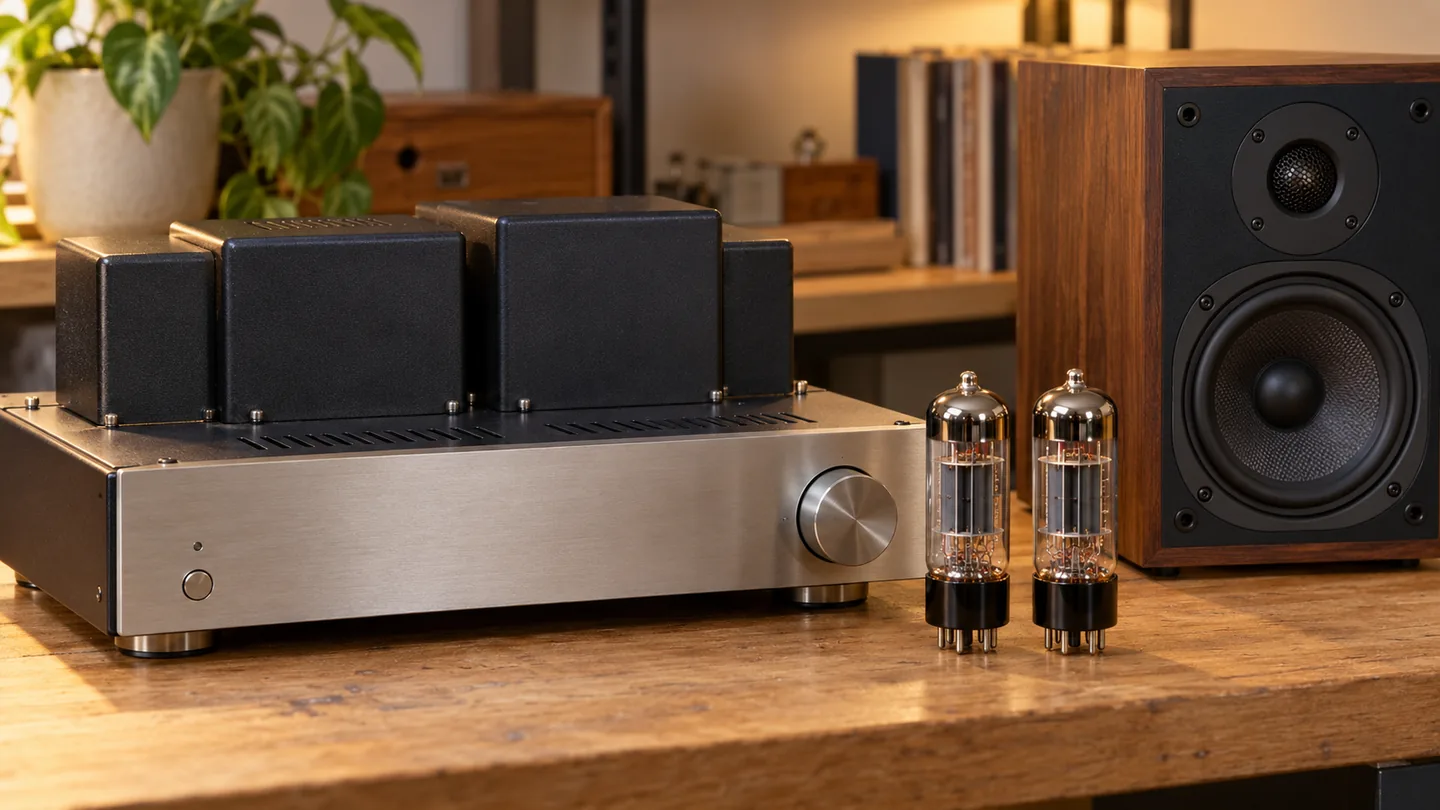
Illustrative image; not a photograph of a specific product.
Decide what you want the amplifier to do
For faithful reproduction, compare measurements made under the same load, output level, bandwidth, and distortion criterion. A wattage or distortion figure without its test conditions tells you little. For example, one maker publishes different output and distortion figures for its all-tube Valhalla 3 and hybrid Vali 3 headphone amps. Valhalla 3’s maximum-power rating uses 10% total harmonic distortion, so it cannot be treated as a clean-power figure or directly compared with a rating using a different threshold. These headphone examples show how to read specifications; they cannot rank speaker amplifiers or predict a speaker system’s sound.
If you enjoy a particular audible character, listen for it using your own speakers and familiar recordings. Keep playback levels as close as practical when comparing; louder often feels more exciting. Ask whether the difference persists after switching back. A preference is a valid buying reason, but it is not proof that the preferred unit reproduces the source more accurately.
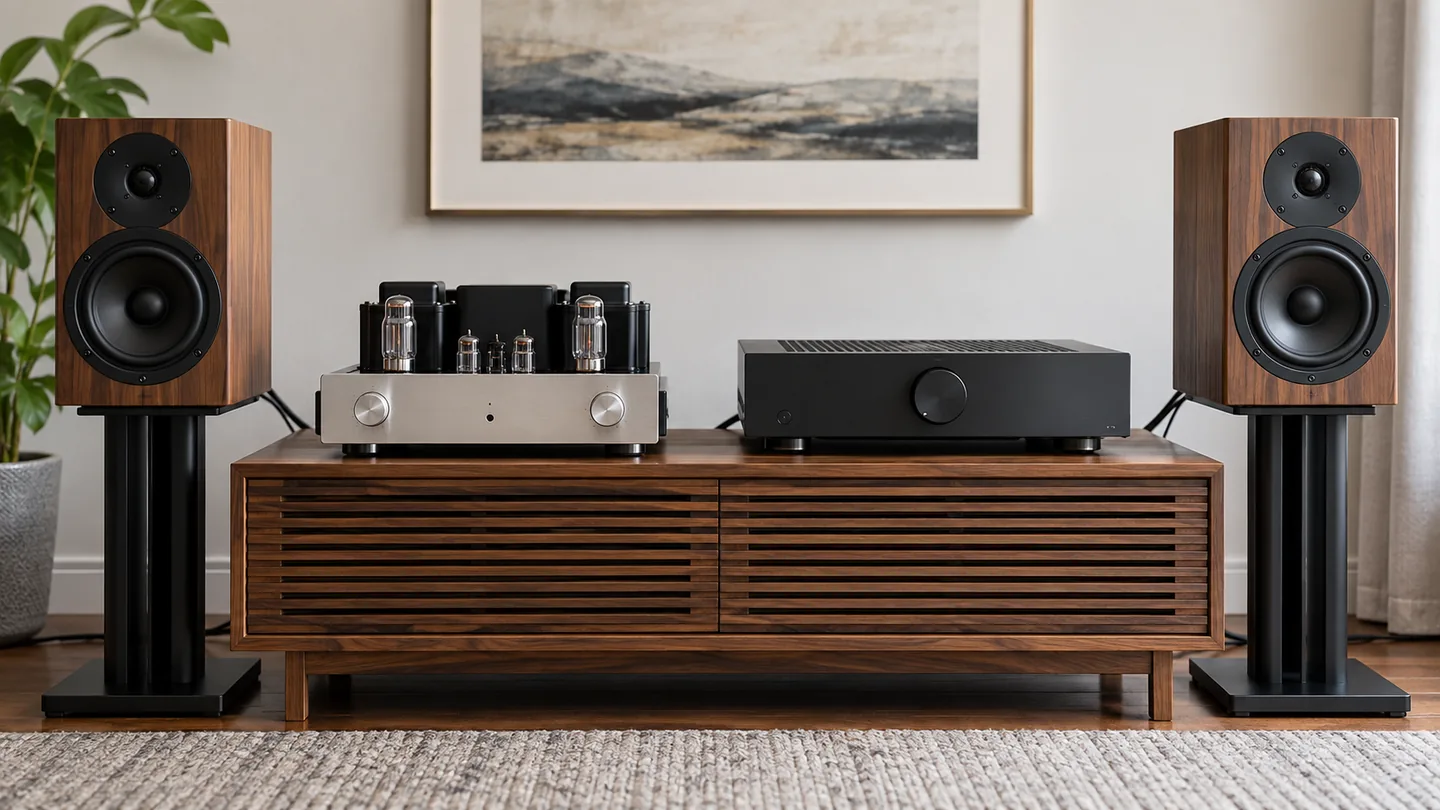
Check the speaker load before the sound signature
A speaker’s nominal impedance is only a shorthand. Its load changes with frequency, while the amplifier’s available output depends on its design and the load. Klipsch’s explanation of speaker specifications makes both the changing impedance and the risk of an overly demanding load explicit. For a tube power amp, check its manual for supported speaker impedances and the correct output tap. For either type, confirm the speaker is within the maker’s allowed range.
Speaker sensitivity, listening distance, room, and desired peaks also matter. A modest power rating can be workable with an easy load at moderate levels; it can be inadequate with a less sensitive speaker or a greater listening distance. Avoid deciding from the room’s floor area or the amplifier’s advertised watts alone. Ask for the actual speaker model and intended listening level before recommending a match.
Compare the ownership costs that follow the purchase
Tube equipment may require replacement tubes, approved bias adjustment, and more space for heat dissipation, depending on the design. Solid-state equipment can also fail and may be expensive to repair; it is simply less likely to require tubes as consumables. Check the model’s manual, tube availability, local service options, warranty terms, and energy use instead of assuming one category has a fixed lifetime cost.
Tube valves get hot, and internal circuits can remain hazardous after the unit is unplugged. The Rogue Audio M-120 owner’s manual explicitly warns that dangerous voltage can remain in its electronics. Follow the instructions for your own model and leave internal inspection or repair to a qualified technician.
When to choose each
Start with solid state if straightforward daily use and a measured performance target are priorities, then verify the exact speaker load it supports. Do not choose it solely because someone says all tubes are inaccurate; a particular tube design still deserves assessment on its own data and listening result.
Choose tubes if you have heard a pairing you like and are comfortable with the upkeep. Glowing valves alone cannot promise warmth, a larger soundstage, or better fidelity. Compare two shortlisted amplifiers on the same speakers, then read their manuals and service terms before buying.