
You’ve invested heavily in premium tubes and components, yet your amplifier still suffers from irritating hum, unexpected squealing, or a frustrating lack of clarity. The secret to pristine tone often lies not in the vintage glass, but in the seemingly simple area of the 9pin tube socket wiring. For the dedicated DIY builder or repair tech, subtle wiring errors—especially around high-gain preamps—can introduce catastrophic noise and cripple frequency response. A single mistake in heater wiring, grounding schemes, or signal path adherence to the critical 12AX7 (ECC83) pinout can result in frustrating parasitic oscillation. Stop letting preventable wiring flaws steal your amplifier’s voice. This guide delivers the specialized, actionable information you need. We dive deep into the chassis to reveal the 5 deadliest 9pin socket wiring mistakes that are fundamentally ruining your sound and show you the precise, technical steps required to build a noise-free, tone-perfect machine.
Why the 9-Pin Miniature Socket (B9A) is the Heart of Preamp Tone
The 9-Pin Miniature (B9A or Noval base) socket is the essential interface for all high-gain dual triodes (12AX7, ECC83) that define classic preamp character. While physically compact, this proximity is both its advantage and its greatest challenge. The structure of the B9A demands extremely meticulous wiring geometry because it is where low-level, high-impedance grid signals (the input, often Pin 2 and Pin 7) are amplified before being passed to the plates (the output, Pin 1 and Pin 6).
Tone purity is fundamentally tied to minimizing parasitic capacitance and inductive coupling between these closely spaced pins. In a high-gain stage, even a slight signal leak from the high-voltage plate lead back to the adjacent, sensitive grid lead can induce motor-boating or high-frequency oscillation (squeal), completely ruining fidelity. Therefore, successful tone reproduction requires maintaining lead lengths to an absolute minimum—often measured in millimeters—especially on the input grid wires, which act as highly effective antennae for external noise.
Furthermore, managing the heater supply (Pins 4 and 5) is critical. Due to their central location, poorly grounded or unbalanced filament voltages will inevitably inject 60Hz or 120Hz hum directly into the delicate cathode/grid circuit (Pin 3 and Pin 8), compromising the signal-to-noise ratio before the signal even leaves the tube. The physical integrity and cleanliness of the socket contacts directly influence the reliability and consistency of the critical signal transfer, making the B9A socket the definitive control point for managing noise floor and gain stability in any tube amplifier.
Essential Pinout Primer: Keying the 12AX7/ECC83 and 6DJ8 Families
The B9A socket may appear universal, but confusing pin assignments between common preamp families is the fastest route to instability and debilitating hum. For the ubiquitous high-mu voltage amplifier, the 12AX7 (and its ECC83 equivalents), the pinout is defined by two segregated triodes and a flexible heater structure. Triode 1 utilizes Pins 1 (Plate), 2 (Grid), and 3 (Cathode). Triode 2 mirrors this architecture on the opposing side: Pins 6 (Plate), 7 (Grid), and 8 (Cathode).
The most critical pin for noise cancellation is Pin 9, the internal center tap for the heater filament (Pins 4 and 5). Improperly grounding or referencing Pin 9—or worse, leaving it floating—introduces AC ripple directly into the cathode reference, resulting in the dreaded 50/60Hz hum that destroys low-level clarity. Correct procedure mandates referencing Pin 9 either to chassis ground or to an elevated DC bias (VDC) to minimize cathode-heater leakage, crucial for high-gain stages.
Conversely, the high-transconductance 6DJ8 (ECC88, E88CC) family utilizes a significantly different heater configuration, lacking the internal Pin 9 center tap. When substituting or wiring for a 6DJ8, Pins 4 and 5 are the only heater connections. Wiring a 6DJ8 into a socket wired for the 12AX7’s Pin 9 reference will often result in a hard short or, at best, incorrect heater voltage, leading to poor tube life and unpredictable circuit behavior like parasitic oscillation or signal cutout. Always confirm the specific B9A wiring scheme (and verify T1/T2 assignments) before soldering the first lead. These subtle pinout variances separate professional-grade fidelity from noisy amateur builds.
Mistake #1: The Hum Monster—Failure to Master Cathode and Heater Grounding
The most common culprit behind invasive 60Hz or 120Hz mains hum is a compromised ground reference at the 9-pin tube socket, specifically involving the cathode and heater circuits. For high-gain preamp stages (like the 12AX7), the cathode connection (typically Pins 3 and 8) must provide an impeccably clean return path. Errors here—such as running cathode bypass capacitor (Ck) leads too long or grounding them far from their associated resistor (Rk)—introduce noise into the bias circuit, which is immediately amplified. Ensure Ck returns to the nearest chassis ground or, optimally, a designated preamp star-ground point to maintain the purest DC reference for gain staging.
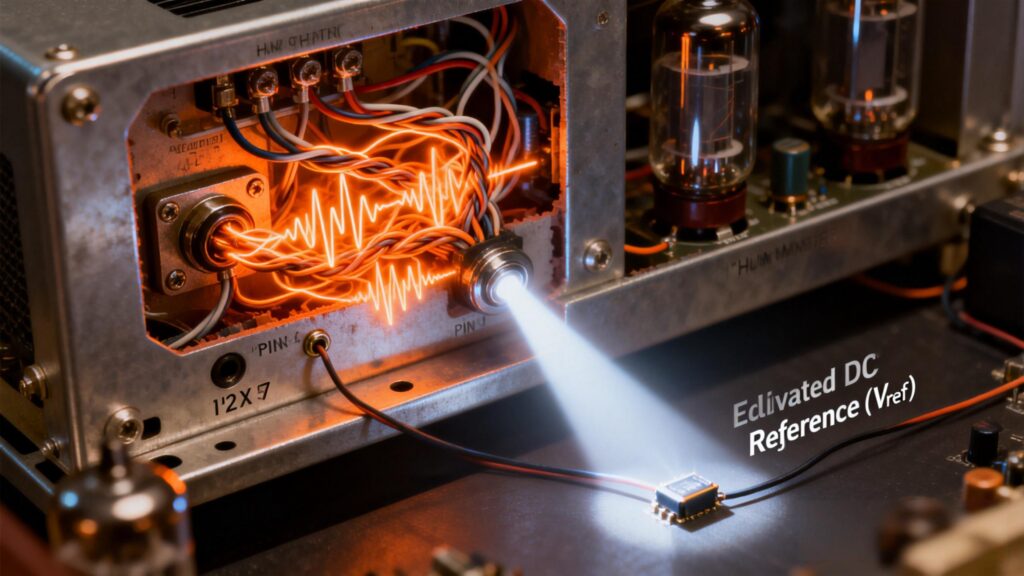
However, the true “Hum Monster” resides in the heater supply (Pins 4 and 5). Improperly grounding the 6.3V AC heater winding injects ambient magnetic fields directly into the signal path. Simply grounding one side of the winding or using an inadequate center-tap connection often leads to unacceptable hum, particularly in the sensitive V1 stage. The expert solution is mandatory use of tightly twisted pair wiring for the heater supply, coupled with an Elevated DC Reference ($V_{ref}$). By referencing the heater supply center-tap (real or artificial, using a 100 Ohm virtual center tap) to a small positive DC voltage (typically +30V to +70V, derived from the main bias supply), you raise the potential difference between the heater elements and the surrounding cathode/grid. This crucial technique dramatically reduces capacitance and cathode-to-heater leakage, effectively pushing the AC noise floor below the audible threshold and ensuring your high-gain circuits deliver maximum dynamic range and tone purity.
Mistake #2: Phasing and Oscillation Issues from Reversed Triode Wiring
The 12AX7 (ECC83) is a dual triode, meaning it houses two entirely independent amplifier sections. Mistake #2 arises when builders correctly identify the dual nature but incorrectly assign the input (Grid) and output (Plate) elements within one or both triode stages, often due to confusion regarding the mirror-image layout of the socket viewed from below.
A fundamental truth in tube amp design is that a common-cathode triode stage naturally introduces a 180-degree phase shift between the grid input and the plate output. If the Grid (input, e.g., Pin 2) and the Plate (output, e.g., Pin 1) are mistakenly reversed, the tube does not amplify in the intended manner; instead, the wiring effectively creates an internal positive feedback loop.
This miswiring transforms what should be a stable gain stage into a powerful, uncontrolled oscillator. The result is almost universally high-frequency parasitic oscillation—a piercing squeal or harsh ultrasonic ringing that drains massive amounts of voltage and completely contaminates your signal path, utterly destroying the amp’s tone and sometimes even damaging output components.
To prevent this catastrophe, strictly adhere to the B9A keying for the 12AX7: Triode 1 utilizes Pin 1 (Plate), Pin 2 (Grid), and Pin 3 (Cathode). Triode 2 uses Pin 6 (Plate), Pin 7 (Grid), and Pin 8 (Cathode). Always trace the incoming signal capacitor lead to the Grid (the input element) and ensure the Plate receives the B+ voltage via its load resistor. When troubleshooting oscillation, double-check that signal wires and plate leads are separated as much as possible, minimizing capacitive coupling that might mimic reversed phasing.
Mistake #3: Stealing High-End—Ignoring Component Lead Dress and Parasitic Capacitance
The invisible enemy of high-fidelity preamplification is parasitic capacitance, which manifests when conductors are run too closely together. This unintentional capacitance acts as a small high-pass filter to ground, causing a measurable roll-off of high frequencies—the very “air” and “sparkle” that defines vintage tube tone. Ignoring precise component lead dress guarantees this theft of the high-end.
The primary vectors for parasitic coupling are the high-impedance grid leads (Pins 2 and 7) and the high-voltage plate leads (Pins 1 and 6). To maintain signal integrity, these leads must be kept exceptionally short—ideally the minimum distance necessary to reach the turret or tag board. Every additional millimeter adds unwanted picoFarad (pF) coupling.
Crucially, lead dress dictates noise floor and stability. High-impedance grid wires must be routed far away from high-current heater wires, plate supply lines, and especially output plate leads (Pin 1 or 6) of adjacent stages. When leads must cross, ensure they do so at a 90-degree angle. This minimizes the length of parallel run and reduces capacitive coupling to near zero.
Failure to observe these principles often results in a dull, muted high end, or, worse, high-frequency parasitic oscillation—an irritating, often subsonic squeal—caused by feedback coupling between the plate and grid leads of the same or adjacent stage. Mastering lead dress ensures your amplifier achieves its theoretical maximum bandwidth and stability.
Mistake #4: Improper Heater Wiring Techniques That Introduce Noise
The 6.3V AC filament supply is arguably the largest potential source of 60Hz and 120Hz hum, which directly contaminates the sensitive grid-to-cathode signal path. Improper heater wiring techniques act like magnetic loops, radiating noise directly into adjacent components and signal leads.
The fundamental countermeasure is the tight, uniform twisting of the heater supply wires (typically pins 4 and 5 for series-wired 12AX7s, or 9 and 4/5 for parallel wiring). This twisting is non-negotiable; it creates common-mode rejection, ensuring that any induced magnetic field couples equally into both wires, effectively cancelling the noise radiation. This twisted pair must be routed tightly against the chassis and kept physically distant from high-impedance signal wires (e.g., those connected to pins 2, 7, and the grid).
A second critical error is poor heater reference. If the AC heater supply is simply grounded at one end (a center tap of the transformer, or one leg to ground), the resulting small AC potential difference between the heater and cathode allows noise leakage. To eliminate this, always implement a Virtual Center Tap (VCT): two matched 100-ohm resistors connected from each AC heater leg to a designated ground point (usually the chassis or a specific bus).
For the absolute lowest noise performance, particularly in the high-gain first stages (V1), you must employ Heater Elevation. Instead of referencing the VCT to ground, reference it to a positive DC voltage (typically 50V to 70V, often borrowed from the negative bias supply or a dedicated low-current rectifier circuit). This elevated positive voltage significantly raises the filament potential relative to the cathode, reversing the potential gradient and dramatically reducing the AC leakage current that causes hum, thus ensuring silent operation and maximum clarity in your amplifier’s tone.
Mistake #5: Cold Joints and Low-Quality Sockets That Cause Intermittent Signal Loss
The ultimate enemy of stable gain and reliable tone is poor component contact, manifesting in two primary forms: the catastrophic cold solder joint and the subtle failure of a cheap socket.
A cold solder joint occurs when the joint is insufficiently heated or is moved during the critical cooling phase. Visually, it appears dull, grainy, and rounded (convex), contrasting sharply with a mirror-smooth, concave fillet of a proper eutectic connection. Electrically, a cold joint acts as a high-resistance or variable resistor. In the critical, high-impedance path of a preamp stage (e.g., the grid connection on 12AX7 Pins 2 or 7), this intermittent resistance introduces crackling, unpredictable oscillation, and complete signal cut-out, especially as the amp’s chassis heats and components expand. Always ensure adequate heat (375°C to 400°C), proper tinning of the iron tip, and zero movement until the solder has fully solidified.
The second failure point is the low-quality 9pin tube socket itself. Many budget sockets use poor plastic insulation that degrades quickly or contact clips made of brass or low-tension alloys plated with thin tin. The result is insufficient pin retention force. Premium sockets use machined, high-retention phosphor bronze clips, often plated with gold or silver, guaranteeing a secure, low-resistance mechanical and electrical mating. When retention is poor, the signal path becomes thermally unstable, leading to subtle voltage fluctuations at the tube elements that cause muddy dynamics and intermittent signal dropouts—tonal instability that no amount of component upgrading can cure. If you suspect intermittent noise, inspect the contacts for oxidation and tension; often, the only permanent remedy is replacement with a high-quality PTFE or ceramic socket.
Troubleshooting Tone Degradation: From Buzz to Blocked Signal
When troubleshooting auditory faults originating at the 9-pin socket, utilize a systematic diagnostic approach that maps the symptom directly back to the most probable wiring error.
If the symptom is excessive 60Hz or 120Hz Hum/Buzz: This is almost always a grounding failure (Mistake #1) or induced noise from poor AC heater routing (Mistake #4). First, power down and confirm the integrity of the cathode grounding point—especially if using a dedicated chassis star point—and ensure the heater wiring (Pins 4 and 5 on a 12AX7) is tightly twisted and run close to the chassis floor, away from high-impedance grid connections. A weak heater center-tap connection introduces severe ripple directly into the circuit ground plane.
If the symptom is High-Frequency Oscillation (Squeal, Whistle, or Motorboating): This indicates positive feedback, most often caused by incorrect lead dress (Mistake #3) or reversed triode wiring (Mistake #2). Visually inspect the socket: Are the high-gain input grid wires (typically Pins 2 or 7) routed closely parallel to the high-level plate output wires (Pins 1 or 6)? Even a few millimeters of proximity can create parasitic capacitance sufficient to induce oscillation, requiring lead separation. If the oscillation is present even with separated wiring, meticulously verify that the plate load resistor is connected to the B+ supply and the cathode resistor/bypass capacitor is tied to ground; reversing these components on a triode section guarantees severe, unstable feedback.
If the symptom is Weak Output, Dull Tone, or Blocked Signal: Intermittent faults or complete signal drop often trace back to mechanical failures. Use an ohmmeter to check continuity from the component lead through the solder lug on the socket. This quickly exposes hidden cold solder joints (Mistake #5)—crystalline or dull joints that look acceptable but fail electrically under thermal stress. If continuity is verified, consider the socket quality: low-tension wiper contacts fail to grip the tube pins firmly, leading to micro-vibrations and intermittent signal breaks, necessitating socket replacement.
Best Practices: Choosing Materials and Utilizing Turret Board Layouts for Maximum Reliability
High reliability and pristine tone hinge on meticulously chosen materials and a structured layout architecture. For high-heat environments typical of tube amplifiers, reject inexpensive mica-filled phenolic sockets in favor of high-grade ceramic sockets. Ceramic bodies offer superior thermal stability and rigidity, preventing minute pin movement that can cause intermittent signal drops. For signal path integrity, always specify sockets featuring gold-plated beryllium copper contacts. Gold plating ensures minimal contact resistance and prevents oxidation, crucial for preserving the nuance of low-level preamp signals.
Wire selection is equally critical to manage both noise and layout. Signal leads benefit immensely from 22 AWG silver-plated PTFE (Teflon) insulated wire. Its low dielectric constant minimizes parasitic capacitance, while the inherent stiffness of the solid core assists in maintaining excellent lead dress discipline—a non-negotiable factor in avoiding high-frequency oscillation. For high-current heater and power supply runs, use quality 20 AWG stranded wire with high-temperature PVC or PTFE insulation.
Turret board construction provides the ideal framework for enforcing disciplined lead dress and robust connections. Utilize the turrets to create short, direct component placement, minimizing the length of signal paths, particularly those connected to the vulnerable grid pins (usually pin 2 or 7). Crucially, integrate the grounding architecture directly into the turret design via a localized turret-bus grounding system. Instead of relying on long flying leads to the main chassis star ground, consolidate all local stage grounds (e.g., cathode resistors, grid resistors) onto a single, heavy-gauge copper bus wire running parallel to the board, connecting this segregated bus to the main power supply ground point only once. This proactive segregation drastically minimizes the possibility of noise injection and ground loop hum.
Have questions or your own tips to share? Drop a comment below!